GAO Report: Many Public Library Buildings in the U.S. Are in 'Poor' Condition
According to the December 18 report, an estimated 38% of the nation’s public libraries have at least one building system in poor condition, while an estimated 61% have at least one building system or feature that poses a potential health or safety concern.

America's public libraries are in desperate need of repairs, states a new report from the Government Accountability Office, the nonpartisan watchdog for waste, fraud and abuse within the federal government, and a large percentage of the nation's libraries are being forced to defer essential maintenance due to budget and funding issues.
According to the December 18 report, an estimated 38% of the nation’s public libraries have at least one building system (such as heating, ventilation, and air conditioning) in poor condition, while an estimated 61% have at least one building system or feature that poses a potential health or safety concern, including inaccessible areas, obstructed walkways, and overcrowding. But the report also found that an estimated 70%—about 11,200 libraries—have "a backlog of deferred maintenance and repair," an issue that 70% of survey respondents say is expected to "continue and or increase" in the next 3 years.
The report was authorized as part of the Departments of Labor, Health and Human Services, and Education, and Related Agencies Appropriations Act of 2024, which included a provision for the GAO to study "the availability and conditions of library facilities." In response, the GAO surveyed roughly 16,400 public libraries in 50 states, the District of Columbia, and four territories (the full survey results are available via the “Additional Data” link of GAO’s website) and visited 21 public and two tribal libraries in seven states and territories.
GAO officials also interviewed reps from the IMLS and several state library agencies, as well as reps from library associations including the American Library Association; Association of Tribal Archives, Libraries, and Museums; Association of Rural and Small Libraries; and Urban Libraries Council.
"Beyond lending books, public libraries provide public spaces to host community programs and serve as voting sites and emergency centers. However, many libraries are in aging buildings, and their building systems may need repair or replacement to serve community needs," the report states. "An estimated 71% of public libraries cited construction costs, such as labor and materials, and limited funding availability, as key challenges to addressing maintenance and repairs. An estimated 90% of libraries use local funding to address maintenance and repairs. However, reliance on local funding, particularly for small town rural libraries and libraries in high-poverty areas, can also pose challenges to addressing facility repair needs."
Among the report's findings, a third of responding libraries cited "physical accessibility" issues that posed "health or safety" concerns, especially in small and rural libraries. "Respondents to our survey mentioned issues such as trip hazards related to the condition of flooring, and concerns about navigation into and around their libraries. One respondent noted that visitors in a wheelchair need physical assistance to enter the library and then need to be returned to their wheelchair," the report found. "Survey respondents cited additional health or safety concerns, such as fire safety, adequacy of security systems, and building temperature."
The GAO estimates that 15% (about 2,200 libraries) self-reported not having but needing, a fire protection system, and cited a library officials visited in Maine that "uses multiple space heaters due to an aging and unreliable heating system," raising staff concerns about the potential for a fire.
The reports also pointed to potential challenges from aging buildings and a rise in extreme weather and natural disasters.
"According to our survey, thousands of the nation’s libraries are over 60 years old, creating facility conditions that may be less able to withstand natural disasters and extreme weather or adapt to changing community needs," the report found. "Specifically, we estimate that 31% percent of libraries, or about 5,000, are in buildings built prior to 1964," with small and rural libraries twice as likely to face challenges from aging facilities.
Perhaps most concerning, most respondents told the GAO they did not expect their maintenance challenges to improve in the coming years, which can lead to worsening facility conditions.
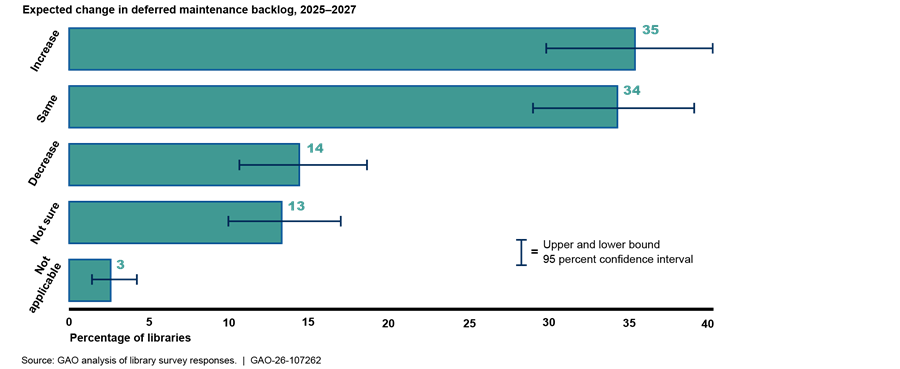
"We estimate that a majority of libraries (roughly 70% or about 11,200) have a backlog of deferred facility maintenance, with many libraries having over $100,000 in deferred maintenance and repairs," the report found. "Based on their budget forecasts and planned projects, libraries expressed pessimism about being able to address their deferred maintenance backlog."
Given the Trump administration's attempts to slash virtually all federal funding for libraries, it's unclear what happens now. While the report notes that the Institute for Museum and Library Services is prohibited from funding library construction (a prohibition that was added in 2003), it's unclear whether federal lawmakers will might seek legislation to support library maintenance nationwide.
In a statement, ALA president Sam Helmick welcomed the report.

"Investments in library facilities should be proportionate to the central role they play in learning, connection and opportunity for so many people. Libraries are where Americans go for answers and support to do life—find a job, learn to parent, finish homework, start a business, get some peace and quiet," Helmick said, in a release. "Every community deserves a great public library. Unfortunately, in many parts of America today, the local public library building falls short of what the community needs.”