In Conversation: Freedom to Read Advocate Leila Green Little
Words & Money talks with the lead plaintiff in Little v. Llano County about her four year fight against censorship.

In a setback for the freedom to read, the Supreme Court on December 8 declined to review a closely watched book banning case in Texas, Little v. Llano County.
First filed in April 2022, the case was the first major litigation to be filed in this current wave of book bans. But after two initial victories holding that the book removals by Llano County officials were unconstitutional, the Fifth Circuit U.S. Court of Appeals in May reversed, in a stunning decision, holding that there is no First Amendment right to receive information in libraries—an unprecedented ruling that, with the Supreme Court now declining to weigh in, effectively gives local leaders in the three states where the Fifth Circuit holds jurisdiction (Texas, Louisiana, and Mississippi) sweeping power to remove books from public libraries at will, even for unconstitutional viewpoint discretion.
In the wake of the Supreme Court's denial, Words & Money caught up with the lead plaintiff in the case, Leila Green Little, who spoke about her four year fight against censorship, her disappointment in the final outcome, and what the future may hold.
Thanks, Leila for the time tonight. How are you holding up after the news from the Supreme Court?
I'm broken right now. I'm just absolutely devastated and broken. The events of the last four years have just completely changed everything about my life in a way that can't be gotten back. And I can talk about 100 little ways that’s happened, and I could talk the big changes, but the point is, this experience has changed me.
This was the most stressful process that I've ever been through. And that’s because I knew that if we lost that we would no longer have a First Amendment right to access information at a public library. Think about how massive the implications of this ruling are. I mean, I truly feel that this decision imperils the American democratic experiment. Libraries that serve 38 million Americans in three states could now become political propaganda centers subject to the whims of the party in power. It’s a gut punch, and it's difficult reconcile that fact with being in the United States of America. It feels like we in these three states have just been left to the wolves, and it hurts. It just really hurts.
The Supreme Court offered no explanation for their denial. Do you have any insight at all about why this case was declined? I find it baffling that the high court would allow three states to have different First Amendment protections than the rest of the country, but maybe there’s some logic to passing on this case? I know the defendants in a court filing had urged the Supreme Court to wait to address the issues in this case until a few other book banning cases were decided in the lower courts, is there any sense that argument might have been persuasive?
No, nothing. It is my understanding that Supreme Court conferences are quite secretive. I believe there is nobody except for the nine justices allowed in the room, not even clerks. Sometimes in denials there will be dissents, but there was nothing here and it leaves one with a lot of questions.
And I agree with you—it is baffling to me too that my two kids are now growing up in a time and a place where it is perfectly legal to censor books from a public library for any reason whatsoever. That's not a world that I have ever known. It's not a world that my parents’ generation ever knew. But that's the world that my children are now going to grow up in. And it's a hard pill to swallow that we're in this situation because we live in Texas, and that we wouldn't be in this situation if we lived in Illinois or Wisconsin or Indiana.
Can you explain what happens now? With the Supreme Court’s denial, your case gets sent back to the district court, but is there any case left to fight?
My understanding is that the end of our case is just a formality at this point. I suspect that will take place over the next month or two.
The conventional wisdom is that the issues in this case will make it to the Supreme Court at some point through a few other cases now in progress—even the defendants acknowledged that in their brief. But I’m not sure the other cases coming through the courts are quite like this case—they are about schools, for example, and also, the plaintiffs in some of these cases are the major publishers, and one wonders if some of the justices will recuse themselves because they have published books with these companies. How are you feeling about the potential of these other cases to fix this mess?
I’m concerned. Our case has been a unicorn. And what I mean by that is that we are a group of library patrons. We are not librarians who were fired and who are suing. We are not a large organization. We are not a library system that is suing a state over a new law. We're a group of readers who took umbrage with our government censoring books from our library, and so we took it into our own hands. And we were early, as you know. We were the first lawsuit to be filed when this wave of book censorship began to take hold nationwide. There are a lot of factors that made our case special. And I think we had incredibly good facts of record, which is why Judge Pitman first ruled in our favor back in 2023.
Do you have hope that there is going to be a correction, at some point, even if it's not going to be through your case?
Well, yes. Because I read and have learned about history. As hard as this is right now, I do take a long view of history, and the pendulum always swings back. You’ll remember the piece you asked me to write for Publishers Weekly in 2024 in which I spoke about McCarthyism, and I still think that that's the truest metaphor for this moment that we're in now. McCarthyism did eventually end, and things did change. So yes, eventually we're going to get out of this. I have faith that America will undergo some sort of a correction, and that we will return to these First Amendment rights. But I don't have much hope that that's going to happen quickly enough, and that really saddens me.
On the facts and the law this was not a case that I ever thought would make it to the Supreme Court. It seemed pretty straightforward. And it was always astonishing to me that, after losing the first two decisions in this case, the county didn’t just work with you to settle this. I mean, all we are really talking about in this case is the library following their own established challenge procedures, right? Was there a moment when you realized that your case might be a Trojan horse for some bigger censorship movement?
Absolutely. The moment that I knew that this was much, much bigger than me or my fellow plaintiffs or the 17 books on a shelf in a rural public library was when the county hired Jonathan Mitchell as their counsel. Mitchell is a former solicitor general for the state of Texas, and when they hired him I knew that this case was going to go far. But until that point, when we first obtained legal representation, we were so hopeful that that would let the county know that we were serious and that they needed to come to the table and talk. That was our sincere hope.
And you’re right, there were processes in place for removing books, and we never said these books shouldn't be challenged or demanded that every book we wanted must be kept on a library shelf. That’s never been anybody's thought or anybody's intent. That's ridiculous. There's always been a challenge process in Llano. But none of that happened. None of it. Not a single challenge form was ever turned in.
And we tried everything in our power, Andrew. We requested in-person meetings, we made phone calls, we sent emails, we sent faxes, we left printed letters on desks in the courthouse. We showed up to meetings, we made public comments, we asked to be considered for the library advisory board. We did everything possible to work toward a resolution, and we were denied over and over again.
What does that tell you, in hindsight?
That this was about censorship the entire time. There's no other way to put it. I know some people will balk at that word, censorship, or they'll balk at the terminology of a book ban, but that's what this is. This is about elected officials and government employees exercising control over the public's reading choices. That's a pretty clear, textbook definition of censorship. And that's what it's been about all along. And if it can be done to In the Night Kitchen, or to Caste, it can be done to any book.
We’ve spoken a bit about how this case has impacted you and the community in Llano. Can you talk a little about what life is like in Llano today, after this four year legal battle?
Llano is a singular place. I grew up in a lot of different small towns in Texas, and we eventually settled in Llano, and it is singular. It is unique. What I have found is that there's a small percentage of the local population, I would say five to 10% that are really, really in full support of the county and the library's actions on this and fully side with them. And then there's probably another five or 10% that are supporting our efforts and committed to pushing back against censorship. And then I think the vast majority of people are uninformed about or don’t really care about this.
As for me, I have read some very painful descriptions of and accusations about me and my fellow plaintiffs, but nobody's ever come up to me and said those things to my face, right? This is such a small town, and I see the defendants regularly at the grocery store or the post office or the coffee shop. We live with these people. They are our neighbors. So that's made this a particularly challenging ordeal.
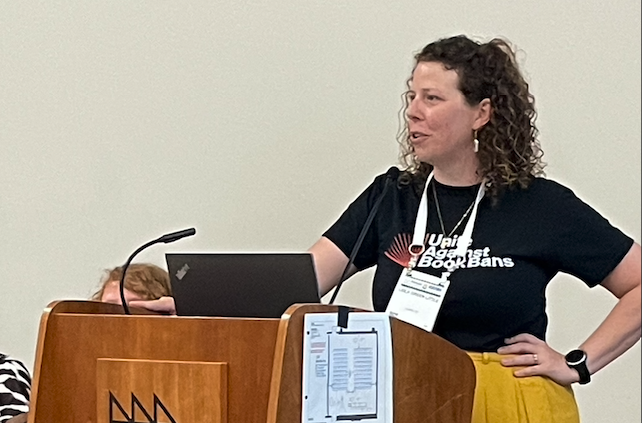
As difficult as this is for you at the moment, do you have some sense that your courage and your actions in bringing this suit have been inspiring to so many people who are also standing up against this current wave of censorship? Is it any consolation to know that you have made a difference in this fight, even if this case wasn’t successful?
I will never, ever, ever be able to adequately express the gratitude that I feel towards the many, many, many people who have supported our efforts over the last four years and who fight alongside me across the country. It is deeply, deeply humbling. Right now, I don't feel like an inspiration. I left town on Tuesday morning, the day after the Supreme Court denial came down, and I just got back home, because I just couldn't be here. I just had to get out of this city and cry.
But look, I didn't have a choice on this. This is something that is so terribly important to me, the ability to read freely. The public library has always been a huge part of my life. It was deeply important to my mother and my grandmother, both of whom have since passed. So, this was a fight that that I had to take on because it was too important not to. And I appreciate anyone who has been inspired by our fight. I'm just one part of a massive group of people that are trying to affect change. But right now, honestly, I’m crushed.
Well, I know many of our readers are deeply grateful for what you’ve done. Which makes me curious about what’s next for you. If it is too early to say, I understand, but any plans for the future?
I'll tell you that my husband and I have both filed to run for county commissioner here in Llano. Jerry Don Moss is the incumbent, and he is a Republican, and my husband has filed to run as a Republican, and I have filed to run as a Democrat. It’s important that our current county commissioner not be unopposed in his race.