Kevin King on 'Quiver, Don't Quake: How Creativity Can Embrace AI' by Nadim Sadek
"Ultimately, 'Quiver Don’t Quake' is not about technology. It is about mindset," King writes. "It encourages curiosity over fear and exploration over avoidance. Libraries have adapted to change before, and we will do it again."

Quiver, Don't Quake: How Creativity Can Embrace AI by Nadim Sadek (Mensch Publishing, 2025).
Standing tall in the office of my most recent job as a library director was a card catalog. The relic was a constant reminder of both the past and of the progress librarians have made regarding access to information. When employees under the age of 30 were in my office, I would ask them to identify the wooden sentry. Most had no clue what it was. "That’s a card catalog?" they would exclaim. "Wow, things sure have changed."
I’ve been a librarian for over 25 years, and if there’s one thing I’ve learned, it’s that libraries are no strangers to change. I’ve seen card catalogs disappear, reference desks reinvent themselves, databases replace indexes, and digital collections grow faster than anyone expected.
When I started working in public libraries, many of my colleagues were fearful of the internet. Patrons, too. While working as a Teen Services Librarian in the early 2000s, I'd often be asked for homework help. I would immediately start researching on the Internet, but many times these young patrons would respond with “I am not allowed to use the Internet.” By the COVID years, this was no longer a question: teens now need the Internet to learn.
Every major shift has come with uncertainty, and the advent of artificial intelligence (AI) is no exception. That’s why my recent conversation with Nadim Sadek, author of Quiver don’t Quake: How Creativity Can Embrace AI, felt especially timely. Our talk was not a hype-driven discussion about AI, nor was it about what libraries stand to lose in this latest technological shift. It was a thoughtful conversation about how libraries can approach AI with the same care, curiosity, and purpose that has guided us through every major transformation in our profession.
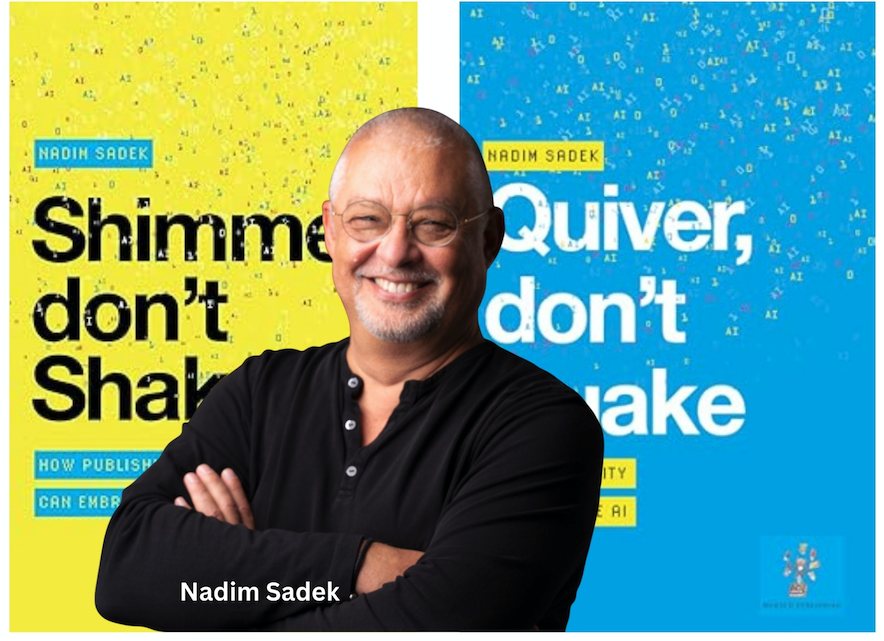
Sadek, Founder & CEO of Shimmr AI and the author of a previous book about AI, Shimmer, don't Shake: How Publishing Can Embrace AI, does not see AI as a threat to librarianship. Rather, he sees it as an ally. That distinction is important, because how libraries frame AI will shape how we use it and how the communities we serve experience it.
Of course, many librarians I speak with feel uneasy about AI. The concerns are real. Will AI replace professional expertise? Will it weaken trust in information? Will it diminish the role of books and human judgment?
The profession is also grappling with many of the broader concerns surrounding AI adoption, such as the environmental impact of the technology, the growing monopoly of these tools by Big Tech, and whether creators are being properly credited and compensated for their work. These issues extend far beyond library shelves, highlighting how the pervasive reach and rapid development of AI demands our immediate attention.
Is the “AI monster” too big to tame? And can library workers help their patrons use these tools responsibly, while still maintaining their ethical standards?
Sadek does not dismiss these concerns. Instead, he seeks to reframe the conversation. Rather than calling the technology artificial intelligence, he prefers the term “Allied Intelligence.” In his view, AI is most powerful when it works alongside people, supporting creativity and inquiry, not replacing them.
This way of thinking aligns closely with the role librarians have always played. Libraries have never been about simply collecting and storing information. We help people explore ideas, refine their inquiries, evaluate sources, and make meaning from what they find. Seen through that lens, AI isn't necessarily a threat to library work. Just like the profession eventually developed ways to effectively use the internet, AI can be another tool that libraries can use to support discovery and learning—when used carefully.
'Panthropic'
That's one of the core ideas in Quiver Don’t Quake: that AI functions best as a creative companion. In our conversation, Sadek talked extensively about creativity, not just in the arts but in everyday problem-solving, learning, and exploration.
For many people, creativity has traditionally been limited by skill barriers: If you do not see yourself as a writer, an artist, or a composer, it's easy to stop before you ever begin. In Sadek's view, AI can lower many of the barriers facing would-be creators. It invites people to experiment. And with the technology, public libraries—the very symbol of barrier-free information, knowledge, and creativity—have an opportunity help more patrons explore their creative potential.
What stood out most to me in both our conversation and in the book was Sadek's emphasis on individuality. AI works best when people bring their own perspective, curiosity, and specificity to the table. Simply put, generic prompts lead to generic results, often summed up as “garbage in, garbage out.” More personal, focused questions lead to richer interactions. That's an idea that should resonate strongly within librarianship, which has always valued individual voices, diverse experiences, and personal connections.
Sadek shared his own creative process as an example. While writing a book set in a fictional society of clouds, he used AI to explore ideas, characters, and narrative directions. The technology did not replace his imagination, he said. It challenged it and expanded it. Through interaction and iteration, he was able to explore possibilities more quickly and more deeply than he could have on his own. Sadek could have traveled to his local library and spent all day researching clouds, but, he noted, "Allied Intelligence" not only produced relevant information more quickly, it acted as a creative partner.
As a librarian, I immediately thought about the implications for our programs and services. Writing workshops, storytelling programs, and makerspaces often struggle with the same problem. People want to create, but they do not always know where to start. AI may help them take that first step.
Among librarians, I've also heard concerns that AI is interactive while libraries are static. Sadek disagrees with that distinction—and I do, too.
While the books and materials we collect may be fixed, what happens in libraries is dynamic. Learning is conversational. Research is iterative. Discovery evolves through questions and reflection. Sadek's concept of "Allied intelligence" fits naturally into that process when we treat it as a partner, he suggests, not as a replacement.
This idea connects to one of the central concepts in Sadek’s book, which he calls the “panthropic.” People often worry about anthropomorphizing technology, assigning human qualities to machines. Panthropic thinking moves in the opposite direction—instead of making machines more human, it seeks to center human knowledge, creativity, and accomplishment and make it more broadly accessible.
Sadek compares this shift to the advent of the printing press, which fundamentally changed who could access knowledge. In the same way, panthropic AI has the potential to give billions of people access to a shared, creative intelligence. Libraries have been working toward this goal for generations. Preserving knowledge and making it available to everyone is at the heart of our mission. AI should not replace that mission, it should reinforce it.
Of course, one of the responsibilities that comes with the technology is the need for education. Sadek agrees that librarians are uniquely positioned to teach AI literacy. That includes teaching people how AI works, where it can fall short and why, and how to approach it critically. It is not about encouraging blind trust. It is about encouraging informed engagement.
During our conversation, I asked Sadek how librarians might engage with patrons about AI, and his response emphasized the continued importance of books, and context. Books remain one of the most reliable ways to preserve ideas, slow down thinking, and provide depth in a rapidly changing digital world, he suggested.
Trust was a recurring theme throughout our discussion. Sadek described interacting with AI as similar to building a human relationship. Trust develops through conversation, testing boundaries, and learning over time, he said.
In my own work, I've been experimenting with AI to crosscheck information, explore context, and verify sources. But I never treat it as the final authority. It's not unlike when teens used to ask me for help with their research papers. They came to me because I was a trusted source. But I didn't just give them information, I taught them how to find and evaluate valid information, consistent with library values and ethical practices. With AI, the questions is how can we as librarians carry forward into our AI future the same ethics and trust that has come to define the trust between librarians and their communities?
It's very much an open question. But if we approach AI as an allied, creative companion, as Sadek suggests, I believe librarians can play a major role in shaping how these powerful new tools are understood and used in our communities. We can ensure that creativity, trust, access and humanity remain at the center of the conversation. Most importantly, librarians can help teach patrons how to use these powerful AI tools thoughtfully and responsibly.
Ultimately, Quiver Don’t Quake is not about technology. It is about mindset. It gives librarians permission to feel uncertain without standing still. It encourages curiosity over fear and exploration over avoidance. Libraries have adapted to change before, and we will do it again.
Kevin King is the Library Solutions Strategist at Midwest Tape/Hoopla Digital. Previously he was the Director at the East Lansing (MI) Public Library, and before that served over 25 years at the Kalamazoo (MI) Public Library. Over the course of his career, he has presented on a variety of topics including innovation, trauma-informed care, organizational health, and library safety and security.