‘There’s a Cold Wind Blowing Across Our Nation’: At PLA 2026 in Minneapolis, Librarians Hear a Message of Reslience
Some 6,000 librarians were in Minneapolis this week for the 2026 Public Library Association Conference.

Amid the challenges facing the library community in 2026, there could be no better backdrop for the 2026 Public Library Association conference than Minneapolis, a city that has also endured more than its share of challenges during the second Trump administration—and through it all has shown the world what true American greatness looks like.
The PLA conference, which officially kicked off on April 1 and closed today, drew more than 6,000 attendees, with PLA officials putting total registrations at 6,410 (including 404 virtual attendees, and 1,555 exhibitor staff). That’s down from the 2024 conference in Columbus, Ohio, but a solid showing given the budget turmoil facing libraries, and the highly anticipated ALA Annual Conference set for Chicago this summer, which will celebrate the ALA’s 150th anniversary.
At one point in her duties as emcee of the opening session, PLA president, Dr. Brandy McNeil, Deputy Director of Branch Programs and Services at the New York Public Library, asked Minnesota librarians to stand for a round of applause.
“This has been a challenging year for our country and for our field, and there are a few places where these challenges have been felt more deeply than communities across Minnesota,” McNeil said. “I'd like us all to show our appreciation for our public library colleagues and friends in Minnesota.”
What Followed was a rousing ovation from librarians. “We are inspired by you, and in so many ways, this conference is our opportunity as a profession to recharge and recenter, to become ready and prepared to navigate changes and challenges, both personally and professionally,” McNeil said.
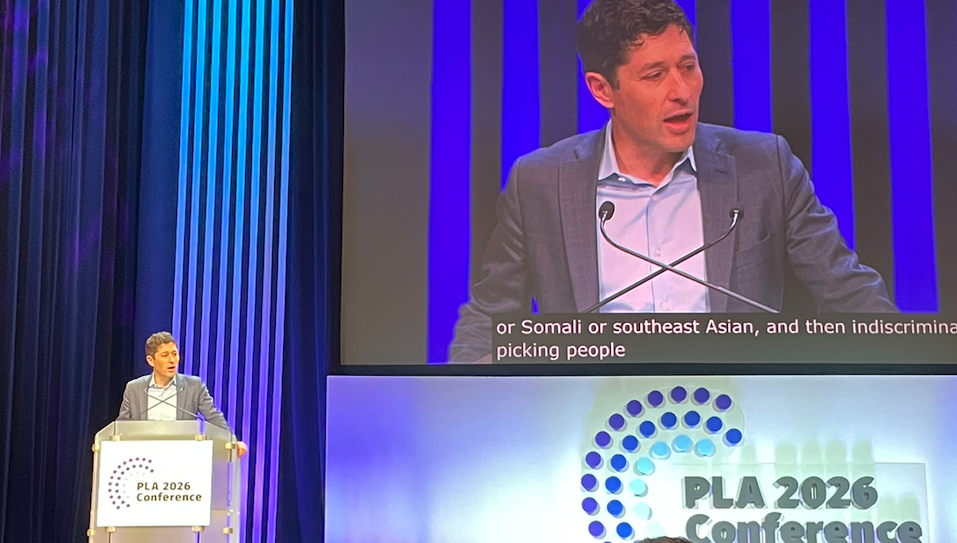
Another show of appreciation came from an energetic Minneapolis Mayor Jacob Frey, who told librarians that having them in Minneapolis for the city’s first major conference of 2024 had put “a hop” in his step.
“We're able to kick our shoulders back a little bit because, you know, when you're going through death, doom, destruction, when you're going through a federal invasion, sometimes you kind of got to keep your head down and focus on the daily grind of everything that we're experiencing,” the mayor said. “You realize that there's national significance to what's taking place. But you don't fully get the scope of it until the Public Library Association comes to Minneapolis,” he added. “Seriously, it means a ton to us.”
Frey, who gained national prominence for his fiery rebuke of ICE and the Trump administration amid a federal crackdown that saw two residents murdered by ICE agents, told librarians that it was “a big deal” to have them in the city.
“You know, never in a million years would I have thought that our own federal government would be invading a great American city. Never in a million years would I have thought that you'd have these federal agents marching down the street like gangs, discriminating only on the basis of do you look Latino or small or Southeast Asian, and then indiscriminately picking people up after that, including United States citizens,” Frey said. “But you know, the fact of the matter is that this city stood up brilliantly for its neighbors. And now you all come out like reinforcements. You all come out because you are also great Americans that care deeply about this country and the underpinnings of democracy.”
‘Proximity’
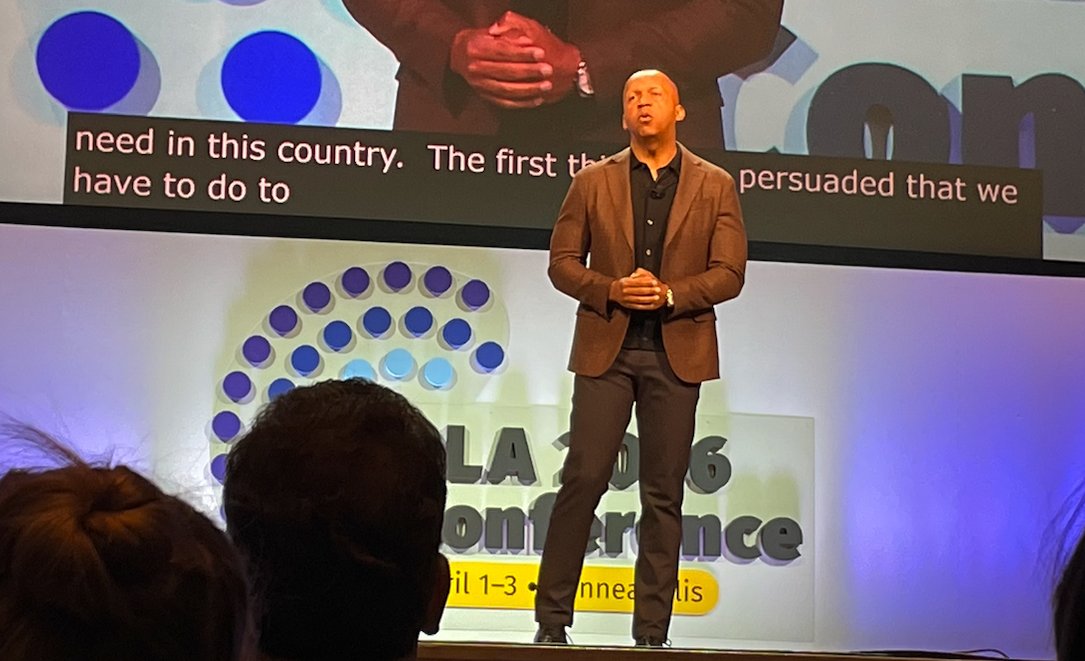
In a stirring opening keynote address that brought librarians to their feet, author and social justice advocate Bryan Stevenson, Executive director of the Equal Justice Initiative told librarians there was “a cold wind blowing across the nation,” and urged librarians to remain hopeful and engaged amid a political effort to ban books and narratives that deny the truth of the American experience.
“There are some people who are actually advocating less knowledge, less teaching, less learning. And that worries me, because I think our strength as a nation, our strength as a democracy, is rooted in our willingness to learn, to discover, to search,” Stevenson said, lamenting the fact that the United States today has the highest rate of incarceration in the world, including an 800% increase in the number of women sent to jails and prisons since the 1970s and too many states that are now trying children as adults.
“But I didn't really come here to talk about problems. I want to talk about solutions,” Stevenson said, “and I think public libraries and libraries are key to the solutions that we need in this country.”
Over the next 45 minutes, Stevenson spoke powerfully of his work with death row inmates, with a 14 year-old child who was sent to an adult jail for killing the abusive boyfriend (who happened to be a deputy) who had just beaten his mother unconscious, and of his own personal relationship to his grandmother, all coming back to a common theme: the power of “proximity,” and how one of the most powerful components of the public library system is that they are present in their communities.
“There's nothing more powerful than opening up a door to knowledge and understanding to people who have been excluded, to people who have been told that their knowledge, their understanding, is insufficient,” he said. “I think the power of the library is that it is a place where the humanity and dignity of every human being can be affirmed.”
But proximity won't be enough by itself, he warned.
“We're living in a moment when there are dangerous narratives floating around our world, and I think libraries are powerful institutions to change some of the narratives that are feeding bigotry and hatred and violence,” he said. “And one of the things I'm worried about in this moment in world history is that the politics of fear and anger are raging all across the globe. And what worries me is that when countries, when societies, give in to fear and anger, when they allow themselves to be governed by fear and anger, they start tolerating things you should never tolerate. They start accepting things you should never accept. When I look at world history over the last 100 years, the worst moments in world history have been defined by periods where whole communities, whole societies, gave in to the politics of fear and anger.”
Stevenson told librarians that until we change some of the persistent narratives around race, they will continue to burden our nation.
“We are not yet free in America. We are still struggling to recover from 400 years of racial inequality, racial injustice,” he said, explaining that the greatest evil slavery in America wasn’t the bondage, or the violence and degradation, all of which was “horrific,” but rather the “false narrative” that empowered the people perpetrating these acts to perceive themselves as moral.
“We need an era of truth and reconciliation, truth and repair, truth and restoration,” he said. “This is critical for our democracy. We will not recover, we will not get to where we're trying to go if we don't have the courage to commit to truth telling.”
But some are trying to achieve the opposite in America, he noted, with book banners and politicians trying ban marginalized voices from library shelves, and to block efforts to confront our past sins. He pointed out that Germany, by contrast, has committed to confronting the atrocities of the holocaust.
“We've never done that in America. We never created space for the victims of enslavement to give voice to their harm. We never did that for the victims of lynching. We didn't do it for the victims of segregation. And so, we remain in this moment where we are still contesting the harms of our past, and some people don't want us to talk about it at all. They don't want us to acknowledge it at all. And I think that is dangerous,” Stevenson said. “And the thing that I keep emphasizing to people is that I don't talk about slavery and lynching and segregation because I want to punish America. I talk about these things because I want to liberate us. I think there's something better waiting for us in this country. I think there's something that feels more like freedom, more like equality, more like justice, and it's waiting for us, but we won't get there if we don't find the courage to talk honestly about the burdens that hold us back, the chains that hold us back.”
He closed by extolling the power of books and libraries.
“And finally, I believe there is nothing more liberating, nothing more exciting, nothing more energizing, than to experience the world through a book,” he said. “Books can liberate us, free us from the burdens and the boundaries that have been created by others.” Which is why, he suggested that politicians today are seeking to ban books and censor content from museums and national parks. “They're trying to suggest that some knowledge is forbidden knowledge, and I think there is this urgency to stand against that.”
He then thanked librarians for what they’ve meant in his life and for the work they do in fighting for marginalized voices to be heard. And he steeled them for the hard work still to come in opposing those who would try to eliminate their stories.
“Because it's only when we understand those harms that we can get to something better, get to something beautiful,” he told librarians. “You will have to be partners. You will have to be players in making sure that these histories, this knowledge, this truth, is not suppressed. And if we do that, if we do it in proximity to the poor and marginalized, if we do it with an understanding that we're going to push against the narratives that feed hatred and bigotry and violence, if we do it with hope, if we do it, understanding that it may be uncomfortable and inconvenient, we can make a better democracy. We can create a healthier future. We can make libraries the places of knowledge and understanding and celebration that I think they're intended to be.”