Texas Seeks to Resurrect Blocked 'Book Rating' Law, H.B. 900
In a new appeal, Texas Attorney General (and GOP Senate candidate) Ken Paxton's office now asserts that a federal court erred by interpreting the state's role under H.B. 900 as a regulator rather than as mere marketplace participant, an argument the plaintiff appellees call "pure fiction."

Publishers and booksellers this week are pushing back against Texas’s legal bid before the Fifth Circuit U.S. Court of Appeals that seeks to resurrect the controversial book rating provisions of state law H.B. 900, despite the full Fifth Circuit previously affirming a federal judge’s decision to preliminarily block the provisions on constitutional grounds in 2023.
Signed into law by Texas Governor Greg Abbott on June 12, 2023, H.B. 900 (also known as the READER Act) was at the time viewed by many as the most high-profile of a wave of book banning laws emerging at the state level in the U.S.
The law would have required bookstores and vendors to review all books in Texas schools (at their own expense) and rate them for “sexual content” as a condition of doing business with Texas public schools—including tens of thousands of previously sold titles. Under the law, books rated “sexually explicit” would then be banned entirely from Texas public schools, while books rated “sexually relevant” would require written parental permission for students to access them. Furthermore, the law would have given the state the unchecked power to change the rating on any book, and to “blacklist” vendors that did not accept the state’s altered ratings, essentially imposing a de facto state standard.
The fresh appeal comes after federal judge Alan D. Albright last October, granted summary judgment to a coalition of booksellers and permanently blocked the state from enforcing the book rating provisions of H.B. 900—also known as the READER Act.
But after losing their bid to overturn Albright’s 2023 preliminary injunction, Albright's final ruling last fall has given Texas a second chance to challenge Albright’s findings. And in the opening brief of their second appeal, filed on February 19, Texas attorneys are seeking to recast the book rating provisions under a new “marketplace” theory.
“For all of Plaintiffs’ overwrought rhetoric about a ‘book ban’ and ‘censorship boards,’ this case concerns a statute in which the State, as a marketplace participant, seeks information about goods it purchases,” the Texas brief states. “The statute at issue requires vendors that sell books to public schools to inform the Texas Education Agency about the sexual content of those books. Vendors can freely decline to provide this information, but if they do, the State is free not to purchase from them.”
 Andrew Richard Albanese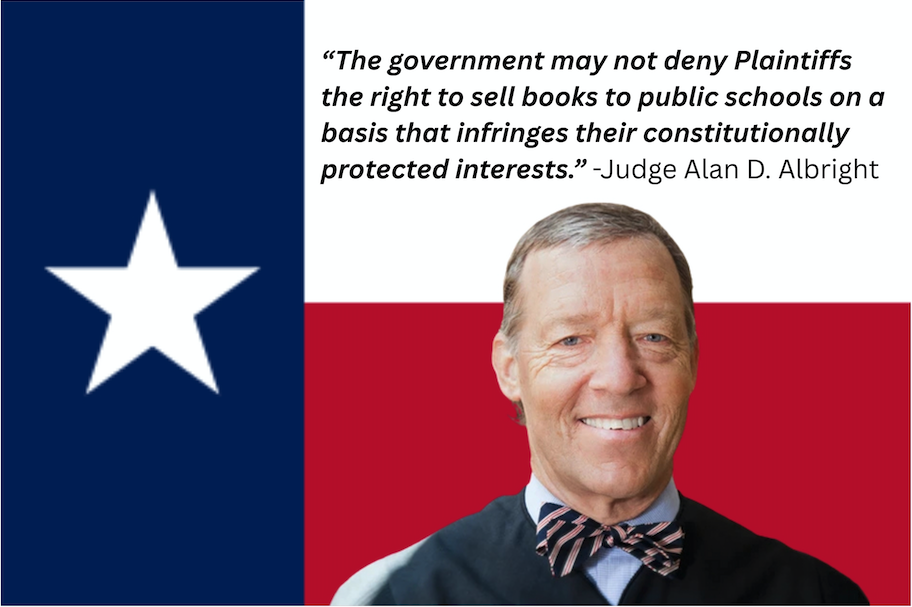
In their May 13 response, the plaintiffs—a coalition including two bookstores (Austin’s BookPeople and Houston’s Blue Willow Bookshop); the American Booksellers Association; the Association of American Publishers; the Authors Guild; and the Comic Book Legal Defense Fund—counter that the state’s new "marketplace" argument fundamentally misrepresents the law.
“Defendant’s position is based on the false premise that H.B. 900 merely guides the State’s own participation in a free marketplace. This fails on every level,” the Plaintiff appellee brief states. “H.B. 900’s plain language confirms its core function: it regulates the ability of private parties to sell books, and it conditions their private rights on their willingness to engage in state-compelled speech.”
The Court Finds ‘Compelled’ Speech
Albright first orally enjoined H.B. 900 at an August 31, 2023 hearing, and a month later issued a substantive 59-page written opinion and order in which he found the law unconstitutional on multiple grounds.
 Andrew Albanese |
And on January 17, 2024 a three-judge panel of the Fifth Circuit unanimously upheld Albright's decision.
In an unequivocal if narrowly drawn 36-page decision, the Fifth Circuit panel easily dispatched with the state’s key legal arguments (that the plaintiffs lacked standing, that the case was not ripe, and that the plaintiffs’ claims were barred by sovereign immunity) but made it only to the first of the plaintiffs’ multiple constitutional claims—that the mandatory book ratings at the heart of the law represent compelled speech, holding that because the plaintiffs were likely to succeed on their compelled speech claim the court did not need not address whether the law was a prior restraint or was unconstitutionally vague.
“We are not persuaded by the State’s characterization of the ratings as a ‘form of consistency review’ that is a ‘purely ministerial task’ instead of an expression of the vendors’ opinion on the subject matter being rated,” the appeals court held, noting that H.B. 900 would require booksellers "to undertake a fact-intensive process of weighing and balancing factors to rate library material,” which the court recognized as a “highly discretionary” undertaking.
Andrew Albanese |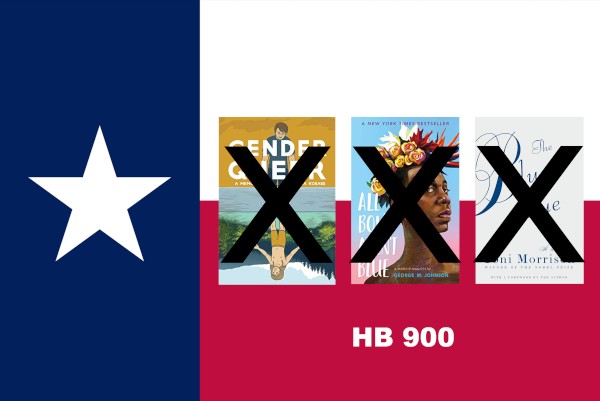
Three months later, on April 16, 2024 the full Fifth Circuit declined to rehear the appeal en banc, letting Albright’s injunction stand by a razor thin 9-8 margin—with five of the 17 Fifth Circuit judges filing a dissent saying they would have overturned Albright.
Following the appeal process, the case landed back in Albright’s court for final disposition. And in his October 2025 summary judgment ruling Albright once again eviscerated the law.
"The Court agrees with Plaintiffs that [H.B. 900] is compelling speech and is a bookselling regulation,” the judge concluded, noting that “the government may not deny Plaintiffs the right to sell books to public schools on a basis that infringes their constitutionally protected interests."
Marketplace Participants?
But in its new appeal, first filed on February 19, Texas Attorney General (and GOP Senate candidate) Ken Paxton's office now asserts that Albright erred by interpreting the state’s role under H.B. 900 as a "regulator" rather than as a mere "marketplace participant."
“Throughout its analysis, the district court disregarded the nature of the law,” the state asserts in its opening appeal brief. “Vendors that wish to sell to public schools must provide information about their products. The only consequence for vendors that decline to provide this information is that public schools will not purchase from them.”
In this context, the plaintiff’s "First Amendment arguments—void for vagueness; compelled speech; prior restraint—are inapplicable," the state goes on to argue.
“No prior restraint of speech occurs, for example, when the government declines to purchase a book,” the brief asserts. “The State is allowed to apply criteria to its own purchasing decisions that would be impermissibly vague if applied by the State as a regulator, and the State is entitled to ask vendors how the State’s criteria apply to the materials they sell. If vendors do not wish to provide this information (or find the requested information too challenging to provide), then their recourse is to forgo the benefit of selling to public schools.”
Notably, the state’s latest appeal may benefit from recent court decisions in other book banning cases, in other circuits as well the Fifth Circuit.
For example, Texas lawyers are also now challenging whether the plaintiffs’ “facial” challenge of H.B. 900's constitutionality (as opposed to challenging an actual application of the law) was proper, in the wake of the Supreme Court’s 2024 decision in in Moody v. Netchoice. That argument comes after a three-judge panel of the Eighth Circuit in August 2024 vacated an injunction that blocked Iowa’s S.F. 496, finding that the district court in that case failed to fully assess the plaintiffs’ facial challenge to the constitutionality of the law.
“As an initial matter, the district court erred by failing to hold Plaintiffs to their burden to satisfy the strict requirements for a facial challenge,” Texas lawyers argue.
Furthermore, the state’s latest appeal cites the Fifth Circuit’s May 2025 decision in Little v. Llano County, which held that there was no First Amendment right to receive information in a library setting.
“Little v. Llano County forecloses the district court’s apparent theory that Plaintiffs have a right for the government to purchase their books,” the appeal argues. “As in Little v. Llano County, Plaintiffs’ arguments rest on ‘unusually over-caffeinated’ rhetoric, invoking the specter of book bans and censorship boards. In truth, [H.B. 900] concerns the State’s own purchasing decisions for its public schools and asks vendors to provide information to the State about products they sell to those schools. Vendors that decline to provide this information or that find providing the information too onerous are entirely free to take their business elsewhere.”
And, the new appeal once again resurfaces a "government speech" argument that has so far been roundly rejected by several courts, asserting that the state's "corrected" ratings, as government speech, would be immune from First Amendment challenges.
A Bookselling Regulation
In their May 13 reply brief, the plaintiffs point out several flaws in the state’s attempt to recast H.B. 900 as a marketplace issue, rather than as what the court properly found to be an unconstitutional regulatory scheme.
"Unable to challenge the District Court’s core holdings that the Rating Requirements are compelled speech, void for vagueness, and a prior restraint, Defendant now pivots to a previously forfeited and novel ‘marketplace participant’ argument,” the plaintiffs’ brief states, a “belated shift in strategy” that, the plaintiffs insist, underscores the “weakness” of the state’s case.
"First, it is pure fiction that H.B. 900 establishes a ‘marketplace’ for the State to buy books. The statute’s plain language confirms that school districts, not the State, purchase library materials, and school districts possess independent authority under Texas law—which is why the Legislature deemed it necessary to regulate this in the first place,” the plainitff brief argues.
Second, "every facet of H.B. 900 carries the hallmarks of regulation," the plaintiff appellees argue, not market participation.
"The State is not merely deciding what to purchase for itself. It dictates what separate entities may buy; it demands what private actors must do; it imposes a comprehensive regulatory scheme for classifying books (by private actors); it empowers TEA to override those private determinations; and it requires private actors to adopt the State’s views as their own. That is pure regulation of speech, and Defendant cannot sidestep the First Amendment with mere semantics.”
Even if the court were to buy into the state's new "marketplace-participant" theory, the brief continues, it still fails to overcome the “unconstitutional conditions” it places on booksellers, which the brief goes on to explain in detail.
“The law requires booksellers to surrender their free speech rights as a condition of selling any books to Texas schools. This violates the bedrock principle that the government may not deny a person benefits on a basis that infringes constitutionally protected interests.”
The brief also rejects the state’s questions about the appropriateness of the plaintiffs’ facial challenge to H.B. 900, arguing that “there is no meaningful application in which the Rating Requirements may constitutionally exist,” and pointing out that both the district court and the Fifth Circuit previously found H.B. 900's book rating provisions to be "facially unconstitutional."
Amici
The return of H.B. 900 is a tense, and unwelcome development for freedom to read advocates.
It comes as the Texas lawmakers have enacted a new law, S.B. 13, which has taken the final say over what books can go in Texas schools away from school and library professionals, and handed it to parents and local politicians, and after the conservative Fifth Circuit, in Little v. Llano County, revealed the court's belief that local politicians should hold virtually unfettered power over library book selections.
Ed Nawotka |
In 2023, Publishers Weekly named recognized H.B. 900 plaintiffs Valerie Koehler, owner of Blue Willow Bookshop in Houston, and Charley Rejsek, CEO of BookPeople in Austin, as its 2023 People of the Year. In comments, Rejsek spoke of the need to stop the H.B. 900 from taking effect. "HB 900 isn’t just an attack on books, it’s an attack on the people represented in those books," Rejsek told PW. “If this doesn’t go well for us in Texas, it could have dire consequences for everyone,” Koehler added.
On May 20, several groups echoed those concerns in three Amicus briefs filed with the Fifth Circuit.
"In short, the Act’s ramifications for booksellers and book publishers alike are
daunting from an economic and cultural perspective. Larger publishers and booksellers will suffer a significant loss of revenue. Smaller ones could conceivably be forced to discontinue operations entirely," argues an amicus brief filed by several publishers and industry associations (Penguin Random House, Association of University Presses, Authors Against Book Bans, Barnes & Noble, the Educational Book and Media Association, Freedom to Learn Advocates, Half Price Books, the Independent Book Publishers Associations, Sourcebooks).
In addition, the brief states, the book rating provisions of H.B. 900, if allowed to take effect, will mean "fewer works will be discovered by young Americans, depriving them of valuable learning and developmental opportunities."
At press time, no date has been set for oral argument, though both sides have requested a hearing.