On Finding Elusive Quiet at the New York Society Library
An author on how this local independent library space was the key to getting her first novel over the finish line.

New Yorkers sacrifice a lot for the chance to live in one of the world’s creative capitals. Our apartments are small; our rents are not. Hot garbage is the prevailing smell of summer city streets. Pizza rats have become our beloved mascot. And privacy, whether on a subway car or inside your very apartment, is more of a state of mind than an actually achievable state.
As both a journalist and soon-to-be author who needs suffocating silence to draft essays or chapters, you can understand how that last New York quality—a lack of privacy—might be the most antithetical to my continued residence in Manhattan. Silence here may as well be a cryptid: rumored, but unproven by science.
So, you can imagine my delight when, upon moving to the Upper East Side four years ago, a friendly neighbor informed me of the existence of The New York Society Library.
Though the name may suggest otherwise, it’s actually one of the most welcoming spaces in the neighborhood, with members coming from all five boroughs and even farther afield than that. An independent library (i.e. not a part of the New York Public Library system), NYSL has been around since 1754 and remains the oldest cultural institution in all of NYC. It’s so old that it served as the de facto Library of Congress when America’s capital was still in New York. And although NYSL has had a handful of homes since it was founded in a room in the old City Hall, from 1937 onward it has occupied a handsome Italianate limestone mansion on E. 79th Street, just a few blocks from Central Park.
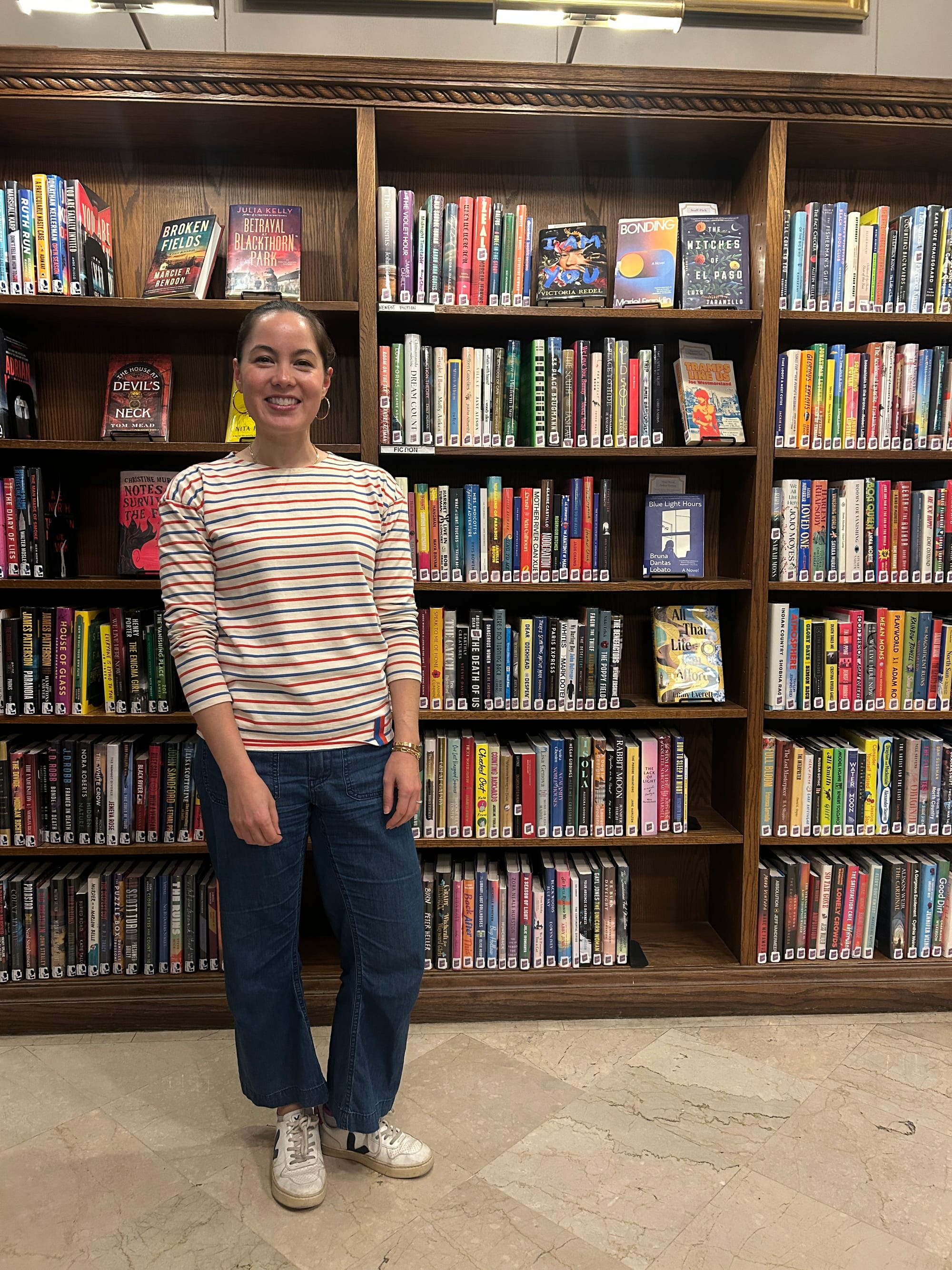
Inside you’ll find 12 floors of stacks, reading rooms, private study spaces, and (minus the children’s floor), a level of quiet heretofore unknown to me in this metropolis I call home. There is no talking on the phone in the library, not even in the stairwells. There is no eating allowed, nor drinking except water. But this silence is not stifling; instead, it’s restorative. I am never more on task than during my days at the library, when so many of my crutches—snack time! Instagram!—are verboten. All that seems to exist is me and the words that steadily grow on the page. It’s gotten to the point where it’s almost Pavlovian: the minute I step inside the stacks and inhale that scent of old paper with an undernote of leather, my fingers can’t move fast enough.
Of course, it’s not just the quiet that spurs me to be so productive. Much ink has been spilt over the concept of third spaces: somewhere not quite home and not quite work but where you nonetheless feel a deep sense of community and belonging. And though my work as a journalist may have me gallivanting around the world, writing fiction is an inherently solitary pursuit. Discovering a space where probably hundreds of other authors (the library has over 3,000 memberships and close to 5,000 members) also tap into their creativity makes the endeavor feel not quite so lonely.
Apart from the psychic connections, the library also encourages actual, in-person networking as well—in spaces designated for talking, of course. Most famous is their afternoon teatime, which as director and head librarian Carolyn Waters informs me, is sacred to many writers who work here.
“Even if you don’t need help on your writing, sometimes it’s nice just to be in the presence of other people who are toiling away,” Waters says. “We love that we’re providing that sort of space for people.”
All in, NYSL organizes well over 200 events a year, which include workshops, reading groups, and readings from authors of all stripes. One of my recent favorites was a talk with journalist Bianca Bosker, who delighted all of us gathered with a witty reading from her book about the art world, Get the Picture.
The sheer proximity to writers, not only in person but through the library’s 300,000 volume collection and its history, is also inspiring. Over the (literally) centuries it’s been open, NYSL has counted some of the country’s most revered writers as members: Herman Melville, Willa Cather, and Truman Capote are just a handful of the household names who have penned pieces in its halls. And though not all of them may have worked in this current building, their creativity and their spirits still imbue the space with a certain kind of magic: If they can do it, why can’t I?
So perhaps it’s fitting that I shot off my first letters to literary agents while sitting in the fifth floor Hornblower Room (and got my first “full request” while sitting there as well). Perhaps it makes sense that the majority of my developmental, line, and copy edits for that eventual novel, The Encore, (Union Square & Co.) were tackled here as well. And now, with my book releasing on March 3, I am proud to join the lineage of authors who have called this place home, and hope it continues to be so for many books and future authors to come.
Juliet Izon is a journalist and author who has written for publications including the New York Times, the Wall Street Journal, Condé Nast Traveler, Food & Wine, and Architectural Digest. She lives with her husband, daughter, and two Ragdoll cats, splitting her time between New York City and the Hudson Valley. The Encore is her debut novel.