The Top 10 Library Stories of 2025
Words & Money looks back at some of the stories that captivated the library and publishing worlds in 2025—and what they portend for 2026.

1. The Battle to Save the IMLS
Though Donald Trump never talked about libraries on the campaign trail, librarians in 2024 expressed concerns that his return to office would threaten their work. And just weeks after Trump was sworn in for his second term, the administration justified those concerns, targeting the Institute of Museum and Library Services, the only federal agency dedicated to supporting libraries, for elimination.
 Andrew Richard Albanese
In a March 14 Executive Order, the Trump administration concluded that several congressionally established agencies, including the IMLS, were “unnecessary” and ordered the agencies slashed to the statutory minimum. Days later, on March 20, deputy labor secretary Keith Sonderling was installed as the IMLS’s interim director, and swiftly placed all but 12 IMLS staff members on leave, dismantled the agency’s advisory board, and began alerting grantees that they would not receive any further funding.
In a March 19 article for American Libraries, Alan Inouye, then interim associate executive director of the American Library Association’s Public Policy and Advocacy Office, called the Trump administration’s actions “a five-alarm fire” for libraries.
Enter the lawyers: On April 4, a coalition of 21 state attorneys filed an emergency action in federal court in Rhode Island seeking to block Trump’s bid to shutter the IMLS. And on April 7, the ALA filed a separate, parallel suit in federal court in Washington D.C.
Thus far, the Rhode Island case has proven successful in staving off the IMLS’s total demise. After issuing a preliminary injunction in May, on November 21 federal judge John J. McConnell permanently blocked the administration’s efforts to unilaterally destroy the agency. As a result, IMLS officials announced on December 3 that the agency was restoring all the IMLS grants it had terminated, to the extent possible. The administration, however, is expected to appeal McConnell’s ruling early in 2026.
 Andrew Richard Albanese
Meanwhile, despite virtually identical facts and legal claims, the ALA’s lawsuit filed in Washington D.C. has proven to be more complicated. After initially finding for the plaintiffs and blocking the administration’s efforts in May, Judge Richard J. Leon reversed course a month later after an adverse appeals court decision in a similar case. As of this writing, the ALA case is ongoing, with competing motions for summary judgment not set to be fully briefed until early spring.
Legislatively, the future of the IMLS also remains tenuous. In its FY 2026 budget proposal, the Trump administration once again targeted the agency for closure. But in a bit of good news, legislators in both houses have proposed keeping the agency funded at $291.8 million. Furthermore, both the House and Senate have proposed a modest increase—about $400,000—for state grants to libraries under the Library Services and Technology Act (LSTA).
But after a tumultuous 2025, it’s clear that the future of the IMLS remains very much in flux heading into the new year. How much of the damage done to the IMLS in 2025 may be irreversible?
And even if the IMLS is spared by the courts and funded by Congress, the agency under Trump would almost certainly hew toward a MAGA agenda. In a statement for his swearing in, Sonderling said as much, vowing to steer the IMLS “in lockstep” with the Trump administration. What might that mean in practice? Nothing to support diversity efforts efforts. Millions for “freedom trucks.”
2. Appeals Court Finds ‘No First Amendment Right to Receive Information’ in Public Libraries
In 2025, freedom to read advocates notched several legal victories over would-be book banners. But as 2026 gets underway, a stunning decision by the Fifth Circuit U.S. Court of Appeals in a key Texas book banning case, Little v. Llano County, threatens to fundamentally transform public libraries in America.
First filed in April 2022 by seven Llano County, Texas residents, Little v. Llano County was the first major lawsuit of this current wave of right-wing book bans. The suit accused Llano County officials of unconstitutional viewpoint discrimination for ordering the removal of some 17 books from library shelves because they disapproved of the content.
Initially, it appeared to be a fairly straightforward case. In a forceful March 2023 decision, federal judge Robert Pitman found that the removals were clearly motivated by illegal viewpoint discrimination, and issued a preliminary injunction ordering the books returned to library shelves. More than a year later, in June 2024, Pitman’s decision was affirmed by a split three-judge panel of the Fifth Circuit.
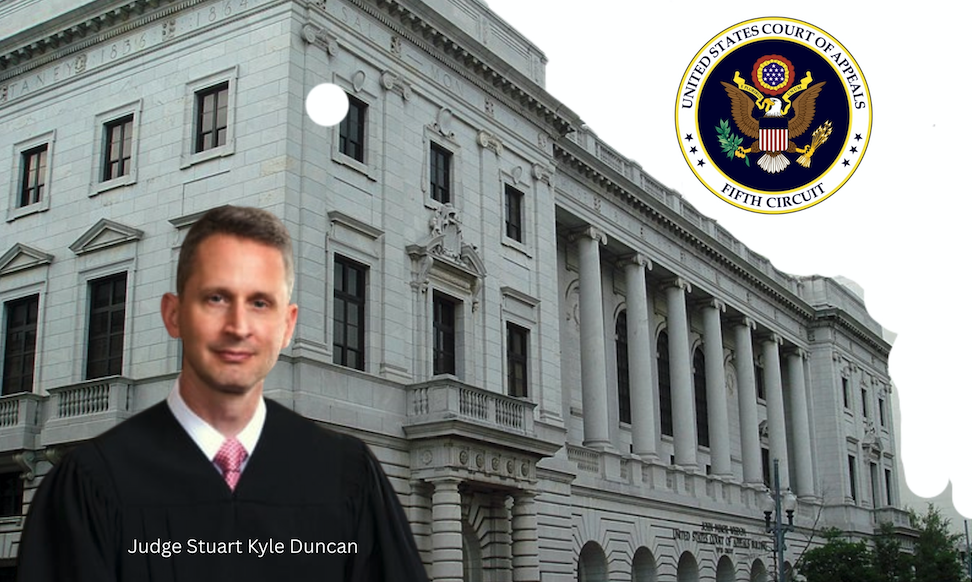
But the panel decision came with a notably fiery dissent by ultra-conservative justice Stuart Kyle Duncan. And weeks later, on July 3, 2024, the Fifth Circuit—widely considered to be the most conservative court in the nation, abruptly vacated the panel’s decision, and ordered the appeal to be reheard en banc by the full Fifth Circuit.
And in May, by a 10-7 margin, the full Fifth Circuit overruled its own 30-year old, unanimous precedent in Campbell v. St. Tammany Parish School Board, and reversed Pitman. This time, Duncan wrote the majority opinion.
“Yes, Supreme Court precedent sometimes protects one’s right to receive someone else’s speech. But plaintiffs would transform that precedent into a brave new right to receive information from the government in the form of taxpayer-funded library books. The First Amendment acknowledges no such right,” Duncan concluded. “A plaintiff may not invoke that right to challenge a library’s decisions about which books to buy, which books to keep, or which books to remove.”
Notably, a seven-judge minority also held that library book decisions are “government speech,” a radical argument that has animated several right wing legislative efforts to ban books in libraries in recent years.
 Andrew Richard Albanese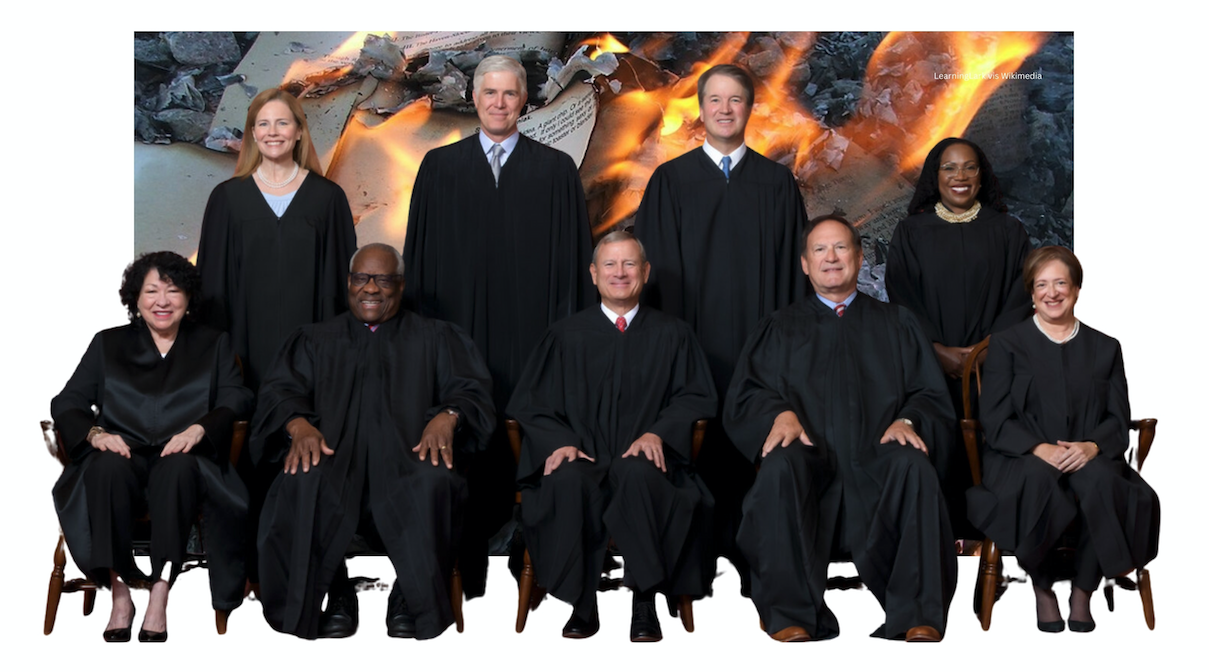
The practical impact of the Fifth Circuit’s ruling is potentially massive. If it ultimately stands, the ruling hands local leaders the power to remove books from libraries they disapprove of for virtually any reason. Want to ban every book about race, or policing, or the LGBTQ community from your local public or school library? Perfectly acceptable. Only want to only shelve want books that align with your party’s political views? Go for it. And if your community doesn’t like it, their recourse is at the ballot box.
Incredibly, that is now the reality in the three states under the Fifth Circuit’s jurisdiction (Louisiana, Mississippi, and Texas) after the Supreme Court on December 8 declined to take up the plaintiffs’ appeal of the Fifth Circuit ruling.
While there is little dispute that several other cases now in the courts will likely get this issue in front of the Supreme Court at some point, for now, the Supreme Court’s denial is a major blow. “Libraries that serve 38 million Americans in three states could now become political propaganda centers subject to the whims of the party in power,” lead plaintiff Leila Green Little told Words & Money in a recent interview. “It’s a gut punch, and it’s difficult to reconcile that fact with being in the United States of America.”
3. Publisher-led Lawsuits Succeed in Florida, Iowa
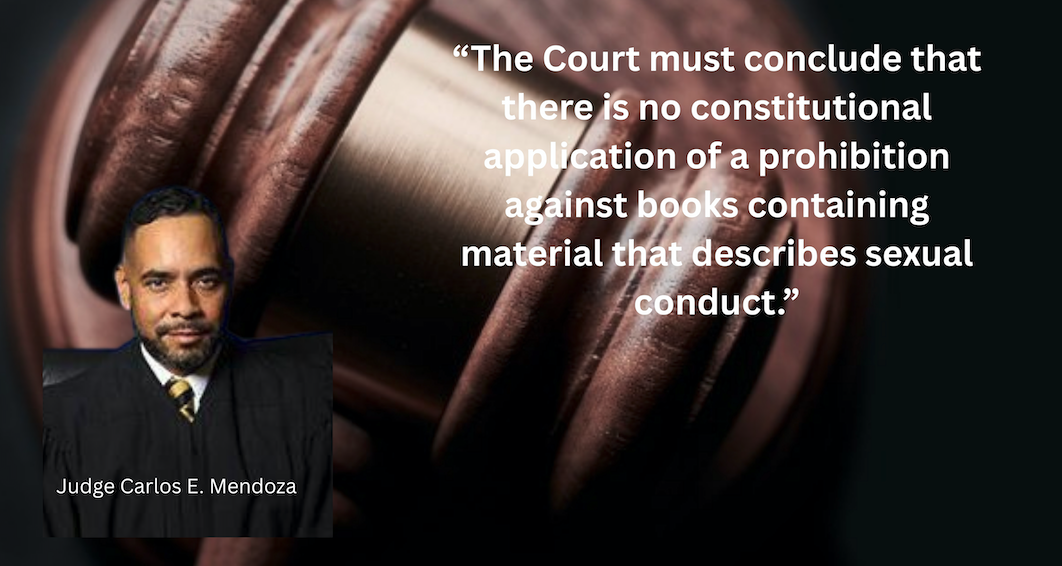
Despite the outcome in Little v. Llano County, 2025 was a pretty good year for freedom to read advocates in court, with several important legal victories, including two decisions that scaled back state laws that had led to sweeping book bans. In Florida, federal judge Carlos E. Mendoza on August 13 wiped out two provisions in Florida state law HB 1069. And in Iowa, federal judge Stephen Locher—for a second time in 16 months—blocked a sweeping provision of Iowa state law S.F. 496.
Signed into law in May 2023, Florida law H.B. 1069 included two provisions that ignited a wave of book bans in the state: one that broadly prohibited books in public schools that included any descriptions of “sexual conduct;” and another that banned books with allegedly “pornographic” content.
In August 2024, a coalition of plaintiffs led by six major publishers, the Authors Guild, several bestselling authors, and a group of parents, sued, arguing that HB 1069’s blanket ban was unconstitutionally vague. And, in a clever argument, the plaintiffs presented the court with a choice: it could strike the provision barring books found to be “pornographic” as unconstitutionally vague, or it could simply declare the term to be synonymous with the obscenity standard already enshrined in Florida law, which is properly grounded in the Supreme Court’s landmark 1973 obscenity case Miller v. California.
 Andrew Richard Albanese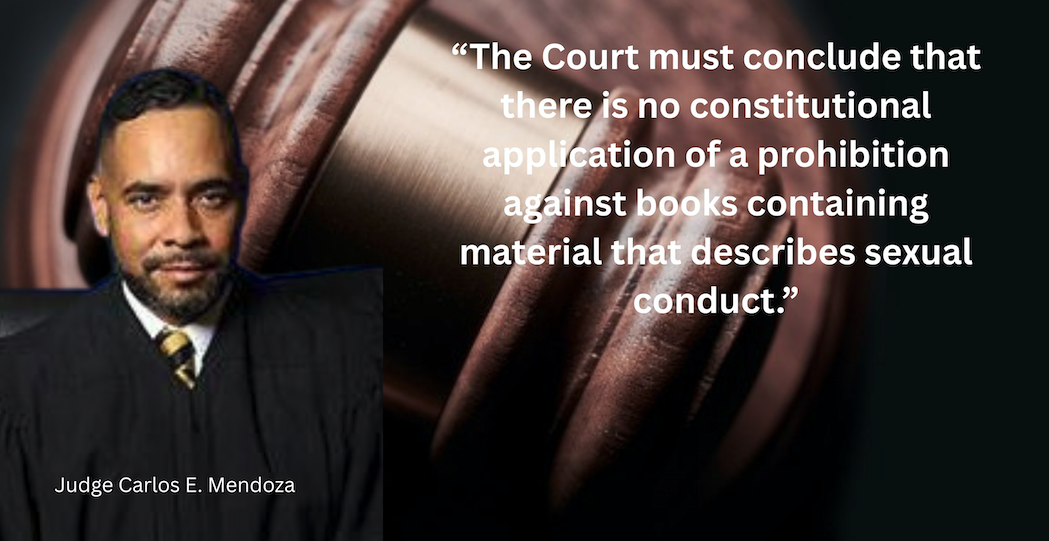
In his highly anticipated 50-page decision, Mendoza found for the plaintiffs, concluding there was “no constitutional application of a prohibition against books containing material that describes sexual conduct.” And rather than choose the more legally complex, “strong medicine” of declaring the provision barring “pornographic” content facially invalid, the judge accepted the plaintiffs’ invitation to declare the term synonymous with the state’s existing—and properly defined—obscenity standard.
The decision in Florida followed judge Stephen Locher’s March 25 decision to block a similar provision in Iowa state law S.F. 496.
Signed by Iowa governor Kim Reynolds in May 2023, S.F. 496, among its provisions, barred all books with depictions of sex from school libraries. In response, Iowa school districts reportedly pulled hundreds of titles from their shelves, prompting two legal challenges, one from Lambda Legal and the ACLU of Iowa, and another from Penguin Random House and the Iowa State Education Association, along with several bestselling authors and a coalition of parents.
 Andrew Richard Albanese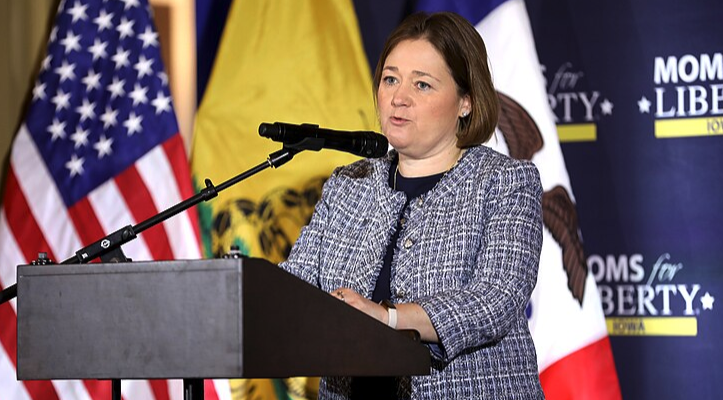
On December 29, 2023, Locher delivered his first 49-page opinion and order blocking the book banning provisions, which he found “vague” and “wildly overbroad.” That decision, however, was vacated by the Eighth Circuit U.S. Court of Appeals in August 2024 and remanded for more scrutiny. But on March 25, Locher once again found the law to be unconstitutional.
Notably, state attorneys in both Iowa and Florida argued that library collections were government speech and thus immune from First Amendment challenges—arguments that were emphatically rejected. “Slapping the label of government speech on book removals only serves to stifle the disfavored viewpoint," Mendoza wrote in his decision. "That way, the Supreme Court has warned, lies danger.”
To say that 2026 is setting up to be a big year in court for the freedom to read may be a bit of an understatement. In 2026, the cases in Iowa and Florida will both face appeals. As will another freedom to read victory—Crookshanks, et al. v. Elizabeth School District—in which a federal court ordered the return of 19 books banned from a local high school, and a December 2024 victory in Arkansas that blocked the book banning provisions in a 2023 state law known as Act 372.
Also headed to appeal, another Florida case, in which a federal judge ruled against authors Peter Parnell and Justin Richardson, whose bestselling 2005 picture book And Tango Makes Three, was removed from Escambia County school libraries based on what the authors allege was unconstitutional, anti-LGBTQ+ viewpoint discrimination.
 Andrew Richard Albanese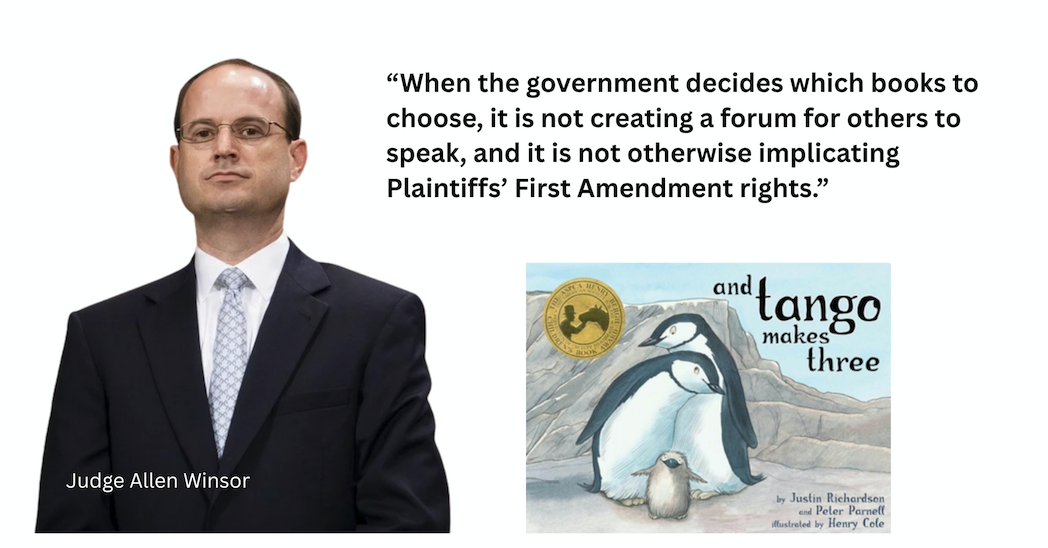
In that case, federal judge Allen Winsor leaned heavily on the Fifth Circuit’s decision in Little v. Llano County, agreeing that Escambia County officials have the unfettered power to ban books.
“The board’s lead argument is that school library curation does not implicate any students’ or authors’ First Amendment rights at all,” Winsor wrote in a brief, 18-page decision. “Thus, the argument continues, even if the board removed a book based on its viewpoint, the removal would not be unlawful. I agree, and that is enough to resolve this case.”
4. Trump Fires Librarian of Congress Carla Hayden
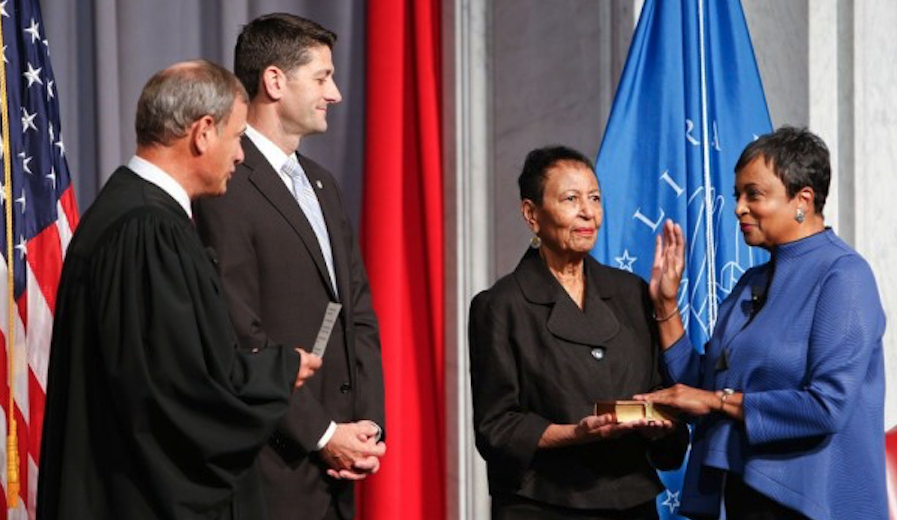
In a move that drew widespread condemnation, the Trump administration in May fired Librarian of Congress Carla Hayden without warning, without cause, and clearly without a plan for what would come next for the hallowed institution. According to Hayden, she never heard directly from the White House. Instead, she was notified of her dismissal after work hours on the evening of May 8, in a curt two-line email from a deputy in the White House personnel office.
Sworn in as the nation’s 14th Librarian of Congress in September 2016, the 73-year-old Hayden was the first woman and the first African American to hold the post, and the first professional librarian to hold the post since 1974. She had a little more than a year left in a 10-year term that was largely considered to be one of the most successful periods in the library’s modern history. And she had earned high marks from lawmakers on both sides of the aisle—a fact that was evident at a House Administration Committee meeting on May 6, just two days before her dismissal.
 Andrew Richard Albanese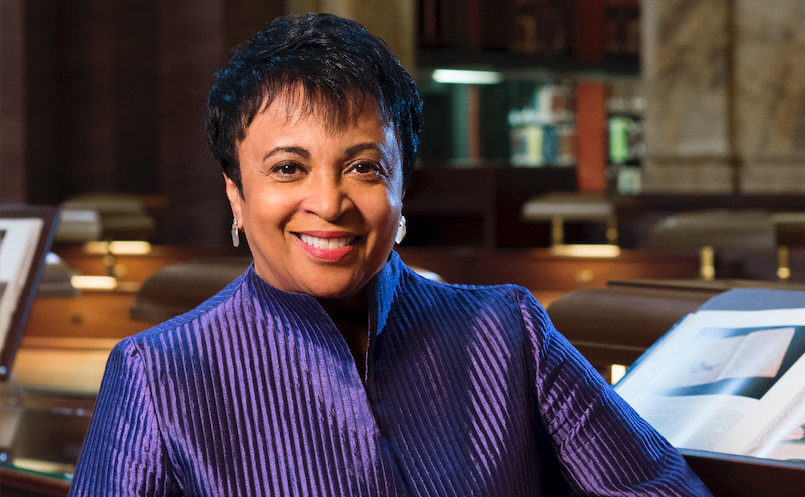
Throughout her tenure at the library, Hayden had proven to be a deft manager and a master at staying above the political fray, including throughout Trump’s chaotic first term. But shortly before her firing, a right-wing political group attacked her as “woke” and “anti-Trump” and urged the president to remove her. And in the administration’s only official comment, White House spokesperson Karoline Leavitt told reporters in the White House press room that Hayden was fired because she was “putting inappropriate books in the library for children,” a laughably false claim.
In one of many statements issued by lawmakers, Senate minority leader Chuck Schumer, fearing a hostile takeover of the library, expressed outrage and said Congress should move to make the Librarian of Congress appointable by a Congressional commission, rather than the president.
While Congress has not moved to take over the appointment process, leaders in the House and Senate do appear to have drawn a line in the sand at the library. On May 12, Trump appointed his former defense attorney and DOJ Deputy Director Todd Blanche to be acting Librarian of Congress. But lawyers insist that the president doesn’t have the authority to appoint an acting librarian, and library officials have not recognized Blanche’s authority. By law, Hayden’s deputy, Robert Newlen, automatically ascended to the role of acting librarian, a role in which he continues to serve as of this writing.
For her part, Hayden has remained above the fray, declining to comment in detail on the Trump administration’s actions. And in July, just days after telling librarians at the American Library Association Annual Conference that her work helping libraries was not over, the Mellon Foundation announced that Hayden had joined the organization for a year-long senior fellowship to advise the foundation on “opportunities to support and advance libraries, archives, and other organizations in the public knowledge ecosystem.”
The question for 2026 is whether the Trump administration will move to appoint a new, full-time librarian, and, perhaps more importantly, whether the GOP-led Senate, which must confirm the appointment, will allow the post to be politicized.
5. A Failed (For Now) Trump Takeover of the U.S. Copyright Office

On May 10, just two days after the shock firing of Librarian of Congress Carla Hayden, the Trump administration further alarmed publishing and library leaders by attempting to fire the Register of Copyrights, Shira Perlmutter. But after a pitched legal battle in 2025, Perlmutter remains in her post—at least for now.
Hayden announced Perlmutter as the 14th U.S. register of copyrights in September 2021, and her purported dismissal surprised and outraged stakeholders in the copyright and intellectual property communities, who have given Perlmutter high marks for her work, including significant progress on a much-needed modernization effort.
Furthermore, observers were quick to note that Perlmutter’s firing immediately followed the pre-publication release of the third and final part of a wide-ranging Copyright Office review of the legal and policy questions swirling around AI, and just weeks after tech industry leaders had expressed a desire to slash intellectual property protections. "Delete all IP law," Twitter founder Jack Dorsey wrote in an April 11 post on X, to which X owner and DOGE leader Elon Musk replied "I agree."
But Perlmutter refused to go quietly and filed suit in May, arguing that the Copyright Office clearly falls under the purview of the Library of Congress and that the president lacks the authority to fire her or to appoint a replacement. And after a contentious legal battle, the U.S. Court of Appeals in Washington D.C. agreed, and on September 10 ordered the administration not to interfere with Perlmutter’s work.
Last month, the Supreme Court punted on the government’s appeal, letting the appeals court’s order stand and keeping Perlmutter in her job for the foreseeable future.
 Andrew Richard Albanese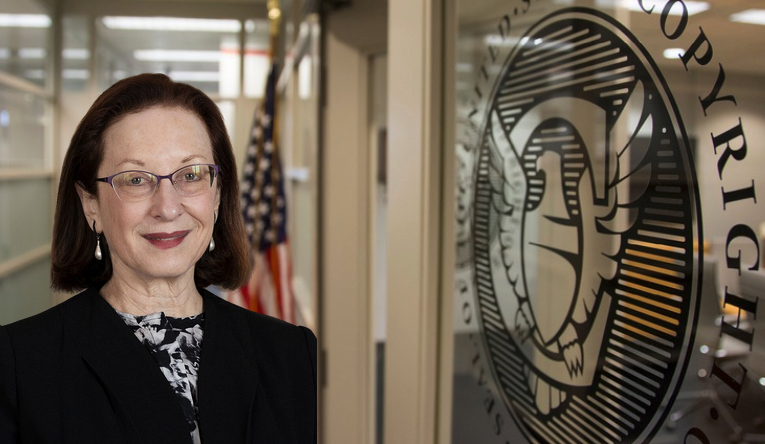
Of course, Perlmutter’s job remains tenuous in 2026. While the administration has vowed to continue its court battle, the president could end the fight by nominating and confirming a permanent Librarian of Congress, who could then legally remove Perlmutter.
But perhaps the biggest question going forward is whether Congress will once again try to hand control of the Copyright Office to the executive branch—as it nearly did a decade ago with the support of the major publishers and the Authors Guild, and over the vocal opposition of the academic and library communities.
Suffice it to say that the dangers of politicizing the Copyright Office have since been pulled into sharp relief. In July, the Trump administration released its long-awaited AI Action Plan, which completely ignored the vast concerns of many in the creative community. And in unscripted comments, Trump dismissed the concerns of publishers and creators.
“You can’t be expected to have a successful AI program when every single article, book, or anything else that you’ve read or studied, you’re supposed to pay for,” Trump told attendees at an event in Washington, D.C. “You just can’t do it, because it’s not doable.”
6. Baker & Taylor Collapses
In a move described by several librarians as shocking but not surprising, leading library vendor Baker & Taylor confirmed in September that it was ceasing operations, just days after a proposed acquisition of the embattled library supplier fell through. According to reports in several local outlets and a vigorous discussion on Reddit, hundreds of workers were let go in the fall, as the nearly 200 year-old company pepared to shutter.
In an article for American Libraries, Marshall Breeding, the well-known expert on the library market and editor of the website Library Technology Guides, said the loss of Baker & Taylor looms as a major disruption, leaving many to "scramble to establish arrangements with other distributors" and publishers with unpaid bills and lost inventory held in B&T warehouses.
 Andrew Richard Albanese
For years publishers have complained about late payments from the vendor, and in 2025 several publishers had reportedly suspended shipments. In addition, a growing number of librarians had reported over the summer that their orders were taking longer to fill–if they were getting filled at all–prompting speculation about the company's financial health.
Against that backdrop, Jim Milliot at Publishers Weekly exclusively reported on September 11 that vendor Readerlink had entered into an agreement to purchase Baker & Taylor. But on September 26, the day the deal was set to close, Readerlink backed out, sending Baker & Taylor into a death spiral.
Meanwhile, in some excellent sleuthing for American Libraries, Breeding pointed to court filings in a separate lawsuit (filed by OCLC over Baker & Taylor's use of Worldcat records for its BTcat offering), which revealed that Baker & Taylor was in default to its main creditor, CIT Northbridge Credit, and that the ReaderLink deal was in fact a foreclosure sale.
Librarians Words & Money spoke to said they were sifting through the fallout, with many saying they were primarily feeling sad for Baker & Taylor’s talented and dedicated staff.
 Tim Coates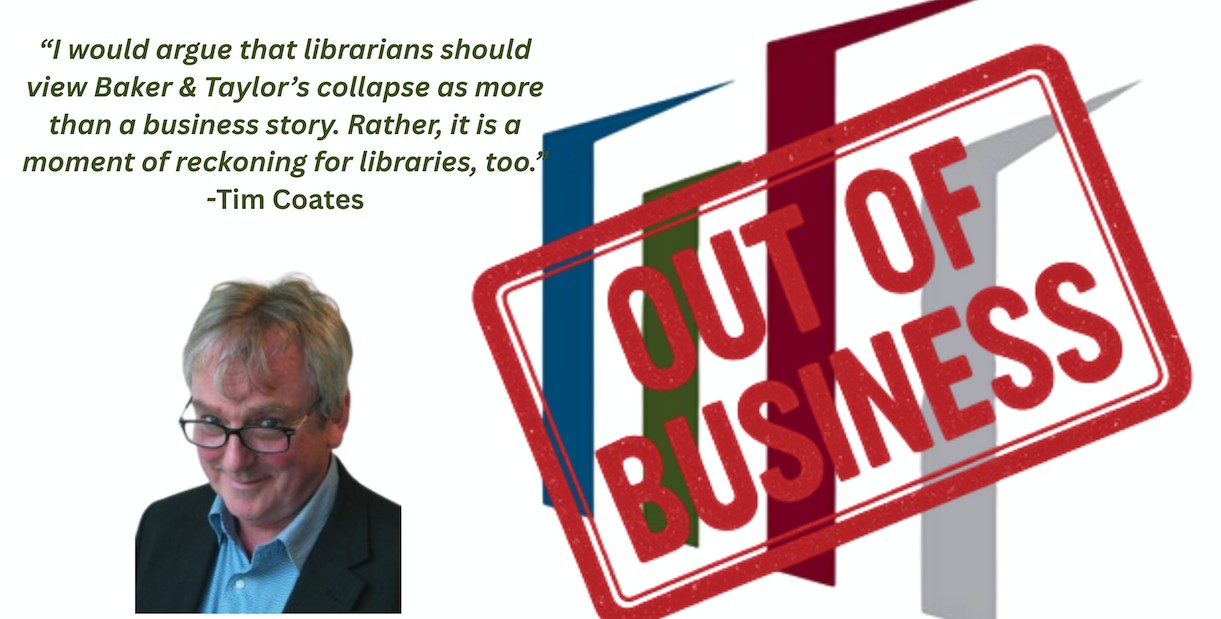
With B&T’s collapse, the library distribution market is facing a massive shift in 2026, with other providers, such as Ingram, Brodart, and Amazon rushing to fill the void. Follett Content has also announced plans to service public libraries for children's content.
But some believe that the problems that pulled Baker & Taylor under remain. “The temptation for many will be to pin the company’s collapse on management decisions," observed U.K.-based library advocate Tim Coates, who conducts an annual market survey known as The Freckle Report. "But it would be a mistake to discount the drop in physical book purchases Baker & Taylor has been navigating for so long.”
7. Connecticut Passes a Library Ebook Law

More than three years after a federal judge struck down Maryland’s first-of-its-kind library ebook legislation over copyright issues, Connecticut in 2025 became the first state since 2021 to pass a library ebook law.
On May 15 the Connecticut House of Representatives passed Senate Bill 1234 by a 106-38 margin, a week after the state senate passed the bill by a 35-1 margin. Supporters say that by focusing the law on library contracts, the bill avoids the copyright issues that saw the nation's first library ebook law in Maryland struck down in 2022.
 Andrew Richard Albanese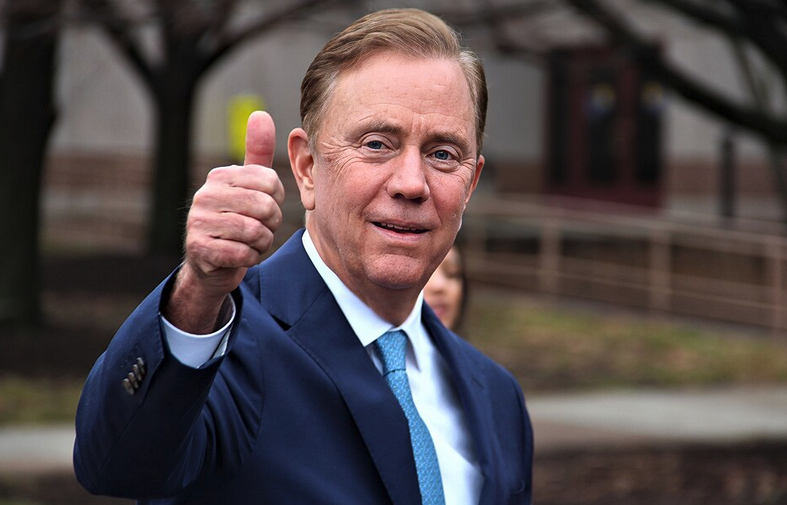
“The Connecticut bill essentially restores the right to negotiate, so libraries aren’t forced into take-it-or-leave-it digital deals, and prevents contracts that impose intentionally restrictive terms, such as unreasonably short lending periods or artificial caps on usage,” Ellen Paul, executive director of the Connecticut Library Consortium, told Words & Money. “We are not telling publishers how to price their works. We are asking for a variety of licensing options. We are hoping that this bill spurs a conversation with publishers on an approach to ebook licensing that balances the needs of libraries and publishers.”
 Andrew Richard Albanese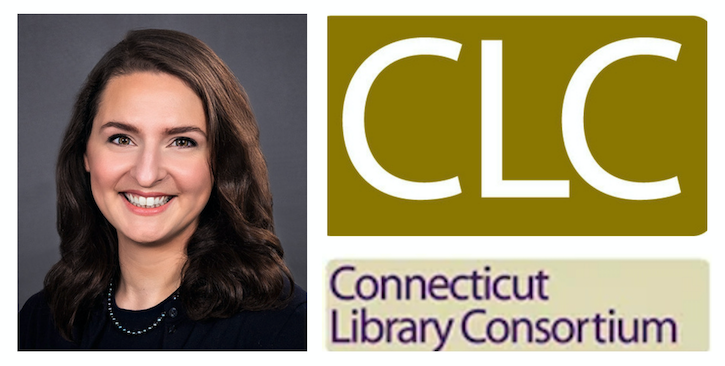
Notably, the bill includes a “trigger clause” for its effective date: the law will not take effect until another state (or states) with a combined population of at least seven million passes similar legislation.
At present, several states have been considering similar legislation, but only New Jersey—which, with a population of nearly 10 million, would meet the threshold and trigger the bill into action—has introduced a bill. But with digital demand surging and libraries struggling to keep up with the costs and restrictions of the digital market, legislation could be on the table in several states.
8. Rhode Island Passes a Groundbreaking Freedom to Read Law
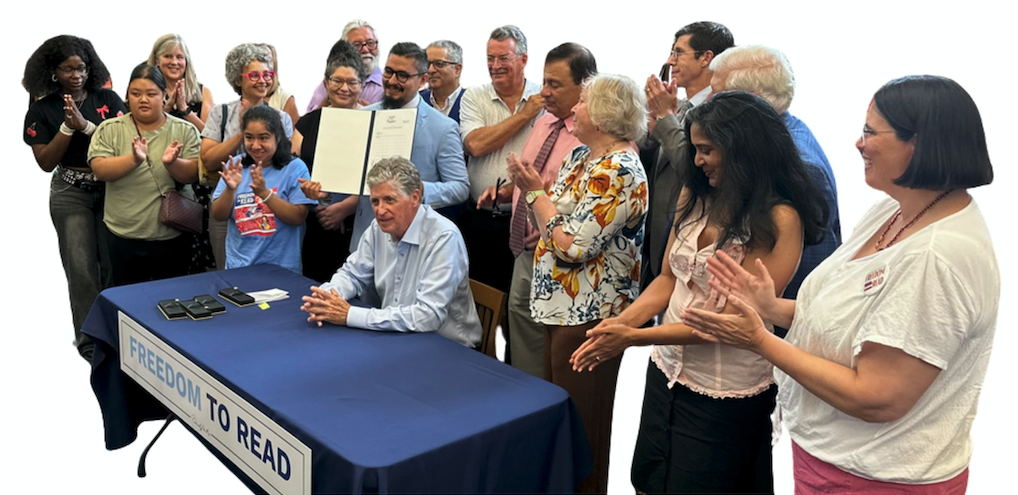
In response to the surge in book bans, roughly a dozen states have now enacted Freedom to Read laws, including five new state measures enacted in 2025: in Colorado, Connecticut, Delaware, Oregon, and Rhode Island. But the law in Rhode Island, advocates say, stands out as a model for the nation.
Rhode Island’s law includes provisions common among freedom to read bills that have emerged in other states: it prohibits the removal of books from libraries due to partisan or doctrinal disapproval; it includes a model policy for materials in public and school libraries; and, critically, it shields library staff from civil and criminal liability simply for making materials available. But it is the law’s protections against censorship for authors and readers that make it truly groundbreaking.
“This is the first time that a state has recognized a private right to read in a library setting,” explained Penguin Random House associate general counsel Dan Novack, who was part of the broad coalition of librarians, authors, publishers, advocates, faith groups, and legislators that came together to craft the bill. “Rhode Island is the first state to come out and say that authors and readers have a right to not have material banned from the library for doctrinal or political reasons.”
In practice, the law essentially gives authors and readers standing to sue over an unconstitutional book ban. And while it doesn’t allow for damages, it allows those who are forced to go to court to protect their First Amendment rights a path to recoup their costs. The law doesn’t inhibit good faith disputes and discussions over a book’s appropriateness. But the law seeks to ensure that challenges are properly and professionally handled and that books are evaluated consistent with the Constitution. And it offers a potent, much-needed deterrent to the kind of organized, politically motivated book bans that have proliferated across the country since 2021.
“Consider the book as a whole,” Novack explains. “That's basically it.”
More state freedom to read bills are expected to surface in 2026—and with any luck, Rhode Island will prove to be a model for the nation. “Public libraries are places where you can find yourself in other people’s words,” Rhode Island Governor Dan McKee said in a bill signing ceremony in July. “In Rhode Island, we promote free expression. We don’t restrict it. And in Rhode Island, we see censorship for what it is: a way to limit what we can learn about the world—and about each other.”
9. ALA Hires a New Executive Director

Nearly two years after Tracie D. Hall's abrupt departure, the American Library Association in June named Daniel J. Montgomery, formerly President of the Illinois Federation of Teachers, as its new executive director, just before the 2025 ALA Annual Conference in Philadelphia. Montgomery officially took the helm on November 10, the first non-librarian to lead the organization in its 150-year history.
 Andrew Richard Albanese
"Dan has worked on behalf of public education and the rights of workers for more than two decades," ALA president Cindy Hohl told members in an email, announcing Montgomery’s hiring. "The steering committee chose him because of his commitment to public institutions, his comfort working across diverse and difficult political situations, his service to both cities and rural areas, and his experience managing a complex, member-driven organization."
Montgomery steps into an ALA facing significant challenges: book bans continue to surge; the Trump administration’s efforts to eliminate federal support for libraries continue; conservative politicians in several states are seeking to cut ties with ALA; membership numbers have been in decline; and the association faces a precarious financial picture, which ALA leaders have warned will require some tough choices in 2026 as the association aims to right-size its operation.
Indeed, 2025 was already a year of tough choices for ALA, including the surprise dismissal of Deborah Caldwell-Stone in October. One of the nation's most prominent freedom to read advocates and the leader of the ALA's Office for Intellectual Freedom, Caldwell-Stone was let go as part of a reduction in force and followed a round of buyouts and staff cuts that sources told Words & Money have led to the elimination of some 30 positions from the ALA staff. ALA also saw the retirement of 18-year veteran Alan Inouye, Interim Associate Executive Director, ALA Public Policy and Advocacy, in February.
 Andrew Richard Albanese
But there was progress, too: In March, ALA announced that Lisa Varga, former executive director of the Virginia Library Association, would succeed Inouye, widely regarded as a strong choice for the role. In June, ALA released a new strategic plan, ALA Forward. And while Caldwell-Stone’s departure was a shock, the work of ALA's Office for Intellectual Freedom continues under the capable leadership of Deputy Director Sarah Lamdan.
For his part, Montgomery brings fresh eyes and an excellent resume to an organization in need of a reset. And he certainly appears to understand the task at hand.
“When times are tough, lean on first principles…If you try to do too much you just attenuate your strength,” Montgomery told American Libraries in September. “Focusing on the real tasks we have—strengthening the finances and making sure it’s a strong organization, strengthening our connection to members, so members really see themselves in what ALA is doing—leads to membership growth. And when people feel secure that their interests and their professionalism are represented in the organization, they want to be part of it, and they want their colleagues to be part of it.”
10. The End of LibLearnX
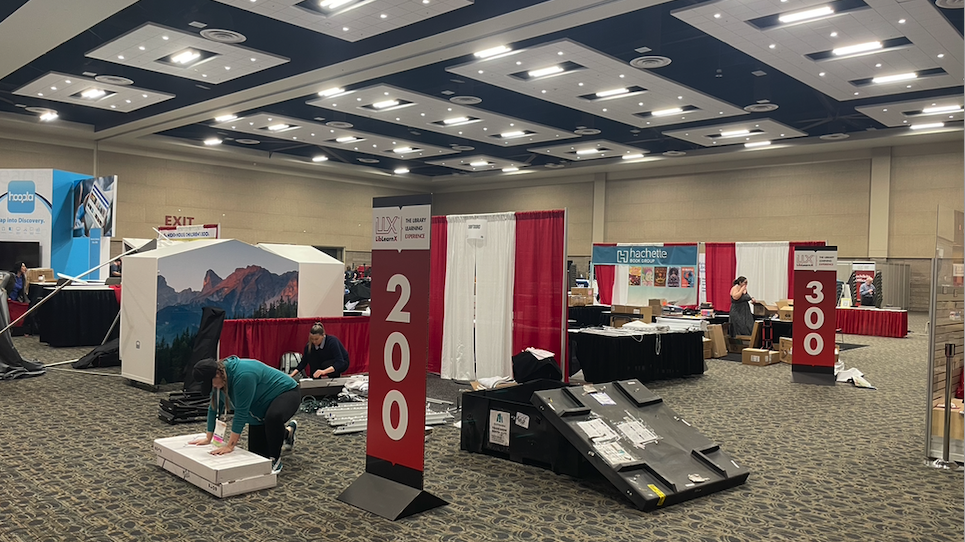
In January 2025, the ALA held its final LibLearnX in Phoenix, closing the book on the money-losing show after just three years.
Designed to take the place of ALA’s long-running Midwinter Meeting, which was retired in 2021 after 107 shows dating back to 1908, LibLearnX faced a host of challenges—including a tenuous post-Covid landscape impacting the ability of librarians to travel—and the show never found its footing.
But despite modest attendance, librarians who did attend LibLearnX were treated to a well-programmed event. The final show in Phoenix featured award-winning author and illustrator Raina Telgemeier and cartoonist and comic theorist Scott McCloud discussing their book, The Cartoonists Club. And a closing session featured Vauhini Vara, who talked about her new book Searches: Selfhood in the Digital Age, a potent, highly engaging exploration of AI, technology, and humanness.
In many ways, LibLearnX delivered exactly what ALA membership had asked for when the association began reimagining the future of its Midwinter Meeting years ago—fewer meetings, more educational offerings, an engaging speaker program, and more time to connect with peers.
In 2026, the ALA is hosting a virtual event on February 10, 2026, Recharging in Challenging Times: An ALA Virtual Event. But looking ahead, can ALA find a formula that works for a future, standalone in-person midwinter meeting? Maybe more to the point, should it even try?