Library Advocate: Baker & Taylor’s Collapse Should Be a Wake Up Call for Libraries
The temptation for many will be to pin Baker & Taylor's demise on management decisions, writes U.K.-based library advocate Tim Coates. But it would be a mistake to discount the drop in physical book purchases Baker & Taylor has been navigating for so long.

The sudden collapse of leading U.S library supplier Baker & Taylor is a seismic development for public libraries in the United States.
At the moment, much of the attention—quite appropriately—is on the hundreds of Baker & Taylor workers who now find themselves unemployed, many after long careers in service to libraries. Similarly, there is concern for the many publishers who stand not to be paid for their deliveries. This is especially tough for the smaller independents.
Libraries that prepaid for orders also might lose money. And even for those who don’t have money at stake, the loss of Baker & Taylor will still be costly. It will take significant time and effort to double back and find new suppliers for the orders lost in the company's collapse, and it is unclear how long library patrons will have to wait for new books and materials to appear on library shelves.
But the demise of Baker & Taylor represents more than a temporary market disruption.
Rather, the company’s long slide into foreclosure suggests that a major link in the supply chain for books to U.S. public librarieshas finally—after years of stress, and to be honest, quite predictably—snapped. Furthermore, I believe the public library marketplace will remain fragile until librarians reverse a largely unaddressed trend for which the alarm bells have been ringing for years: according to data from the Institute for the Museum and Library Services, physical book purchases, physical book circulation, and library visits have, since 2010, been in a level of sharp decline that few organizations could withstand.
A Long Time Coming?
For the last five years, I’ve authored The Freckle Report, which, along with a proprietary reader survey (done with the help of the EveryLibrary Institute) parses the annual IMLS statistics. The numbers are eye-opening.
According to the IMLS, library visits across the U.S. are down more than 50% since 2010 and the amount of money spent on purchases of physical books by public libraries has fallen by 27%. And while those numbers have bounced back slightly from the low point of the pandemic shutdowns, both remain well below 2010 levels.
Print book circulation—still by far the most popular service offered by public libraries—has fallen by 30% over the same period. Moreover, the IMLS data shows that more than half of public library circulations now come from children’s books, this despite the adult user population being eight times greater. In other words, book circulations to adults have fallen, relentlessly, by a lot more than 30%
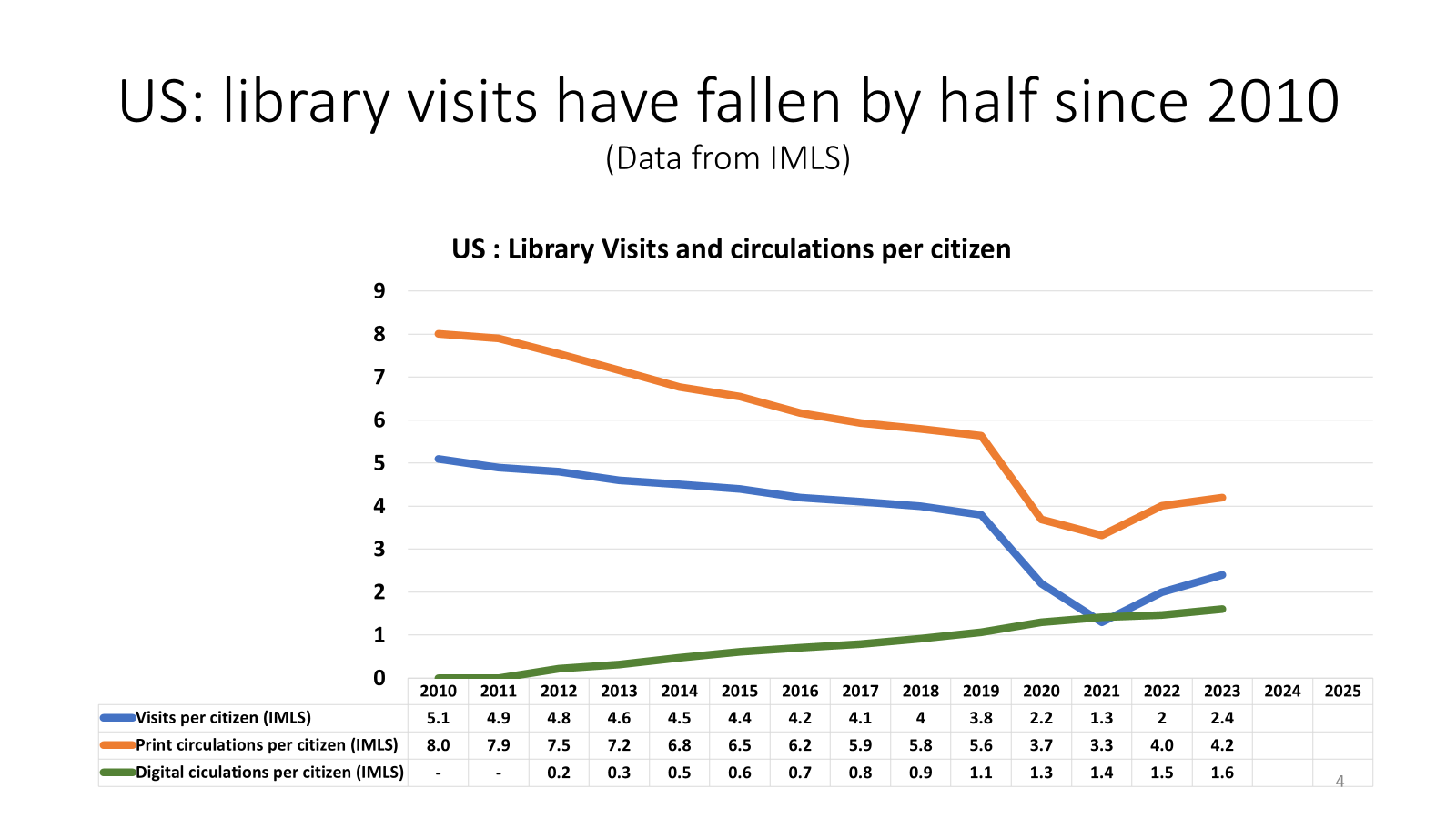
The IMLS figures also show that since 2010, library spending on all materials actually grew by 40%, from $1 billion to $1.4 billion. That funding, however, has obviously been spent on other things, including ebook and digital audio licenses. But it appears that the rising expenditures on digital material has not been in addition to spending on print, but in place of it.
The evidence also suggests that many U.S. public libraries over the last 15 years have made the decision to reduce their print collections in favor of other services. Indeed, libraries today increasingly seem to focus more on marketing their programs and services rather than their book collections—maker spaces, digital databases, internet terminals, classes, employment help, and of course the “library of things,” where patrons can borrow everything from fishing gear to ukuleles.
I don’t disagree that innovative library programs and digital content are important. But as librarians continue to point out, the current library ebook market is financially challenging to say the least. And as robust as library programming is today, it remains a small fraction of what library patrons in my Freckle Report surveys (and in several others) still say they value most by a wide margin: rich physical book collections, and a comfortable place to browse and read.
As libraries begin to pick up the pieces from Baker & Taylor’s collapse, the temptation for many will be to pin the company’s collapse on the supplier's management decisions. Fair enough. But it would be a mistake to discount the drop in physical book purchases Baker & Taylor has been navigating for so long.
Just look at the number of times Baker & Taylor has been up for sale, sold, or not sold, over the last two decades. In hindsight, this is a clear indication that the largest supplier of books to libraries has been unable to make a sufficient profit, despite annual income of more than $600 million.
That should be deeply troubling to library leaders. And while other players appear ready to step in to pick up Baker & Taylor’s once commanding market share—Ingram, Brodart, and Amazon to name a few—I believe the post-Baker & Taylor future remains very much uncertain.
After all, even in the best of times, public library fulfillment is a tough business. In addition to offering competitive discounts, vendors in the public library space must navigate myriad accounts of varying size, credit, each with their own budget pressures, purchasing rules, metadata, processing requirements, and shipping needs. Indeed, the competitive edge that allowed Baker & Taylor to become the dominant player in the library book market was not its discounts, but its investments in tools and programs to help libraries manage their purchasing.
Those investments appear not to have paid off. And given the long-term decline in the demand for books as reflected in the last 15 years of IMLS data, even most enthusiastic sales managers looking to fill Baker & Taylor’s shoes might question whether there is enough long-term growth and profit potential to make servicing public library accounts a worthwhile investment, much less worth innovating around.
This is the reality libraries must now confront. Some library leaders may say it is not their business to worry about marketplace pressures, that this is out of their control. I would argue that librarians should view Baker & Taylor’s collapse as more than a business story. Rather, it is a moment of reckoning for libraries, too. And a time for library leaders to reflect seriously on the best path forward.
Books Still Hold the Key
Fortunately, despite steadily declining gate counts and circulation, I have seen no evidence to suggest that people’s need or desire for library books in the U.S. has waned. On the contrary, my survey data shows that the demand for library books has remained fairly steady over the last decade, and that, overall, Americans continue to greatly value their public libraries.
The question is, for how much longer? I can attest from experience that when political leaders believe they are paying for something that isn’t a good value, they will eventually look to slash that funding. And in the U.K., readers have watched in horror as library funding has been cut by more than 50% over the past decade, and a third of British public libraries have been closed.
As I have opined in recent years, it is my belief that shrinking print book collections is a strategic mistake for U.S. public libraries. Furthermore, I remain convinced that a deep, well-marketed book service with rich, diverse new and backlist offerings and attractive, bookstore-like displays, holds the key to reversing the 15-year declines in library usage and circulation.
Admittedly, my conclusions haven’t always sat well with some librarians. But the data tells the story. And now, so too does the marketplace.
As libraries confront a post-Baker & Taylor future, I believe it won’t be enough to just reorder books from a new vendor and move on. The steady decline in print book purchases almost certainly played a role in Baker & Taylor’s failure. And without a renewed commitment to print books, I believe the public library marketplace will continue to suffer from an instability that no one can afford—not libraries, not publishers, not authors, and certainly not readers.
Tim Coates has worked in the book industry for four decades, including as the former CEO of Waterstone's and WH Smith in Europe. He has tracked, advised, commented on, and worked in the public library service for 20 years in the U.K., U.S., and other countries. He can be reached at tim@freckle.us.