Publishers Sue Google, Alleging Massive Copyright Infringement Behind Its Gemini AI Service
The lawsuit accuses Google of illegally copying millions of works to train its Gemini AI service which, the publishers argue, is already being used to flood the marketplace for books with “AI-generated substitutes.”

Nearly six months after seeking to intervene in a high-profile copyright lawsuit in California over Google’s Gemini AI service, the Association of American Publishers (AAP) has announced that three of its member publishers—Cengage Group, Elsevier, and Hachette Book Group—have now filed their own lawsuit against Google.
The proposed class action suit, filed on July 10 in federal court in New York, was also joined by bestselling author Scott Turow. It accuses Google of illegally copying millions of works to train its Gemini AI service, including works scraped from “behind paywalls” off the web, from “known pirate sources,” and books scanned and submitted for its Google Books database, its Google Play retail service, and Google Scholar. The suit also accuses Google of removing copyright identification to conceal its actions.

“The result is an AI system that competes directly with Plaintiffs’ and the Class’s works in the market,” the lawsuit claims. “Those substitutes take multiple forms, including verbatim and near-verbatim copies of portions or entire works, replacement chapters of academic textbooks, summaries and alternative versions of famous novels, and inferior knockoffs that copy creative elements of original works.”
The complaint goes on to note that Gemini can generate “a 100-page murder mystery set in a quiet seaside town filled with secrets, that substitutes for an original copyrighted murder mystery on which Gemini trained” in “20 minutes” for just 39 cents.
“No publisher or author can compete with that,” the filing states. “Users are already touting Gemini’s ability to generate books with ease, and the market is flooding with AI-generated substitutes. The scale and speed at which Gemini can create books and compete with human writers is unprecedented, and it can only do that because Google copied Plaintiffs’ and the Class’s works to train its AI.”
Scope-limited?
Perhaps the most eye-opening claims in the suit, however, accuse Google of using copies of books for AI training that were acquired through what the publishers say are “scope-limited” programs—Google Books, the Google Play store, and Google Scholar.
In their complaint, the publishers argue that the “legality of Google Books hinges on a narrow, heavily litigated premise that Google would provide a free searchable books index to the public—and nothing else.”
 Andrew Albanese |
The publishers argue that nothing in the 2015 U.S. appeals court decision affirming the legality of Google’s massive project to scan and index books, authorizes or “deems it fair use” for Google “to make copies of copyrighted works for the new and separate purpose of training or developing commercial AI models, or indeed any other purpose beyond the then-existing Google Books service.”
Strictly speaking, that is true—nothing in the Google Books decision explicitly authorizes AI training or any program beyond the claims that were at issue in the litigation. But neither did the court expressly limit Google’s use of the scans it acquired for Google Books to providing an index, as the publisher filing could be read to suggest. Rather, the court emphatically affirmed that Google’s copying of entire works for Google Books was fair use because the use of the scans was highly transformative, which suggests that other uses of the scans could also be fair use, as long as those uses comport with copyright law.
Things may be much murkier, however, in terms of Google Play Books, which, the complaint notes is “a retail storefront through which publishers and authors sell books.” While the exact terms of the publishers’ Google Play contracts are not included in the complaint, the complaint does state that “authors and publishers provide Google with access to digital books for the limited purpose of selling authorized ebooks.”
In addition, the complaint notes that a third program, Google Scholar, provides Google with access to “millions of journal articles” but only for “the limited purpose of powering Google Scholar’s search engine, which directs users to links where the articles can be lawfully accessed.”
Notably, the Complaint cites several internal communications that suggest Google officials themselves acknowledged that using “publisher provided…copyrighted books” from Google Play Books to train its AI was potentially “highly problematic for Google.”
The suit seeks to establish a class made up of those whose works have been “infringed” by Google. Among the proposed relief, the complaint asks the court for an order declaring that Google’s actions violated the Copyright Act; an injunction barring future infringement; monetary damages up to the maximum amount allowed by law; and the destruction of all infringing copies in Google’s possession.
U.S. Publishers Are Ramping Up their AI Fight
The filing is yet another sign that, after waiting out the initial rush of lawsuits against AI companies, publishers are now all in.
 Andrew Albanese |
The Google suit comes just two months after five major academic, professional, and trade publishers (Elsevier, Cengage, Hachette, Macmillan, and McGraw Hill), also with author Scott Turow, and organized by the AAP, filed its first AI lawsuit, suing Meta and founder and CEO, Mark Zuckerberg in New York.
Much of the Google suit is based on similar claims contained in the Meta suit, which alleges the “willful infringement” of millions of works used for training Meta’s large language model. Turow is also a named plaintiff in that suit (as well as in a 2023 Authors Guild class action lawsuit against Open AI).
 Andrew Richard Albanese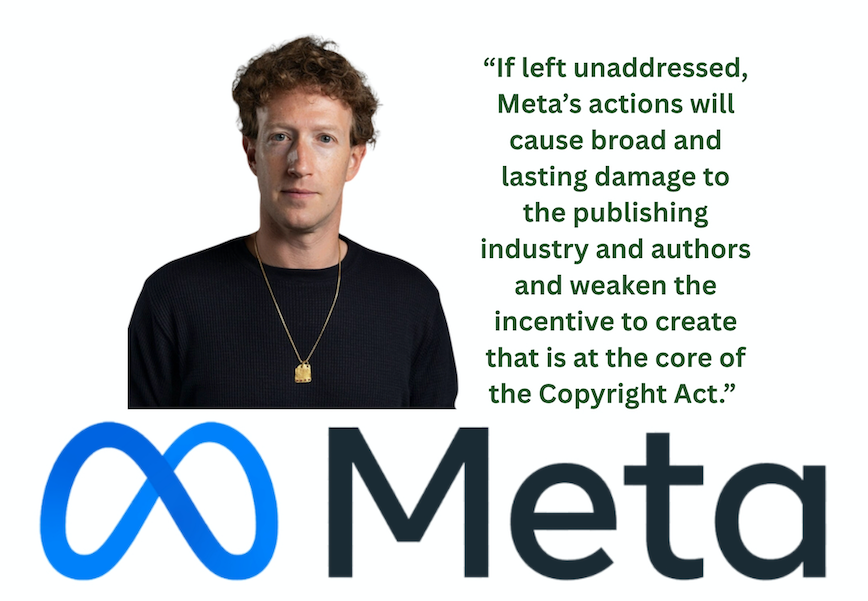
And, as noted, the newly filed publisher suit against Google also comes after publishers in January filed a motion to intervene in a separate copyright infringement lawsuit filed against Google by a group of authors. That case, In Re Google Generative AI Copyright Litigation, was first filed in 2023 and is currently before Judge Eumi K. Lee in the Northern District of California. But despite holding a hearing nearly five months ago on class certification, Lee has yet to rule on the publishers’ motion to intervene in the that case.
In a release, AAP reps said the decision to file its own suit against Google “aims to preserve the right to pursue all the claims that publishers and their authors have against Google, including important ones that fall outside the putative class in that case,” adding that the action “underscores that authors and publishers are united in the goal of protecting their valuable intellectual property rights.”
Meanwhile, in a separate July 10 filing, the publishers officially withdrew their bid to join the California suit. “Cengage and Hachette have thus determined that they must take action to protect claims that appear to be outside the scope of the putative class in this action,” the filing explains. “The independent assertion of those claims makes intervention unnecessary here. Cengage and Hachette respectfully ask, therefore, that the Court deem the Motion to Intervene withdrawn.”
The publishers’ complaint adds to the long list of actions now filed over AI in the U.S. Courts, which reportedly sits at 128, according to blogger Edward Lee’s running count at ChatGPT Is Eating the World.

The suit also comes as a federal judge could rule any day now on final approval for the $1.5 billion settlement in Bartz v. Anthropic, which had its final fairness hearing on May 14.
 Andrew Richard Albanese
Thus far, copyright lawsuits over AI development have delivered mixed results.
In the Anthropic case, for example, judge William Alsup in June 2025 found that Anthropic’s digitization and use of legally acquired copyrighted books to train its Claude AI system was fair use. But the judge also found that the company’s decision to keep millions of unauthorized downloads from pirate sites for a permanent research library was not—a finding that ultimately led to the massive settlement that now awaits final approval.
Also in June 2025, in Kadrey v. Meta, a lawsuit also brought by authors, judge Vincent Chhabria similarly found that AI training on copyrighted works was fair use. Chhabria, however, chided the plaintiffs’ lawyers for their presentation of the case and suggested that there was likely an issue with “market dilution”—that is, the possibility that AI-generated works could disrupt the marketplace for works created by human authors—claims the publisher suits now feature prominently.