In the Latest IMLS Stats, Some Worrying Trends for Libraries Persist
U.K.-based library advocate and Freckle Report author Tim Coates offers his first take on the recently released IMLS statistics, which continue to show an alarming slide in physical circulation and gate counts.

The annual release of data from the Institute of Museum and Library Services, which covers 2024, appeared the week of the ALA gathering in Chicago, so if librarians and library leaders haven’t yet had a moment to digest the report’s significance, that’s understandable. But they should.
As usual, the Public Libraries Survey report is a large, dense spreadsheet with little to no guidance. There is no interpretation, just numbers—but numbers that, when viewed alongside previous IMLS reports, present a vivid picture of the state of public libraries in America.
The 2024 IMLS Numbers at a Glance
On the positive side, if the purpose of all the advocacy we do in the library community is to sustain a large, well-funded, national enterprise, with highly trained professional staff, then we appear to be succeeding. The IMLS figures show that the U.S. public library service—made up of more than 17,000 libraries—is consistently and fairly well-resourced.
In 2024, the IMLS stats showed 17,580 libraries in total (9,046 Central libraries; 7,769 branches; and 765 “mobile” libraries). The survey also showed the highest number of library staff: 147,289 (34,382 librarians with MLIS degrees; 53,058 “other” qualified staff; and 94,151 library workers).
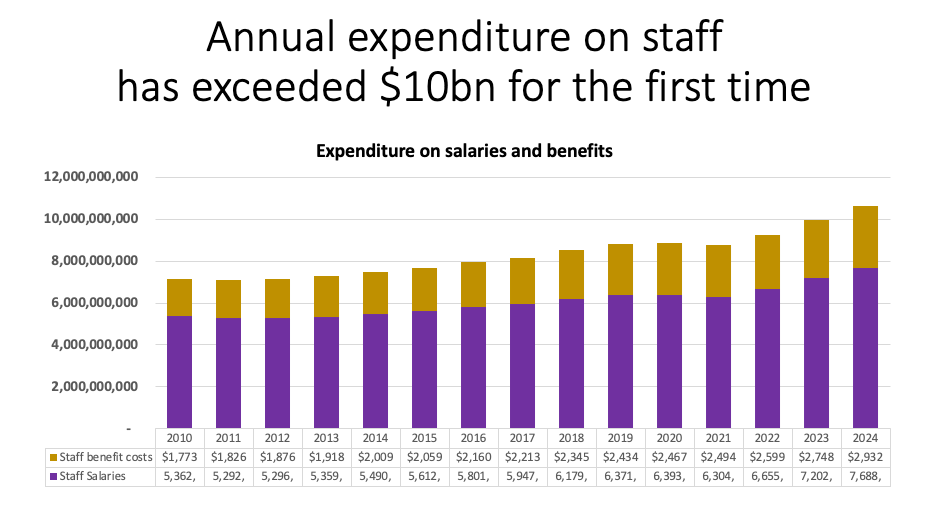
Furthermore, in 2024 the IMLS stats showed that public libraries in the U.S. took in nearly $18 billion in operations funding. Average salaries and benefits also came in at the highest level ever.
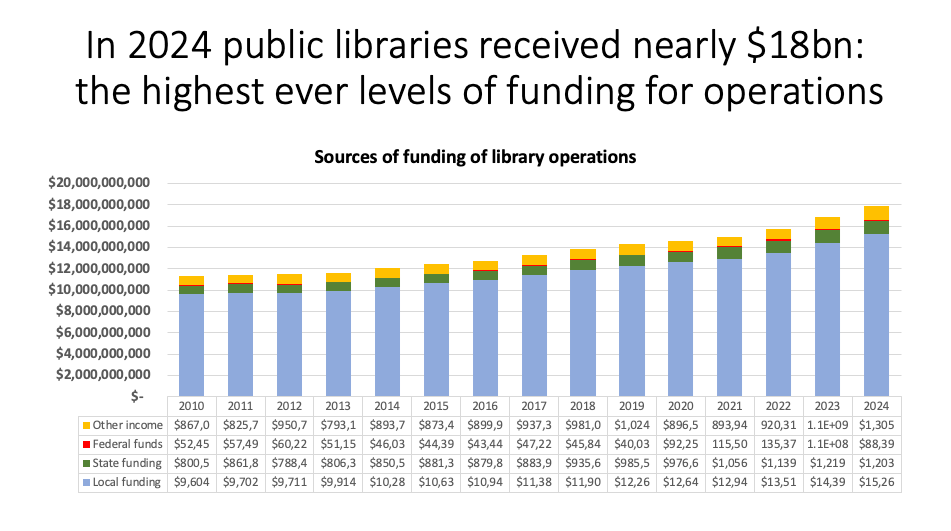
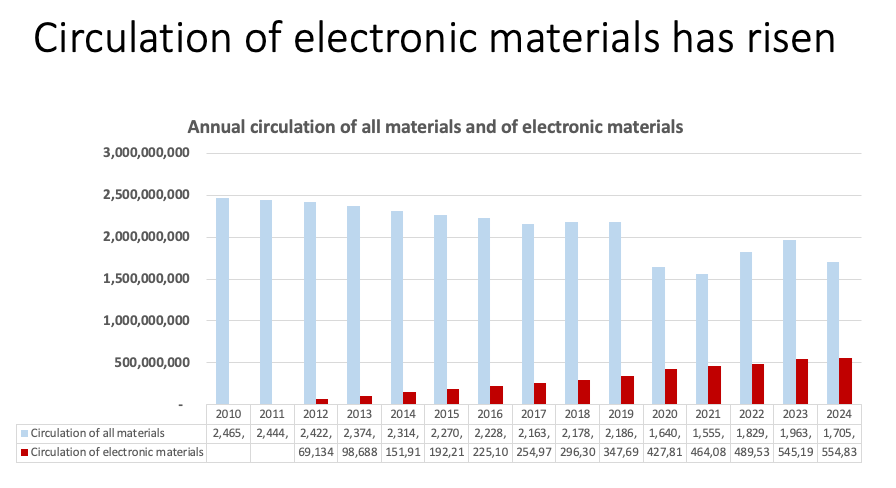
Yet, despite what appears to be relatively stable funding and staffing levels, the IMLS stats continue to show that use of the public library been in a steady decline since 2010, with a particularly substantial slide in print book circulation and physical visits.
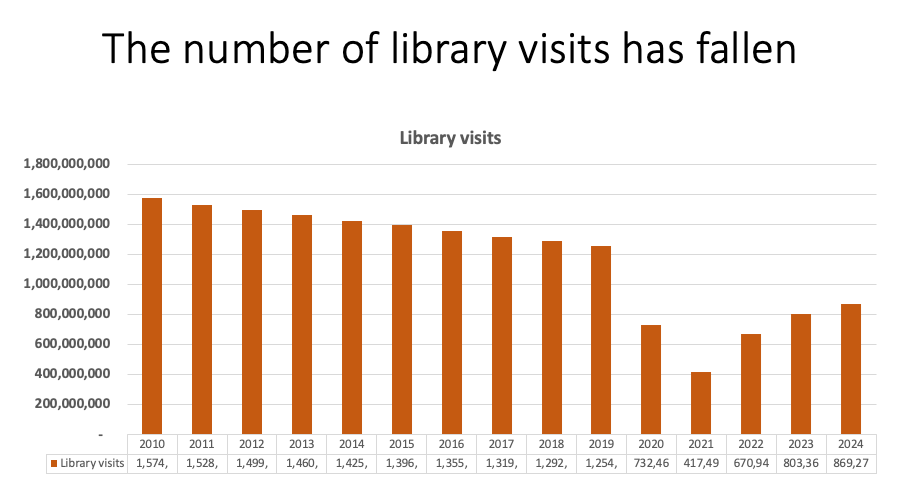
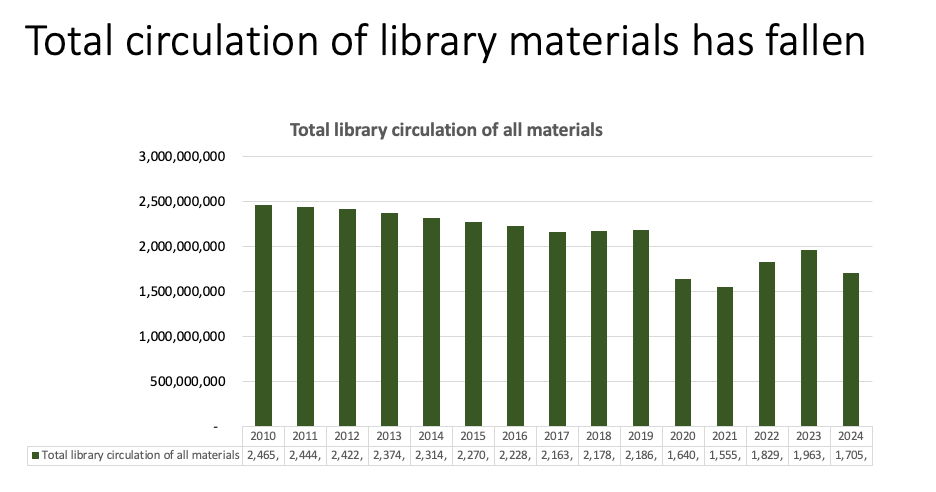
Overall—while library visits and physical circulation ticked up in 2022 and 2023 as libraries emerged from the pandemic shutdowns—they remain well below 2019 levels, and significantly below 2010 levels. And while library visits ticked up again very slightly in 2024 (although visits still remain well below 2019), total circulation, after two years of increases, once again declined.
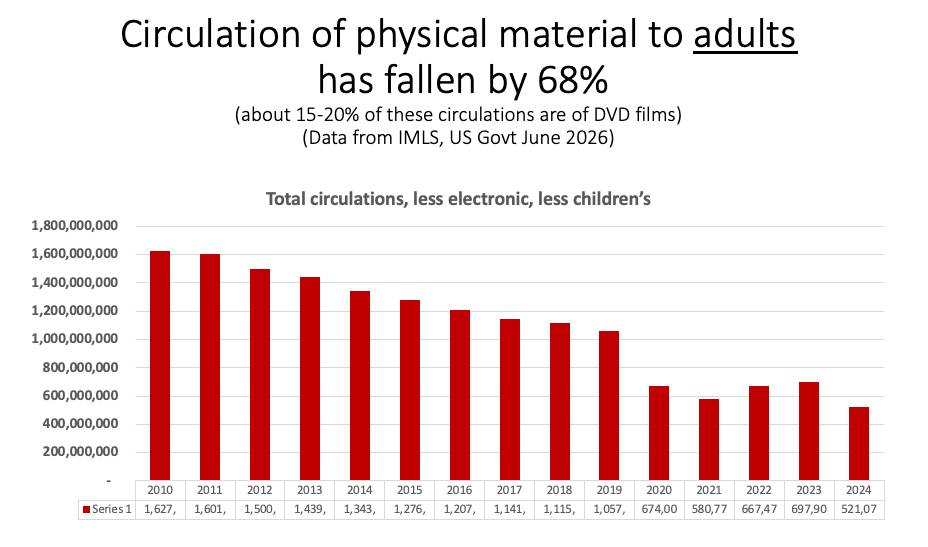
The 2024 IMLS stats showed that physical circulation of adult materials is now down by a massive 68% since 2010. Furthermore, in what should be of particular concern, the circulation of children’s materials is also down since 2010—and after a modest post-pandemic rebound in 2022 and 2023, circulation of children’s books declined again in 2024.
However, one important dimension the IMLS figures fail to show is whether these falling numbers come from falling audience size or from falling numbers of visits by loyal regulars. They need to. One would plead for a much clearer presentation of all the figures, for the benefit of management, and funders.
At the same time, the 2024 IMLS stats show that expenditures on digital materials nearly drew level with print in 2024. And, while still well below print levels, digital circulation rose again for a 12th straight year.
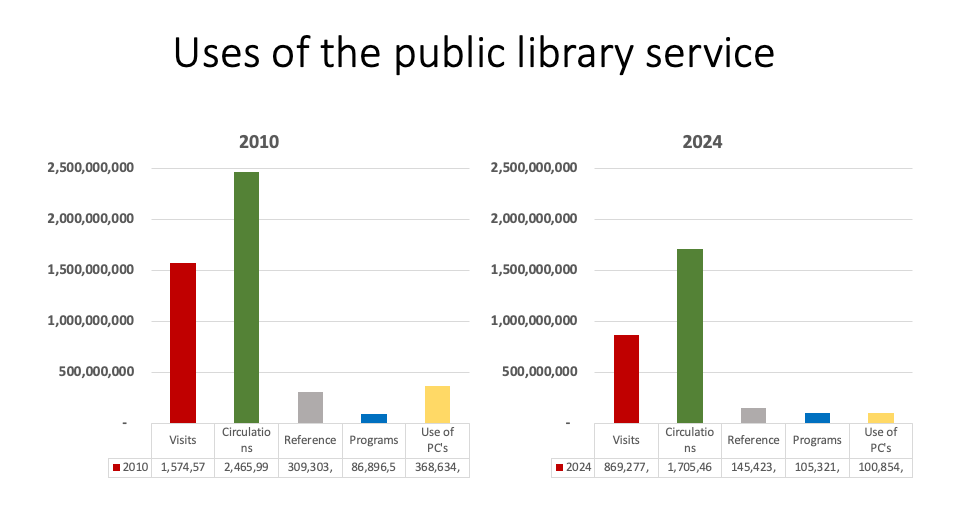
People argue that libraries offer a lot more than books and other materials for circulations, which is true, of course. But the IMLS stats show that programs and things like computer usage remain a very small fraction if library use. While the IMLS stats showed library programming rose in 2024, computer usage declined precipitously—but again, the IMLS stats show those offerings represent a very small part of overall library usage.
Back to the Future
Since 2019, in a series of reports, the Freckle Report, I’ve been tracking the official IMLS stats alongside a proprietary reader survey. And with the 2024 stats now in, and with the pandemic well behind us, I stand by my previous conclusions: namely that the decline in library usage represents a massive challenge to the library system, and that the best way to reverse these declines is to refocus the service on what libraries do best: high-quality print book collections in attractive welcoming, buildings.
 Tim Coates |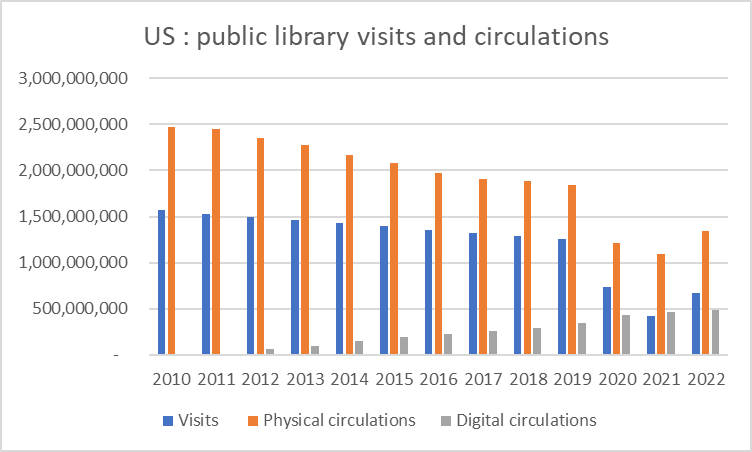
Despite years of decline in physical visits, there is still great strength in U.S. public libraries. And despite the ongoing wave of book banning across the U.S., libraries still enjoy a high level of public and political support.
Still, as I’ve argued in the past, I do worry that the financial support for libraries could change. After all, when political leaders believe they are paying for something their constituents aren't using, they will eventually look to slash that funding—especially in tough economic times.
Yes, there are some libraries who are trying to address these matters. And I understand this is not an easy task, given that existing practices have become so deeply entrenched.
But with the release of the latest round of IMLS figures covering 2024—which comes after a year in which the IMLS itself was politically targeted for elimination—I renew my call, loudly, and urgently, for library leaders to recognize the trends reflected in the data, and to act.
Tim Coates has worked in the book industry for four decades, including as the former CEO of Waterstone's and WH Smith in Europe. He has tracked, advised, commented on, and worked in the public library service for 20 years in the U.K., U.S., and other countries. He can be reached at tim@freckle.us.