What Librarians Wish Publishers Knew: Takeaways from the 2026 Library Insights Summit
Ahead of the 2026 ALA Annual Conference, the fourth annual Library Insights Summit, founded and produced by Foreword Reviews, offers something sorely needed: a space for libraries and indie publishers to talk and figure things out.

Ahead of the American Library Association’s Annual Conference in Chicago, a highly engaged group of small publishers, indie authors, librarians, and other industry professionals gathered in Chicago for the fourth annual Library Insights Summit (LIS), founded and produced by Foreword Reviews.
And while the ripple effects from the escalating tensions between larger publishers and public libraries in the digital marketplace were felt at times throughout the day, overall the mood was optimistic, and the focus on mutually beneficial opportunities and solutions to systemic challenges in the library market.
“ALA provides a wonderful opportunity for librarians and publishers to meet, and LIS is designed to give those conversations more time, focus, and intimacy,” explained Victoria Sutherland, the founder and publisher of Foreword Reviews, the 28 year-old magazine dedicated to spotlighting books from smaller indie publishers and authors. “Our primary goal is to create a space where librarians, publishers, authors, and industry partners can have deeper and more candid conversations than are often possible on a busy trade show floor.”
This year’s summit was developed in partnership with the Independent Book Publishers Association (IBPA), Book Industry Study Group (BISG), and National Information Standards Organization (NISO).
“When [Foreword] approached us about partnering with them on this day of educational programming and networking among librarians and publishers, it felt like the perfect opportunity to provide an outlet for IBPA members to learn more about how the library market actually works," said IBPA CEO Andrea Fleck-Nisbet.
“For the past couple of decades, BISG and NISO have partnered to bring publishing content to librarians attending ALA,” noted Brian O’Leary, outgoing executive director of BISG. “The Library Insights Summit was doing something similar for traditional and independent publishers. We wanted to see if we could combine efforts to offer a broader program that addressed the needs of librarians as well as publishers.”
The 'Friction Tax'
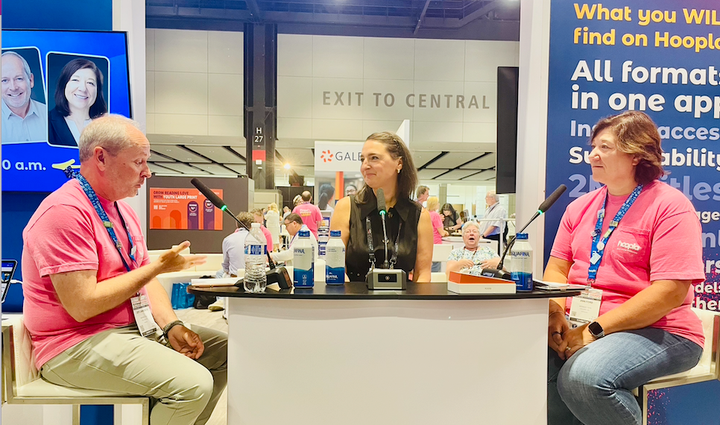
Among the highlights, LIS attendees participated in a full-day program that included keynotes from Jason Low, publisher for Lee & Low Books, and Drew Bordas, chief operations officer for OCLC, and panel discussions featured experienced librarians and industry professionals covering the nuts and bolts of working with libraries, everything from how to reach library selectors and how to optimize books for discovery, to the geeky but critical differences between ONIX and MARC records, and the challenges presented by the impact of artificial intelligence tools on the publishing supply chain.
The opportunity for publishers, Sutherland said, is to make their books "easy for libraries to discover, evaluate, purchase, and lend." And throughout the day, speakers and attendees shared useful insights on the myriad opportunities for publishers and libraries to close gaps for readers who want (and need) more than just the latest bestsellers, including offering books, Sutherland added, "in affordable and accessible digital formats."
One of the longstanding issues facing indie publishers: that the publishing supply chain today has evolved to primarily support larger publishers at a scale that smaller publishers often can’t match. Furthermore, public libraries often have unique requirements and needs best served by dedicated library vendors that many smaller publishers simply don’t have equal access to—which means that library selectors often don’t have equal access to those publishers’ books.
During a session titled "Discovery That Matters: The Power of Collaboration," Barbara Fitzgerald, manager of collection services at Oak Park Public Library, mentioned what she called the "friction tax" facing smaller publishers: the harder a title is to acquire, the less likely it will be acquired, unless there's a notable spike in demand from readers. The panel also pointed out how smaller publishers’ titles often aren't surfaced in the automated selection tools many library vendors offer to help librarians quickly order titles based on anticipated reader demand, which usually focus on established authors, starred reviews from professional trade media, or publisher marketing campaigns.
Morgan Hillman, senior director of sales for Abrams Books' distribution clients, agreed that smaller publishers face an inherent disadvantage—namely that direct relationships don’t scale, so even if the publisher has built relationships with libraries, not being part of the selection systems often means a book goes undiscovered. Hillman's colleague, Lori Benton, SVP and publisher of Children's Books for Abrams Books, expanded on that point, explaining that "distribution relationships" are critical for titles from smaller publishers to have any shot at being discovered by library selectors.
But while direct relationships don’t scale, good metadata does. Daniel Barden, collection and discovery services director for Cuyahoga County Public Library, suggested that smaller publishers are ideally positioned to “fill gaps major publishers aren’t aware of,” and one way to do that is “take your metadata seriously.”
Allison Belan, incoming executive director for BISG, agreed.
“Library selectors have told BISG clearly that they often make collection decisions based on metadata, not the books themselves. But many smaller publishers are not as familiar with the critical publishing metadata standard, ONIX, how it works with libraries’ MARC standard, and how important good metadata is for purchasing discovery as well as patron discovery in the library catalog," Belan said. "As we heard at LIS, ‘if you don’t take care of your metadata, your metadata will take care of you.’”
Identifying Gaps to Serve More Readers
A panel titled "Tell Me What to Publish: What Librarians Wish Publishers Knew" might have been the most anticipated session on the program. Moderated by Ann Lehue, Director of Collection and Metadata Development for Ingram, LeHue led a panel of school and public librarians through an insightful discussion about the various "gaps" in the market that publishers should be paying attention to, and working with libraries to fill.
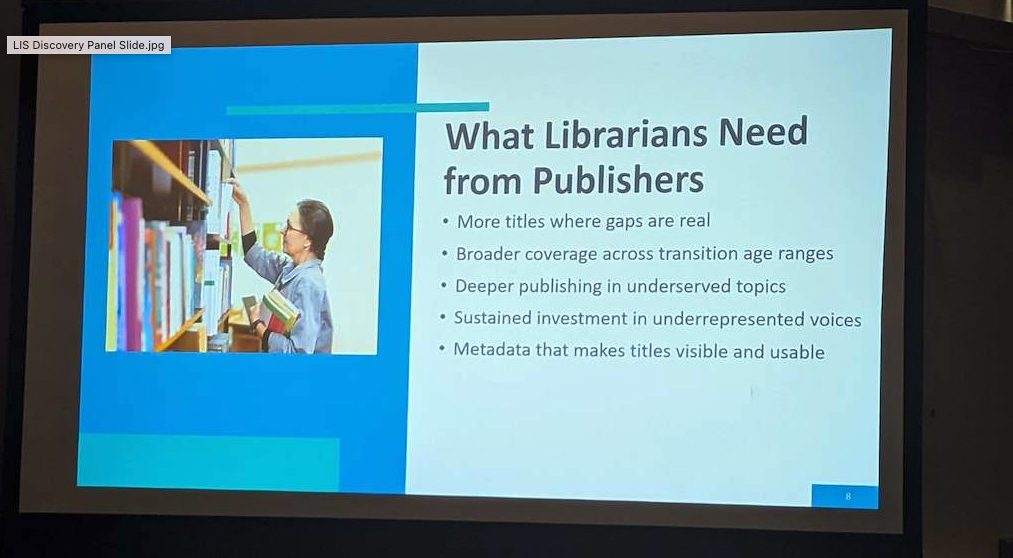
Christina Chatel, a school library media specialist from Michigan and co-founder of Young Teen Lit, championed the need for stories featuring characters in their early teens (14-16) as an alternative to Young Adult novels that have steadily aged up over the years, often featuring 19- and 20-year-old main characters and increasingly written for adults. Her advice: shorter lengths (180-300 pages), no cartoon covers, and a clarification that it’s a very different market from Hi/Lo readers.
Dr. Corinthia Price, a school librarian in New York and president of the International Association of School Librarianship, focused on quality nonfiction for emerging readers (PreK-2) with simple text and realistic pictures, as well as shorter picture books that can be read aloud in one storytime session. She spotlighted the Meg and Greg series by Elspeth & Rowena Rae and Elisa Gutiérrez as a good example of the latter.
Stephen Sposato, collection development manager at Chicago Public Library, agreed with their observations for younger readers, while adding that older adults represent another underserved audience, calling for genres beyond mysteries that feature older protagonists.
Lehue, a librarian herself who is passionate about metadata, had a handout for attendees that included a list of other gaps Ingram has identified, including modern Indigenous stories that don’t focus on generational trauma; simultaneous Spanish/English publication; and large print for adults.
During the Q&A period, Teri Rider, CEO and acquisitions manager for Torchflame Books, noted that they’ve had success with the latter after it was identified as an opportunity at a previous Summit.
Identifying and filling gaps still requires good metadata for those titles to be discoverable to library selectors and readers, Lehue noted, though good metadata alone isn't enough. “BISAC can’t do it all,” LeHue warned, also cautioning against the use of AI tools that claim to automate the creation of descriptions and author bios, especially when dealing with underserved categories and readers. “AI is not good at that. You need to go back and fill in specific details.”
AI, Of Course…
Artificial Intelligence is an unavoidable topic in the publishing industry these days, (albeit too often without any useful specificity) and, not surprisingly, it was the focus of two of the Summit’s morning breakout sessions.
“One of my favorite moments came at the end of a provocative discussion about artificial intelligence [during the session ‘AI in the Stacks and the Supply Chain: What’s at Stake for Libraries and Publishers’], when a young publishing professional asked, ‘Why are we even bothering? My friends and I don't use it, and don't plan to.’ I thought it took courage to say that aloud," Sutherland told Words & Money. “It interrupted some of the hand-wringing that can surround AI in publishing and challenged everyone in the room to think more clearly about what problems we are actually trying to solve.”
A panel titled “Misinformation, Metrics, and Meaning: Measuring Trust in the System” identified a very specific problem: the amplification of AI-generated summaries as bad actors learn how to game the various tools that generate them and the platforms that center them.
Dr. Jodi Schneider, associate professor at University of Wisconsin-Madison, referenced the “onslaught of crap” libraries are dealing with thanks to a surge of artificially generated content, suggesting that librarians have to be more aggressive when curating their collections—a manual process that's difficult to scale.
On the academic side, Qiana Johnson, associate dean of libraries, collections and content strategies at Dartmouth Libraries, spotlighted an acute need for better curation of open access resources, and called for publishers and vendors to offer more transparency for the origination of the content they make available to libraries, including AI disclosures and peer review processes.
“Interoperatability happens because we have standards,” said Todd Carpenter, executive director of NISO, which has a number of relevant initiatives to support good scholarship, information literacy, and credibility via metadata, including the Communication of Retractions, Removals, and Expressions of Concern (CREC) Recommended Practice.
Schneider summed things up best, similar to Lehue’s comments on the limitations of metadata: “It doesn’t matter how many flags you have if you’re not reviewing the content,” she pointed out.
Convene. Collaborate. Communicate.
Meanwhile, one of the long-standing challenges facing publishers and libraries is a general lack of understanding about how things work in other parts of the supply chain—including the fact that there’s no monolithic definition that captures the full range of the labels “publishers” and “libraries”.
What works for the Big Five is often very different for, and unavailable to, smaller publishers, while the Chicago Public Library’s needs are very different from rural libraries in Florida or Texas. And while school and academic libraries have unique and occasionally overlapping concerns of their own, these are rarely reflected in general “library” conversations.
Fleck-Nisbet said that “discoverability and lack of education on how the library supply chain really works” stand as the biggest challenges for smaller publishers and indie authors, and called for library vendors to offer more support. “[They can] provide education on their platforms including how books need to be priced and how metadata needs to be optimized to effectively reach librarians and influence their buying decisions,” she pointed out.
Belan agreed. “The industry needs to grapple with this new universe in which a supply chain built to work with a relative handful of publishers must support 3.5 million new independent titles a year,” she said. “That’s BISG’s job—convening the industry to meet new opportunities and overcome challenges."
Reflecting on the event afterwards, Sutherland spotlighted the combination of speakers and attendees themselves as a highlight of the Summit.
“The mix is important to us," Sutherland said. "LIS is most valuable when people who occupy different parts of the book and library ecosystem are able to hear directly from one another rather than discussing each other from separate rooms.”
Among the publishing industry’s various challenges, Michael Cairns recently suggested that the alphabet soup of organizations serving overlapping segments of the supply chain was one worth examining. On first glance, his suggestions seem logical—until you dig into the specific missions and audiences of each organization and realize that overlap doesn’t necessarily mean redundancy. The Summit offered a glimpse of an alternative solution: better collaboration, rather than consolidation; proactive communication, rather than conflict.
The Library Insights Summit will return next year, set to convene on June 25, 2027, ahead of the ALA’s Annual Conference in New Orleans. And once again, Foreword Reviews plans to partner with IBPA, BISG, and NISO to develop an inclusive program that aims to move the conversation between publishers and libraries forward in a positive, productive direction.