Author and school librarian Kalyn Gensic writes about the power of stories—and why we must resist the efforts of those who seek to ban them.
Like all public school employees, I revel in summers. The sleeping in, the quiet, the freedom to indulge in hobbies well past bedtime. However, I don’t always start my summers well, and this was especially true this June after a challenging school year.
I am a school librarian and a writer, which means I have gone out of my way to avoid speaking out loud. Yet, this past school year, I became a regular speaker at school board meetings when the Taylor County chapter of Moms for Liberty decided to use these meetings as a staging ground for their efforts to remove dozens of books from the shelves of my high school library.
 Kalyn Gensic
A few days after the final day of school, the stress I hadn’t had the time or energy to process caught up and body-slammed me.
My husband was the lucky recipient as I sobbed and said that maybe I actually hated the job I was pretty sure I loved, and I didn’t know if I could keep being a librarian because Moms for Liberty is a bunch of meanies. But also, I felt purposeless after three days without work, and why had I launched a book the second week of summer? What was I thinking? What kind of hobby was writing romance novels, anyway? Also, had he ever noticed that my arms are flabby and stupid?
My husband has a heavy burden to bear.
But in all seriousness, being a librarian is hard right now. We are unwilling pawns in a culture war. And being a writer is always hard. There is a vulnerability to sharing what one has spent months or years crafting only to face readers who might give it one star because the cover was bent upon arrival.
What has crystallized for me over the past year is that stories, both the ones lived and the ones imagined, are worth all of the fight, the pain, the imposter’s syndrome. And in fact, if stories weren’t worth all of this, people wouldn’t call for their banning or break out in a cold sweat the moments before pushing “publish” at the bottom of a KDP screen. The very fact of the discomfort is a testament to their power.
Like many writers, I learned the importance of stories from my father. John Pierce is seventy-four years old, born smack-dab in the middle of the Baby Boomer years. He can catalog every failure by the government during the Vietnam War, and his litany of complaints about trickle-down economics is extensive and well-earned. He can tell you exactly where he was for the moon landing, when JFK died, when the Challenger exploded, and on 9/11. I remember him watching the news every single night of OJ Simpson’s trial. In other words, he is a man of his time.
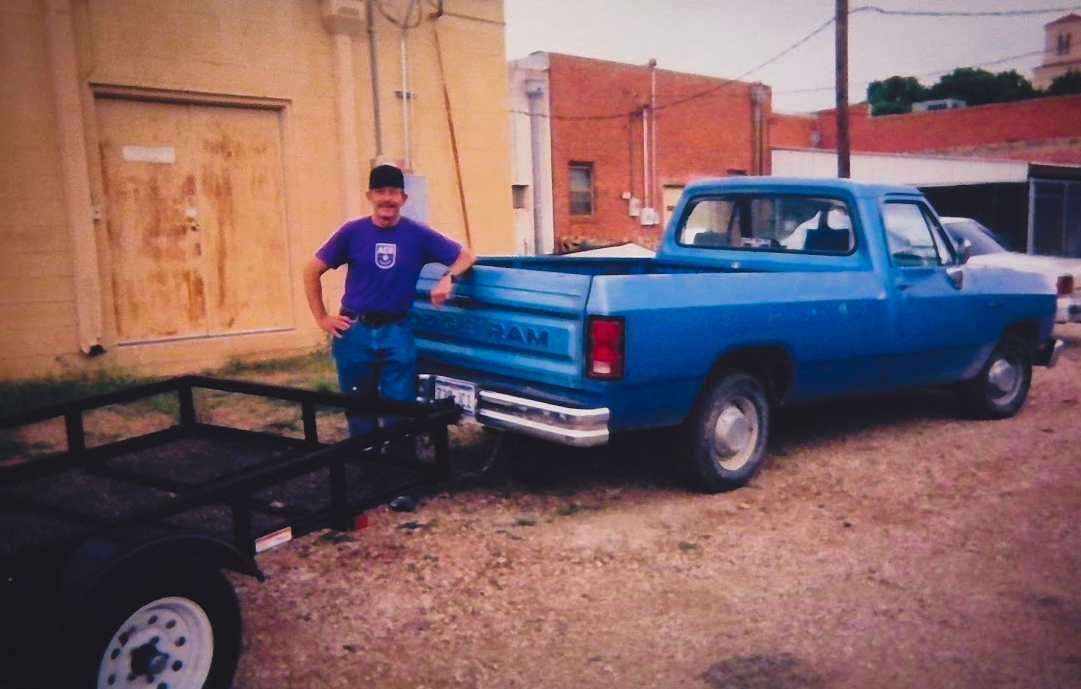
And it has not always been an easy time. I was in middle school the first time he was hospitalized for heart issues, issues he has now battled for decades. For our family, the knowledge that he won’t always be here has been more present than is usual or comfortable. The unexpected upside of these hours spent in hospital rooms is that I’m acutely aware of everything about him for which I am grateful, and I take none of those things for granted.
I love so many things about him. His softness, how quirky he is. The saw-dusty smell of his truck. But what I love most is his stories. And he has one for every conceivable occasion. No event comes and goes without sparking the memory of a story from his life, or from the life of Menard, Texas, a small, Hill Country town where he was born and raised and has lived his whole life. And all of the stories follow the same basic formula.
They start with what car he was driving when the events took place. “It was when I had the orange ‘67 Dodge Dart. I wish I’d never sold that thing.” He then identifies the characters, usually either members of our redneck family or a few of the colorful characters that make the citizenry of Menard County.
Just as the listener is getting a sense of the story—how it connects to the conversation and where it fits into his life—he makes his way to the climax and conclusion. This is the part where someone dies.
There are no happy endings in John Pierce’s stories. Someone always dies. Or, if no one dies, at the very least, they lose a limb.
Let me take a moment to offer assurances. This is not the reason for my above-mentioned neurosis. That is all genetics. No, Dad’s stories weren’t traumatizing. They were what kept life interesting in the 90s before there was an endless supply of Labrador puppy videos.
Even though there were no happy endings, there was always laughter at the absurdities of life and the people living it. Or a fascinating disbelief that is the same reason one walks into a Ripley’s Believe It or Not. There was often romance and intrigue and mystery. Not mystery about the facts of the ending. Someone was going to die. But you didn’t know who, and that was thrilling.
Through my dad’s story, Menard became more than the struggling, poor town with nothing going for it. It was a treasure trove of interesting people and shocking events. Even today, when I drive down Highway 83 as it dips into the valley of Menard, I feel like I’m slipping into a good book. Or, if not a good book, at least one that won’t put me to sleep.
'The Laughing and Loving and Growing...'
I started telling my own stories in the third grade, when I discovered I had a knack for writing after winning my first Ready Writing competition. The prompt was to write about my hero, and I waxed poetic for three pages on Elvis Presley.
I never stopped writing after that point, competing throughout school until I was State Champion of Ready Writing in high school. In college, I added a minor in Creative Writing to my BA in Art, forever and always a pragmatist.

This year, my husband and I celebrated 20 years of marriage, which means we married at the front end of the blogging era. I was twenty-one, lacking a fully-developed prefrontal lobe and any real filter to speak of, and I blogged those early years of marriage candidly and hilariously. I’m both glad the record of our early years exists, and not keen for my kids to find it.
Several years into our marriage, we started having children, one right after the other. Four kids in seven years, and no time or money or knowledge to know how to treat the post-partum anxiety that grew exponentially with each birth.
So, like the lover of stories I am, I read tropey mystery and romance novels end to end, allowing the neat conclusions to offer some relief until treatment could come. And, of course, I wrote. I wrote about faith and family for several publications in Oklahoma where we lived during those years. Each time I saw my writing in print, I was reminded that the world was a little bigger than my anxiety kept telling me it was.
Then we moved to Abilene, Texas, where I discovered the wonders of anxiety medication, and therapy. These were all very good things. But I did lose something in the move. I lost the publications I had been writing for in Oklahoma. I lost my readers.
But I wasn’t going to quit writing. You can only hold your breath for so long.
So I took that restless energy, and I channeled it into a novel, For the Love of Mark Twain. And I made the novel into a series. In a few weeks, I will finish the rough draft of the fourth and final book in this series. I will be proud and excited and relieved and a little bit devastated. I’m going to miss this world I’ve created.
Four years ago this month, I became a librarian. In the job interview, I was asked what stories mean to me. It is the only time I have ever teared up in an interview. After all, reading and writing have been the constant through every part of my life, sometimes offering leisure, and sometimes being my lifeline. It seems only natural that I spend my days peddling stories to people.
And as I said earlier, I have met resistance in this job. At one point this past school year, someone stood up at a school board meeting and said that the mental health crisis in teens is because of the books in our libraries. No mention of the phones or social media or isolation. It’s the books. It’s the stories causing society’s problems.
If we follow this argument to its logical conclusion, it tells writers we must get smaller, like a hedgehog curling tighter and tighter. Our stories must stay light, but also, have a clear, moral lesson at the end. We mustn’t use gray, much less any actual colors. Only black and white for us. Don’t let our characters talk or act like real people. Have them talk how people should talk. Get smaller. Smaller. Smaller. Until everyone feels safe.
They say it’s protective. I say it’s cynical.
If humans can only handle the literary version of milk-toast, how in the world are any of us supposed to handle real life? But we do. The characters—the real-life people—who populate my dad’s stories are part of the vibrant life of my hometown and my family. Yes, the endings can be grim. But no one does gallows humor like my family. And what’s more hopeful than that? The laughing and loving and growing, even when life has dealt you a sorry hand?
'At Least No One Died...'
I like to think that my family’s penchant for storytelling is being passed down to my children, and I know that we are building our own canon as they grow. A favorite we tell is the story of my daughter Lydia’s very first piano recital.
It was December 2021, back when I was driving a 2004 white Chevy suburban, one of the only vehicles that will fit how many children I have. Our house was covered in Christmas decorations, and my children were counting down the days until they could tear into their presents. Lydia was nine years old and had just completed her first five months of piano lessons.
During the final week before the Christmas recital, the piano teacher pulled the newbie parents aside to deliver a lecture I’m sure she has been giving for decades. We were each told to not under any circumstance ask our little performers if they were nervous. We were not to mention the possibility that performing in public might be nerve-wracking. We were to act as if a recital was no big deal, no problem. So I did as I was told, and for good measure, I called every grandparent, aunt, uncle, and friend who might see her before or during the recital, and I delivered these same instructions to them.
When the morning of the recital dawned, our family sat around the breakfast table trying to play it cool. Unfortunately, Lydia didn’t look so good. She was picking at her food and a little pale, so I carefully worded a question so that I could check on her without breaking any of the rules: “Sweetie, how ya’ doin’ this morning?”
And she said, “One time, Pap told me a story.”
Pap is what my children call my dad. And to add context, he majored in piano in college, so the man has some recital stories.
Knowing the gravity of the situation, I asked, “Yeah? What story did Pap tell you?”
Shivering, Lydia said, “When Pap was in college, one of his classmates had a recital, and halfway through her song, she completely went blank and forgot everything she’d ever been taught about the piano, and she ended up having to quit college, and it ruined her whole life.”
My first thought was, at least no one died.
And my second thought was that telling my father these rules on the week of the recital was far, far too late. We should have told him right after she was born.
I’m happy to say that Lydia did quite well in her first recital as well as all the ones since. And as much as I wished at the time that my dad hadn’t shared his fun anecdote, I’ve come to appreciate it. After all, it has given my family a really great story to tell and retell every time we drive to a recital.
Meanwhile, the book banning movement continues to grow in America, with reports this past month that groups are still organizing to coordinate book challenges across the nation. I hope writers will resist these calls to make themselves smaller. I hope they will continue to engage in the subversive act of writing the stories they feel called to tell, whether they are as light as cotton candy or as bleak as my father’s tales.
And I have every confidence that my fellow librarians will continue to make room on their shelves for stories as rich and varied as our readers.
Librarian by day and crafter of cozy rom-coms by night, author Kalyn Gensic lives surrounded by stories. She resides in Texas with her charmingly grumpy husband, four precocious children, and two dogs who shed quite a lot of fur.