As Summary Judgement Decision Looms, Copyright Infringement Lawsuit Against OpenAI Draws More than 50 (Very Illuminating) Amicus Briefs
The briefs provide an outstanding resource for understanding the fault lines in the what has become perhaps the most closely watched AI lawsuit in the world, and more importantly, a cogent primer on what's at stake in our AI future.

It’s one of the most important—if not the most important—copyright infringement lawsuits currently pending in AI world: the case—In re OpenAI Copyright Infringement Litigation—consolidates more than a dozen major AI lawsuits, including cases filed by the U.S.-based Authors Guild, and several news organizations, including the New York Times. And in case you needed further evidence of its importance, the court overseeing the case received an astonishing 51 amicus briefs by the October 30 deadline, including briefs from publisher and author associations, individual creators and journalists, copyright scholars, tech groups, and even some U.S. legislators.
Amicus briefs are a popular tool in U.S. law that allows various parties, with permission from the court, to weigh in on litigation to which they are not party to.
In cross-motions for summary judgment filed last month the parties presented some (by now) familiar arguments: the plaintiffs argue that OpenAI committed copyright infringement in copying works to train its models (including from pirated sources), and that the company’s AI outputs can also be infringing. In their filings, defendant OpenAI attorneys counter that its copying for training qualifies as fair use, and also that its outputs are not infringing.
A final round of briefs is due to be filed on November 6, after which oral arguments will be set before judge Sidney H. Stein.
 Andrew Richard Albanese
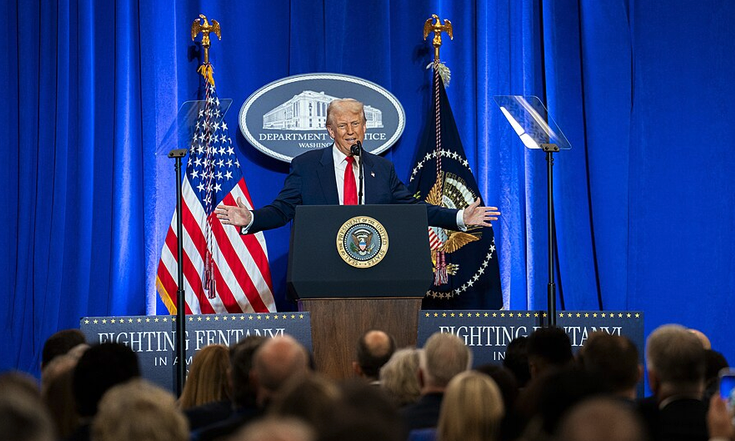
Already, the case has generated several significant headlines—most notably, the U.S. Department of Justice on September 4 filed a “Statement of Interest,” urging the court to find that the use of copyrighted works for AI training to be fair use. And in October, judge Stein struck from the evidence a study that suggested AI books were displacing human-written works, after OpenAI attorneys argued that the author failed to disclose a conflict over funding (note: the author denies the conflict, but the plaintiffs did not oppose OpenAI’s motion to strike).
Now, judge Stein has the opinions of 51 amicus briefs which highlight a wide array of opinions on our AI future. Fully half of the briefs (26) support the plaintiffs; 18 briefs support the defendants; and eight briefs are neutral.
 Name
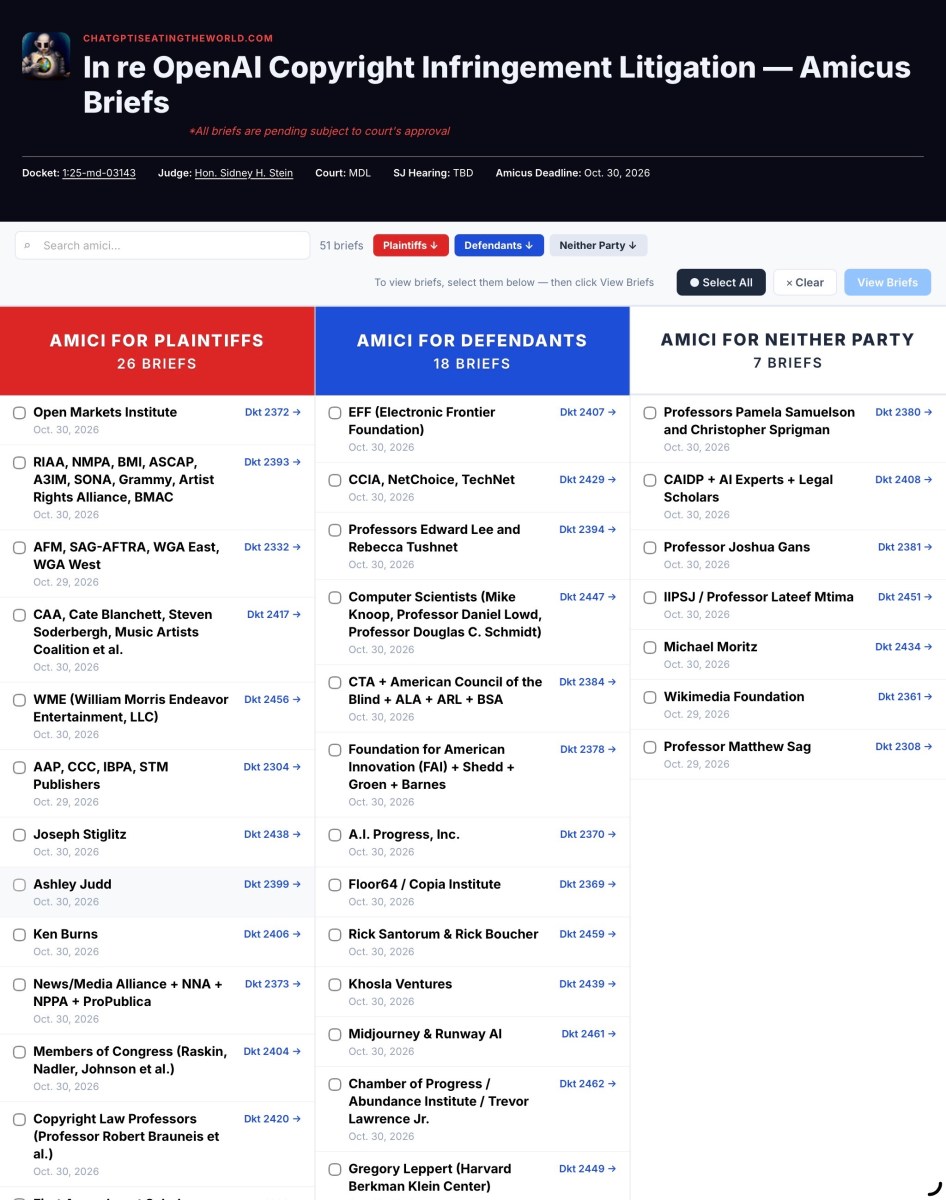
Over at ChatGPT is Eating the World, lawyer and blogger Edward Lee (who filed an amicus brief of his own with copyright scholar and author Rebecca Tushnet) has conveniently collected all the briefs on a handy reference page. And I’ve read them all so you don’t have to. However, below I’ve collected a sampling of 16 briefs you absolutely should read, briefs that point to both the fault lines in the case at hand, but more importantly, to the importance of this case to our AI future.
Amicus Briefs In Support of the Plaintiffs
Association of American Publishers, CCC, IBPA, STM Publishers: “the goals of copyright are undermined when fair use is applied to authorize the uncompensated appropriation of the creative labor of thousands, if not millions, of copyright owners where licensing is practical, beneficial, and commercially reasonable. Overly expansive interpretations of fair use displace the market mechanisms Congress established, replacing negotiated exchange with uncompensated use, and transferring value from the authors and publishers that invest in them to industries that neither incurred the costs nor assumed the risks of producing the underlying works.”
Copyright Alliance: “While Defendants claim that Google Books “compels” a finding of fair use in this case, it is distinguishable because it involved a completely different purpose for the use of the copyrighted materials—to provide information location services to drive readers to the relevant source material… By contrast, Defendants cannibalize Plaintiffs’ copyrighted works for the purpose of allowing its users to generate the same type of works and thus is much more likely to usurp the market for (and obviate any need to consume) Plaintiffs’ works.”
Authors, Photographers, Playwrights, and Literary Translators: “The fair use doctrine carves out a limited exception that allows certain uses of copyrighted works if such uses do not interfere with the owner’s ability to exploit the work. Applying the exception here would swamp the market for creative works and threaten the livelihoods of creators. Artificial intelligence models can create works that substitute for human-authored works in seconds, for pennies, around the clock. To develop these models, Defendants systematically looted millions of works of authorship and exploited their creative expression, without permission from or compensation to creators, knowing that they would destroy creators’ professions. The fair use doctrine does not justify this conduct.”
Ken Burns: “Recently, Burns has learned that several large language models (LLMs), including Defendants’, have copied and ingested dozens (if not all) of his film’s transcripts and perhaps other copyrighted material that he owns or controls, including companion books to the films, without his permission. These works are now being regurgitated by the LLMs in response to queries from copycat filmmakers, who are using the outputs to produce competing films, of inferior quality, at far lower cost. The result is a vicious downward spiral, which is already having deleterious, downstream effects on Burns’s work: as research becomes less expensive (thanks to Burns’s enormous upfront investment of time and resources) nonfiction film budgets decrease; as budgets decrease, quality suffers; as quality suffers, the public’s trust and interest in historical documentaries erodes; and, as audiences dwindle, budgets sink even further.”
WME (William Morris Endeavor Entertainment): "WME thus comes to this case not as an opponent of AI but as a participant in the licensing market for creative works, on behalf of clients who already profit from AI when it is licensed. And WME is uniquely positioned to describe that market. As an agency, it works with all sides of it: the authors, artists, and performers whose copyrighted work AI systems use, the studios, brands, and technology companies that seek to license that work and incorporate it into their AI models, products, and services... WME’s position is therefore not that AI use of creative materials should be stopped, but that it should be licensed.”
Members of Congress in Response to the Statement of Interest of the United States: “The DOJ has injected its views in this case in a manner that runs contrary to its standard practice under this Administration and prior Administrations, without input from the federal bodies that possess actual expertise in the subject at hand. The Statement is breathtaking in its scope. Rather than specifying any particular copyright claim or even type of claim that might be a national security concern, or for that matter any particular type of security threat, the Statement proposes what is in effect a blanket exemption that would, if adopted, preclude every copyright claim that might fall within the nearly unbounded ambit of ‘training LLMs.’ That is not a specific, tailored exception to copyright law. It’s a bulldozer that would eliminate copyright protection with respect to AI training for all works in all circumstances.”
PEN America, Protect Democracy Project, RSF USA: “Since the Founding, press freedom and copyright law have worked in tandem to support republican self-government. Defendants’ legal arguments would invert this relationship, jeopardizing the economic viability of the news media under the banner of fair use… In prohibiting Defendants from freeriding off the work of storied journalistic institutions, a decision for the News Plaintiffs would preserve financial remuneration for the press, sustain the press’s ongoing viability as a newsgathering proxy for the public, and reaffirm the contemporary relevance of bedrock constitutional principles.”
Briefs In Support of Defendants
Authors Alliance: “This brief addresses only one issue: whether so-called ‘market dilution’ is a cognizable form of harm under [The Copyright Act]. By ‘market dilution’ we mean the theory, first articulated by a court in Kadrey v. Meta Platforms, that copying works (in this case, to train an AI model) weighs against fair use because that copying helps enable the generation of new works that compete with the originals, ‘even if those works aren’t themselves infringing.’ Market dilution departs radically from the settled structure of copyright law, which deliberately limits what is protectable so that ideas, facts, genres, and the other building blocks of expression remain free for every author to use… A theory that counts the creation of new, non-infringing works as a harm to be weighed against fair use would discourage the very abundance of expression copyright exists to promote.”
Kevin Kelly: “A ruling for Plaintiffs on fair use would therefore grant Plaintiffs far more than the limited monopoly to their original expression Congress intended to confer. It would hinder the development of technologies capable of disseminating previously unimaginable quantities of information. It would also impede new modes of thought and the creation of new original works in both the arts and sciences… Based on his lifelong pursuits of writing, the protections afforded to copyright owners are important to Mr. Kelly. Equally vital is preserving room for permissible uses of copyrighted material and the growth of transformative technologies. Otherwise, copyright will stifle the very creativity, innovation, and spread of knowledge it exists to encourage. The fair-use doctrine is critical to ensuring that balance.”
EFF: "The Constitution gives Congress the role of adjusting copyright law to address new technologies, including deciding whether those significant changes are needed at all. Congress may not move quickly, but that legislative lag can be beneficial when it comes to adapting copyright to new technologies… AI tools are developing rapidly, and it is not yet clear what new regulations may be needed, and even less clear that copyright is the appropriate regulatory terrain. In the meantime, this Court should apply well-established copyright precedents that, construed in light of copyright’s purpose to promote progress of science and culture, favor fair use here.”
Professors Edward Lee and Rebecca Tushnet: “Plaintiffs’ unprecedented theory of ‘dilution’ turns copyright on its head: genres and facts are uncopyrightable…. In more than 200 years of copyright law, dilution is ‘without any precedent and is an erroneous position given it is not only contrary to the statute but is not based on ‘any infringement at the output stage.’ And penalizing as “dilution” the non-infringing works only of people who used AI—but no one else—violates the First Amendment as impermissible content and speaker-based discrimination. The law cannot ‘target one kind of speaker’—here, creators who use AI to create noninfringing works—'while allowing others to speak without restriction.’”
Gregory Leppert (Harvard Berkman Klein Center): “A robust ecosystem of general-purpose models is thus integral to libraries’ needs; limiting model training to a subset of materials—curated perhaps by cost, or commercial importance, or the practical availability of a licensing contract—would reduce the effectiveness of those models in preserving and making available materials outside of that distribution. Stretches of our shared cultural history could appear as dark ages in the computationally accessible historic record, excluded from the accessibility advancements and connected knowledge fabric that AI models enable… Providing Plaintiffs the absolute control they seek would serve to ‘limit, rather than expand, public knowledge.’”
Public Knowledge: “For years, publishers have been adapting to the changing demands of the digital landscape, including the rise of powerful tech gatekeepers. Many publishers have even shut down, been acquired, or merged with other entities—which raises its own concerns about media concentration and the loss of independent voices. Concerns that AI could deepen those dependencies, or further industry consolidation, deserve serious attention as a matter of public policy. But copyright is not a general remedy for technological disruption or a means for reallocating the gains from a new technology. Preserving a robust understanding of fair use is itself part of protecting the public’s ability to benefit from new technology and ensuring a healthy information ecosystem. A finding that model training is not fair use, by contrast, could favor the largest technology and media companies… As the United States explains, ‘only the largest technology companies might have the capital necessary to pay licensing fees,’ while ‘such licensing fees would disproportionately benefit legacy media outlets.’”
Briefs Taking a Neutral Position
Professors Pamela Samuelson and Christopher Sprigman: “Even if empirical evidence eventually shows that some markets or market segments are being diluted in ways that undermine authorial incentives, such harms would most likely affect all authors who participate in those markets or market segments, and not just plaintiffs in individual infringement cases. Moreover, such harms would be caused not by any one developer of generative AI who might be a defendant in an infringement lawsuit but by all developers whose models were being used to create new works. Because collective harms require collective solutions, the appropriate venue for addressing market displacement caused by generative AI––assuming it is occurring—is Congress, not courts.”
Wikimedia Foundation: “Sustained increases in non-human traffic from scraping and crawling impact Wikimedia’s ability to keep Wikimedia sites online for human readers… Without the backing of enforceable copyright, web publishers will be pushed to put up more walls against bad actors, leading to a more closed internet for people… Wikimedia is concerned that the parties’ positions in this case push for overbroad and simplified applications of the fair-use doctrine to uses of copyrighted works throughout AI chatbots’ development. Fair use should not be interpreted in a manner that would gatekeep all uses of copied works under proprietary terms to the detriment of efficient innovation. Neither should fair use doctrine serve as a green light to snub licensing terms and fragment the flow of knowledge between human authors and audiences. In the interest of promoting open access to knowledge, Wikimedia urges the Court to adopt a sharper and more nuanced application of the fair use doctrine than the parties in this case are seeking.”
Professor Matthew Sag: “Even if this Court determined that plaintiffs should be entitled to license the defendants’ highly transformative use, it would have to contend with the impossibility of such a market forming. The problem in a nutshell is that although training data is valuable in aggregate, the marginal contribution of any individual piece of training data, whether a book or a social media post, is approximately zero. No amount of magical thinking will establish a market mechanism under which defendants could transact with hundreds of millions or billions of rights holders. As such, rights clearance at internet scale is not merely difficult, challenging, expensive, it is literally impossible.”
“Copyright owners have no right to charge for transformative uses, but they do have a right to charge for access to their works. A commercial user that bypasses the market for access without a compelling reason arguably undermines the economic incentives that copyright is designed to create. That, rather than any theory of separate uses, is the core of Judge Alsup’s objection in Bartz … This is not a clean-hands requirement. Fair use does not categorically require that the defendant begin with an authorized copy… It would be unwise to elevate lawful access to a per se rule, however, even for commercial defendants. The relevant question is whether, by obtaining books as it did, OpenAI bypassed a market for access that was actually available to it in a way that was likely to cause harm. A defendant cannot be faulted for bypassing a market that did not exist. But the Court will have to decide whether buying and scanning print copies was a reasonable alternative in all the circumstances.”