The 'Darn Unusual' Legal Filing That Could Alter the AI Landscape, and Bolster Fair Use
In a 20-page 'Statement of Interest," lawyers for the U.S. Department of Justice told the judge presiding over a closely-watched lawsuit that requiring "paid licensing" would "put U.S. AI companies at a competitive disadvantage."

In a remarkable—and highly unusual—legal intervention, the U.S. Department of Justice this week filed a “Statement of Interest” in a closely-watched copyright infringement case filed by the New York Times against Open AI, urging the court to find that the use of copyrighted works for AI training is fair use, and rejecting the “market dilution” claims at the heart of two recently filed lawsuits filed by book publishers.

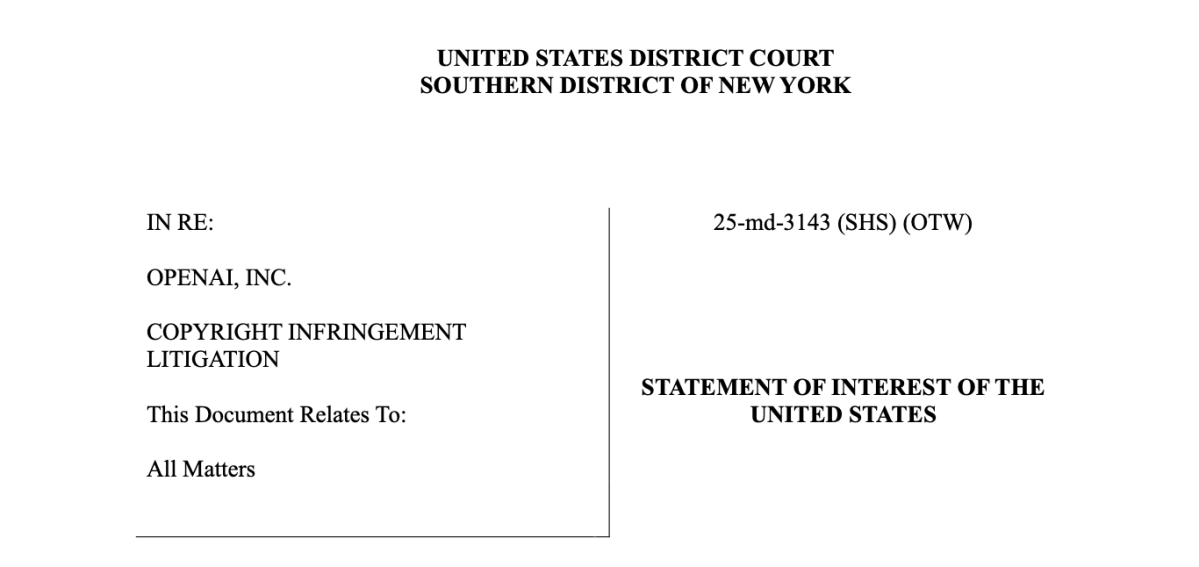
In a 20-page filing, lawyers for the U.S. Department of Justice told presiding judge Sidney Stein that the United States has “a strong interest in continuing to develop a robust and competitive artificial intelligence industry,” and that constraining the development of large language models “under a misunderstanding of fair use” would thwart “creative and scientific progress while hindering American prosperity and economic mobility.”
The filing comes as dueling motions for summary judgment in the case are due to be filed by today, September 4.
In their brief, DOJ lawyers argue that AI training is highly transformative, and that an adverse fair use ruling “would hamper competition in the market for LLMs,” because only the largest technology companies are likely to have the necessary capital to pay licensing fees.
“It is not in the public’s interest for the largest technology companies to have an oligopoly on LLM training due to licensing entry barriers that function primarily as large subsidies for old mainstream media,” the brief states. “By contrast, if not hindered by a strained understanding of copyright law, LLMs can and should help level the playing field between mainstream and independent publishers.”
In a footnote, DOJ lawyers took “no position” on whether “a licensing regime” would be “financially or logistically” feasible. But requiring “paid licensing” would “put U.S. AI companies at a competitive disadvantage relative to competitors located in other countries that do not consistently respect U.S. intellectual property law,” the brief concludes.
In addition to arguing that AI training is highly transformative, the brief also rejected the argument that “indirect competition” from AI outputs trained on copyrighted works might constitute infringement—claims that are at the center of two lawsuits lawsuits recently filed by book publishers, one against Google and one against Meta.
This “market dilution” argument was championed by judge Vince Chhabria in his June 2025 decision in Kadrey vs. Meta, who raised the specter of AI works “flooding” the marketplace. But DOJ lawyers called Chhabria’s theory “deeply flawed” and argued that “future outputs” that might cause “market harm” were simply not relevant to the case-by-case fair use analysis that is required by law.
 Andrew Richard Albanese
Notably, the DOJ’s stance diverges from that of the U.S. Register of Copyrights Shira Perlmutter, who the Trump Administration attempted to fire last year. But in a curt footnote, DOJ lawyers said Perlmutter’s “understanding” does not “warrant deference.”
While DOJ lawyers acknowledge that “the fair-use inquiry hinges on the specific facts and uses at issue in each case,” they conclude that it would be “problematic—and legally incorrect—to impose broad copyright liability that would generally render training of AI models impermissible without licensing.”
‘Darn Unusual’
Speaking to reporters at the independent news outlet NOTUS (News of the United States), several fair use advocates said the filing could be a watershed moment for U.S. copyright law.
 Ben T.N. Mause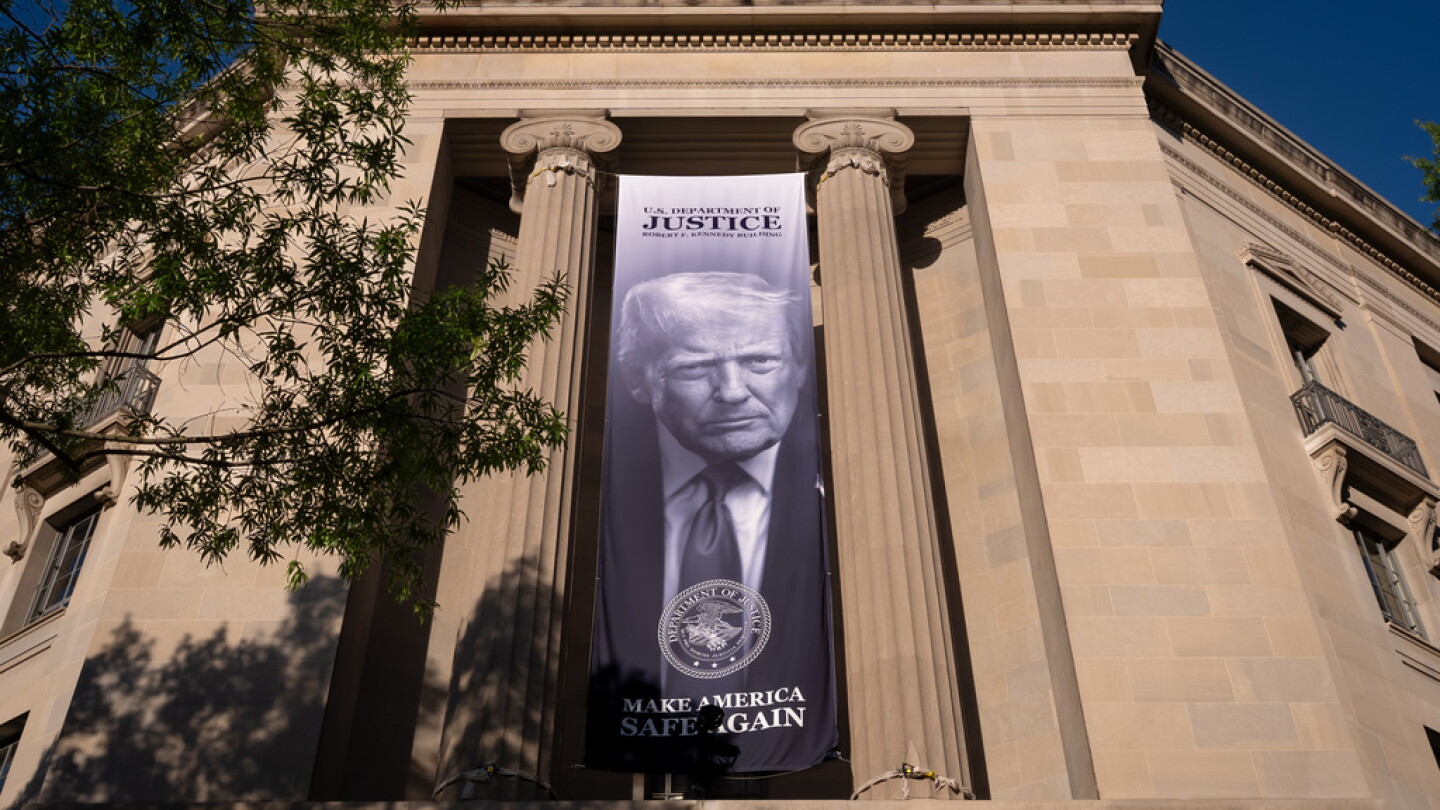
“I can’t remember any other example where the government, in a clear-eyed, full-throated way, made it clear to a court, on purpose, that this is how they felt about fair use,” Adam Eisgrau, senior director of AI, creativity and copyright policy at tech advocacy group Chamber of Progress, told the outlet. “If it’s not unprecedented, it’s darn unusual.”
And while the DOJ has taken a slew of questionable, politically-motivated positions for the Trump administration (to be polite), this filing, copyright lawyers say, is surprisingly well-grounded.
“If Trump changed his mind tomorrow and tried to order OpenAI burned to the ground, would we get a thoughtful brief like this?” Cornell Tech professor James Grimmelmann told Words & Money, suggesting that the DOJ’s “work product” in truly politically-driven cases is typically much lower quality.
“It makes some thoughtful arguments about fair use, which I think are well within the range of expert opinion,” Grimmelmann said. “It’s written in sober prose, cites appropriate cases, and makes a well-structured argument that gives reasons for its conclusions. I agree with some of what’s in there and disagree with some, but on the whole it’s a good piece of advocacy and it was enlightening reading.”
Of course, there is certainly a political element in play here, as the Trump administration has been an unqualified booster of the AI industry, a point made by the New York Times, in their response.
“Graham James, a spokesman for The Times, said in a statement that the Justice Department was siding with a handful of ‘trillion-dollar A.I. companies’ at the expense of American creators,” the Times reports. “The administration’s proposal to let companies take content without permission or compensation would undermine the sustainability of the human-created content that a healthy society depends on, and which A.I. needs to function.”