Publishing Industry ‘Study’ Says Digital Library Lending Is Cannibalizing Retail Sales—Librarians Say It Reveals Something Else
AAP and Authors Guild leaders characterized the study as “independent” and “the most rigorous analysis to date” of the shift toward digital lending in U.S. libraries. Librarians say it is neither.

As library ebook legislation picked up momentum over the last year, library advocates knew something was coming in response from the publishing industry. And sure enough, publishing industry lobbyists kicked their opposition into overdrive with the September 1 release of a 71-page “study” that suggests digital library lending is cannibalizing industry sales.
Commissioned by the Association of American Publishers and the Authors Guild and conducted by Washington D.C.-based Secretariat Advisors—a “global expert witness, litigation consulting, and economic advisory firm”—the study, titled An Empirical Study of the Impact of Library E-Lending on the Book Economy— concludes that “shifts in the library marketplace,” primarily through “frictionless library apps,” have “affected consumer behavior and commercial markets.”
Specifically, the study, which is based “on a model spanning multiple states and years,” purports to show that a shift toward “more digitally intensive library holdings” are “systematically associated with measurable reductions in print sales,” with consumer sales estimated to decline by “approximately 0.85% to 1% for every one-percentage point increase in the share of e-books in public libraries.”
A second prong of the analysis, based on “detailed, title-level data from the Seattle Public Library” and matched with “local physical retail sales” reportedly found “evidence of direct, within-title substitution between library e-lending and retail sales.”
Officials at the Seattle Public Library told Words & Money that their data is open and available to researchers, and that they did not participate in the study.
In fact, SPL director Tom Fay said library officials didn’t even know about the study’s existence until Thursday afternoon (September 3) and that none of the researchers had contacted SPL leadership about the study, either for help understanding the data, or even to just offer a friendly heads-up that their data was being used (which, they noted, is not required).
“We provide this longitudinal data as an open resource to researchers across the world and we honestly want people to use it for study and research. And we are always available to help people better understand the data, because in longitudinal data elements over two decades there's a lot to understand and various anomalies along the way,” Fay told Words & Money. “So, from that standpoint, we would have liked to have had discussions with the people doing the research to help them better understand what they're seeing.”
Having not had a chance to digest the study’s conclusions, SPL officials at press time declined to comment specifically on the study’s findings. [Update: SPL on September 8 offered Words & Money a brief statement on the report: "The study identifies several correlations, but its methods do not demonstrate that an SPL e-book checkout displaced a retail sale. The observed patterns are also consistent with a simpler explanation: readers, libraries and retailers are responding to the same broader shift from print to digital."]
A third analysis in the study, which looked at “nationally bestselling titles,” concluded that library e-lending is not serving as “a channel for discovery” for high-demand titles but is instead “substituting for retail ebook sales.”
Based on its modeling, the study argues that there is no “market failure” that would justify state legislation in the library ebook market, asserting that the pricing and license restrictions that librarians have long warned are unfair and unsustainable are in fact a rational and reasonable response to a shifting marketplace.
In a statement accompanying the release, AAP and Authors Guild leaders made clear that the study was aimed at blunting the current momentum for library ebook legislation.
“It is our view that debates in the states, frequently accompanied by misinformation about law and facts, have not assisted the discussions between licensors and licensees but rather polarized and confused them,” reads a joint statement from AAP President and CEO Maria A. Pallante and Authors Guild CEO Mary Rasenberger. “For state legislatures that seek to intrude into the literary marketplace by singling out e-formats for government mandates, the study addresses the significant economic consequences likely to result from such actions.”
An 'Independent' Study?
The study is the latest salvo from publishing industry groups to push back against bills that seek to address pricing and equity issues in the digital library market.
As Words & Money previously reported, the Authors Guild in June released a consumer survey that also suggested library ebook lending was substituting for retail sales and hurting author incomes.
 Andrew Richard Albanese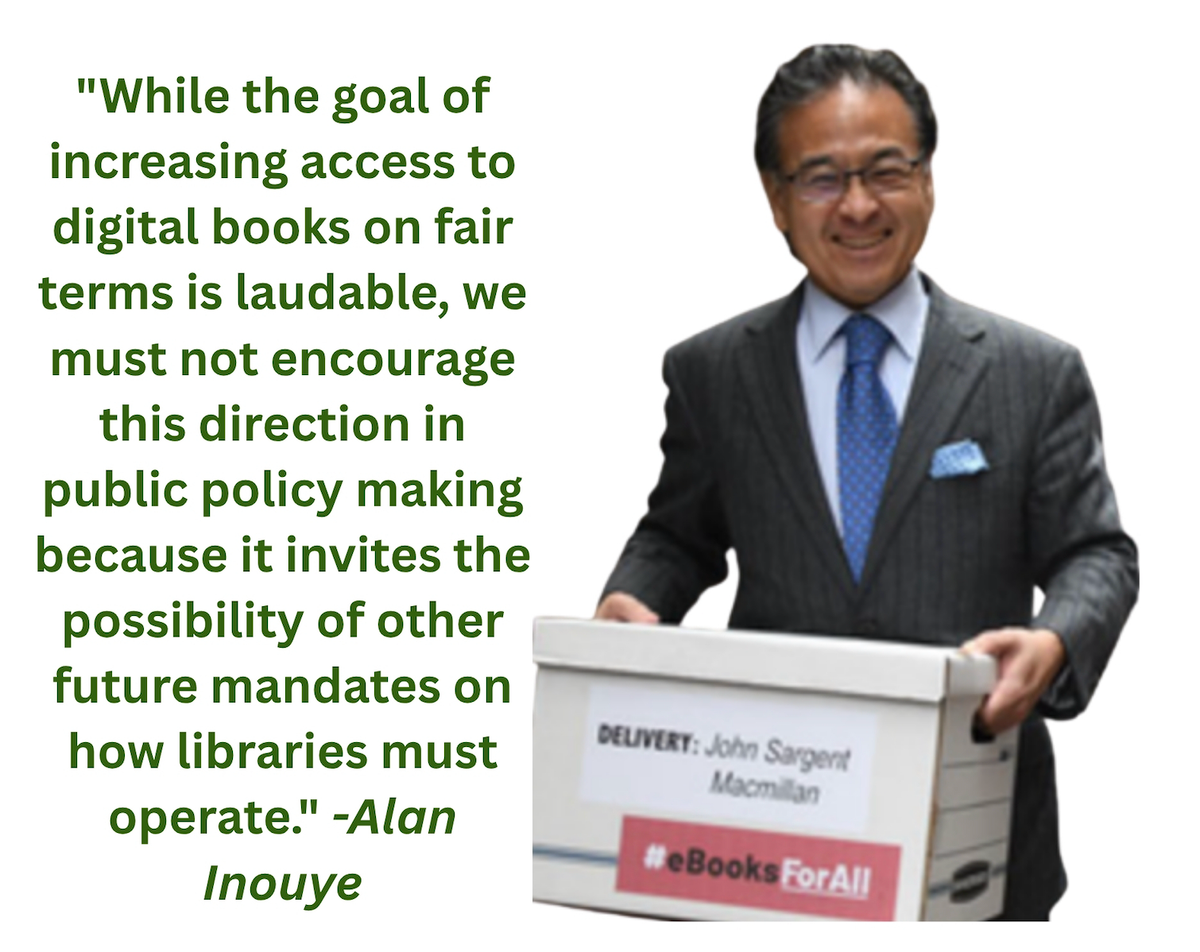
Also in June, Alan S. Inouye, the former head of public policy and advocacy for the American Library Association, published a 9,000 word “policy paper”—underwritten by Big Five publisher Penguin Random House—which argued that more study was needed in the digital library marketplace, and cautioned against state-level library ebook legislation—a sharp reversal of his public testimony while he was at ALA.
But while AAP and Authors Guild leaders characterized the Secretariat study as “independent,” and “the most rigorous analysis to date” of the shift toward digital lending in U.S. libraries, librarians were quick to point out that it’s neither. Asked to respond to the study, multiple observers contacted by Words & Money characterized the study as an obvious lobbying effort.
"This is a limited approach, paid for and designed to oppose potential legislation directly, and without offering a sustainable path forward,” said Angela Goodrich, COO of the Urban Libraries Council, adding that while the report identified “some of the issues” in the digital library market, it was “funded to illustrate one view.”
Kyle Courtney, who helped draft the legislative language now being used in library ebook legislation via the Ebook Study Group, called the study a “calculated escalation” in the publishing industry’s lobbying efforts against such bills. “We recognize this industry-funded study for exactly what it is,” he told Words & Money.
“Secretariat is a legal consulting firm. They're not qualified to do an ‘independent’ analysis of the digital book marketplace,” observed Carmi Parker, ILS Administrator at the Whatcom County (Washington) Library System. “And if this isn't an independent analysis, but part of a legal strategy to stop library ebook legislation, then people of good faith who are interested in truly understanding the digital book marketplace should absolutely ignore it.”
But by Thursday afternoon, several librarians, including Parker, had already begun to point out apparent flaws in the report. In a post on the ReadersFirst website, Parker observed that the IMLS Public Library Survey used by researchers doesn’t account for consortium purchases—which is how many libraries across the nation license access and share digital collections.
 Carmi Parker
For example, as Parker notes, Rhode Island has 49 library systems, all of which participate in the Ocean State Libraries consortium. In the 2023 IMLS data, which the study used, each of the 49 libraries accurately reported to IMLS that its patrons have access to a digital collection of roughly 186,000 items. But that’s a shared collection of 186,000 items serving 49 separate libraries, not 49 library collections of 186,000 items as the study apparently counts. And ebook consortia are the norm in the U.S., she explains. "Every state has at least one consortium. At least eight consortia are run at the state level like Rhode Island," Parker writes, adding that "37 of the 50 states have at least one consortium with more than 20 libraries," and some are much larger.
“Unfortunately for the study's authors, their numerous arguments about the economic impact of library ebooks rests on the claim that 1.5 billion library ebooks were available in 2023,” she writes. But because the data doesn't recognize shared digital collections, that number is clearly, fatally wrong, she concludes, and not by just a few percentage points. “Because this number is wildly inflated, all conclusions they draw about the availability of library ebooks and its impact on the retail market must be summarily rejected.”
More broadly, librarians were also quick to point out that the “study,” while focused around alleged copyright issues with state ebook bills, completely ignores the central issue driving the library community’s push for state level legislation: the outsized power of a handful of major publishers—the so-called Big Five (Hachette, HarperCollins, Macmillan, Penguin Random House, and Simon & Schuster)—whose bestselling books represent the overwhelming majority of the digital demand in libraries, and thus command an outsize portion of library budgets.
 Andrew Richard Albanese
“To the extent that library ebook lending, more so than the lending of physical books, is likely to significantly decrease book sales at least in the short term, economic theory predicts that market forces would account for that in negotiations over the scope and extent of restrictions on library lending of e-books in licensing agreements,” the study asserts at one point. But with the Big Five publishers there is no negotiation with libraries—which feels like a fairly crucial detail for a purported “study” of the digital library market to completely omit, especially considering the Big Five’s well-documented refusal to negotiate with libraries over digital library terms.
For their part, librarians do not dispute that copyright law gives rights holders the power to set license terms. While it's true that the nation's first library ebook law (in Maryland) was struck down in 2022 over a copyright conflict, the reworked ebooks bills now in play squarely focus on regulating libraries, not copyright holders, resting on state procurement laws. "We are protecting the use of state dollars," Courtney stressed to Words & Money, "not preempting the Copyright Act."
Furthermore, librarians readily acknowledge that the vast majority of publishers are working well with libraries, offering fair pricing and terms for digital books.
Rather it is this quirk in the marketplace—the exclusive rights codified in the Copyright Act and the market power of the five largest publishers to charge public institutions non-negotiated high prices and impose more restrictive terms for the most in-demand titles—that has thrown the digital library market out of balance.
 Michael L. Blackwell
As such, asserting that there is no evidence of “market failure” while ignoring the impact of non-negotiable cartel-like pricing, which has empowered a handful of dominant players to charge significantly higher prices and impacted the ability of libraries to create broad, deep, and sustainable collections for their communities—is disingenuous, librarians told Words & Money.
“What struck me is that [the study] looks at the economic impact of library lending on the commercial book market but doesn’t examine the terms of the market that libraries operate in on the buying side,” observes Jennie Pu, director of the Hoboken (New Jersey) Public Library. “I’ve said before that this is a market that was never designed for public institutions at scale. This report proposes to examine one side of that market. But the other side matters, too.”
Furthermore, librarians dismissed the AAP and the Authors Guild's suggestion that more funding for libraries is the answer to tensions in the library ebook market. While librarians certainly agree that they are underfunded and would welcome a meaningful collaboration with publishers to lobby for more funding, without change, the current market dynamic would likely persist.
“Governments at all levels support libraries as well as they can, especially in a time when libraries are in many areas under attack,” notes St. Mary's County (Maryland) Library Director Michael Blackwell, a longtime advocate and organizer of ReadersFirst. “But even if more money was available, would it be a good idea for libraries to shovel it into a trough at which the big publishers are feasting while indie publishers are providing titles at reasonable costs?"
What the Study Does Show
While the study’s analysis is likely to be more heavily scrutinized in the coming weeks, librarians told Words & Money that it does show one thing: the lengths to which the nation’s largest publishers are apparently willing to go to avoid negotiating a sustainable path forward with libraries.
 Ron Charles
Multiple observers told Words & Money that if the major publishers were really interested in understanding the impact of the digital library market on retail sales, they would work more closely with libraries and vendors. Certainly, there is a wealth of data available from which to conduct a meaningful, truly independent study that could positively inform the future for libraries, authors, and publishers. Instead, the publishers have chosen to pay a K Street consultant to devise a self-serving theoretical model.
Indeed, librarians have long insisted that legislation is not a first choice, but a last resort. And they point out that they have been eager to work with the major publishers on a sustainable path forward in the digital library market for more than 15 years, only to be consistently rebuffed. That's the story library advocates will now be taking to legislators, they say, while the major publishers try to sell a 71-page economic regression analysis.
“This flawed so-called study suggests that rather than talk, the Big Five wish to dig in to protect the status quo. I hope that isn’t so,” Blackwell says. “If the Big Five’s digital prices and terms were to become fair, more authors and publishers would benefit, both through library sales and our promotion of titles, not just the relatively few bestselling authors that our collections are reduced to by high costs and quick expiration of licenses. Libraries haven’t put publishers out of business for hundreds of years despite collecting at fair prices. We don't intend to start now.”