Vonnegut Estate, ACLU Sue to Strike Down ‘Unconstitutional’ Utah Book Banning Law
A coalition of plaintiffs, including two unnamed high school students, argue that portions of HB29, Utah's Sensitive Material Review Law, are unconstitutionally overbroad in violation of the First Amendment.

As 2026 gets underway, the battle over the freedom to read is picking up where it left off, with a coalition of plaintiffs this week suing Utah state officials in federal court alleging that a controversial state law has led to more than 20 books so far being unconstitutionally banned from Utah public schools.
Filed on behalf of the Estate of Kurt Vonnegut, authors Elana K. Arnold, Ellen Hopkins, and Amy Reed, and two unnamed Utah public high school students, the suit alleges that H.B. 29, the state’s “Sensitive Materials Law,” is overbroad and in violation of the First and Fourteenth Amendments. Defendants include the Utah State Board of Education, Utah Attorney General Derek Brown, and three individual school districts in the state along with each district’s superintendent.
 Aaron Welcher
Among the remedies, the plaintiffs ask the court to declare the “Per Se and Statewide Bans” enabled by the law to be declared “facially unconstitutional” and to order all books removed under the law “immediately returned” to the shelves.
In 2022, Utah passed H.B. 374, which prohibited books containing “pornographic or indecent content” from K-12 libraries and classroom, and amended and expanded the law's reach with H.B. 29 in 2024. Utah is one of a handful of states to pass state laws in recent years seeking to ban books that contain sexual content, with Utah’s law providing for a mandatory statewide ban if at least three school districts (or two districts and five charter schools) across the state find a book to be inappropriate.
The lawsuit comes as three new titles were added to the list of banned books for 2026—Wicked: The Life and Times of the Wicked Witch of the West, by Gregory Maguire; Nineteen Minutes by Jodi Picoult; and The Perks of Being a Wallflower, by Stephen Chbosky—bringing the total number of books banned under the law to 22.
"No one disputes that pornography and obscene material can and should be excluded from school libraries," the complaint states. "By design, the Per Se and Statewide Bans go further than the Constitution allows. They were drafted to remove books that are not pornographic or obscene under the Miller-for-minors standard, i.e. books that have value as a whole and are constitutionally protected from removal by the First Amendment. These prohibitions sweep away Pulitzer Prize winners, National Book Award finalists, New York Times bestsellers, and critically acclaimed works by branding them ‘indecent’ and ‘pornographic,’ simply because they contain a sexual reference, regardless of context or a book’s value as a whole. As a result, the law makes no distinction between a five-year-old learning to read, and a 17-year-old preparing for college—once a book contains even a fleeting reference to sexual conduct, it must be stripped from every shelf, including the high school library."
The complaint adds that “hundreds” of books have been banned so far from Utah public schools under the law beyond the 22 books that have triggered a statewide ban—including classic works like Kurt Vonnegut’s Slaughterhouse-Five and Toni Morrison’s The Bluest Eye—with many of bans targeting "voices that have historically been silenced, authors of color, women, and LGBTQ+ writers."
In addition to the three books added to the statewide banned list for 2026, titles previously banned statewide under the law include:
- Water for Elephants by Sara Gruen
- Three books by Ellen Hopkins (Tilt, Tricks and Fallout)
- Blankets by Craig Thompson
- Six books by Sarah J. Maas (Empire of Storms; A Court of Thorns and Roses; A Court of Mist and Fury; A Court of Wings and Ruin; A Court of Frost and Starlight; and A Court of Silver Flames)
- Damsel by Elana K. Arnold
- Forever by Judy Blume
- Like a Love Story by Abdi Nazemian
- Living Dead Girl by Elizabeth Scott
- Milk and Honey by Rupi Kaur
- Oryx & Crake by Margaret Atwood
- What Girls Are Made Of by Elana K. Arnold.
- Thirteen Reasons Why by Jay Asher
“In 1975, my father Kurt Vonnegut’s book Slaughterhouse-Five was among eleven books removed from library shelves in a New York school district, leading to a landmark victory in the U.S. Supreme Court case Board of Education, Island Trees School District v. Pico,” said Nanette Vonnegut, daughter of author Kurt Vonnegut, said in a release announcing the suit. "Now, more than half a century later, Utah’s lawmakers’ determination to ban books like Slaughterhouse-Five denies innumerable young people in Utah the freedom to read, think, and grow; it is antithetical to what my father fought for during World War II and focused much of his literary legacy on addressing."
Commenting on the suit, Tom Ford, Staff Attorney at the ACLU of Utah, stressed that “the right to read and the right to free speech” are inseparable. "This law censors constitutionally protected books, silences authors, and denies students access to ideas, in violation of the First Amendment rights of students and authors alike, and must be struck down,” Ford said, in a statement.
The suit is the first suit to be filed in the wake of the Supreme Court’s decision not to review a controversial Fifth Circuit decision in Little v. Llano County, which held three is no First Amendment right to receive information in public libraries, and is one of several lawsuits challenging sweeping book bans in public schools now making its way through the courts.
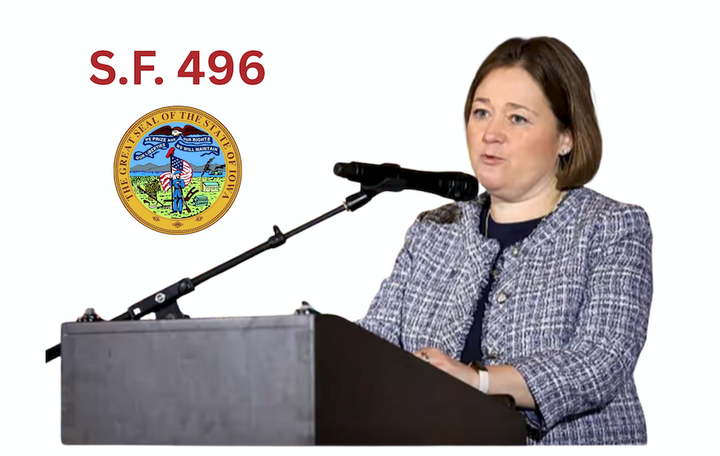
Among the cases also challenging sweeping book bans: In the Eighth Circuit, Penguin Random House v. Robbins, in which a district court found Iowa's sweeping book ban provision in SF 496 to be unconstitutional); in the 10th Circuit, Crookshanks v. Elizabeth School District, in which a lower court found that 19 book removals in a high school were unconstitutional); and in the Eleventh Circuit, Parnell v. School Board of Escambia County (in which a district court, leaning heavily on the Fifth Circuit's Llano decision, agreed there is no First Amendment right to receive information in a school library). In addition, the Ninth Circuit is currently reviewing a challenge of Idaho's recently enacted law HB 710, which requires schools and libraries to remove books vaguely deemed to be “harmful” to minors.
In a post this week on the three new titles banned by Utah, library advocacy group EveryLibrary (which supports the Let Utah Read coalition in the state), posted this week about the danger of H.B. 29.
"When the threshold for statewide censorship is this low, it creates incentives for coordinated campaigns, ideological targeting, and manufactured moral panic," the EveryLibrary's John Chrastka pointed out. "The structure of H.B. 29 enables political actors to game the system and use a few districts to control education for the entire state. When the state replaces professional judgment and parental involvement with political censorship, it does more than remove books. It weakens society itself."