New Jersey's Library Ebook Law Passes Out of Committee
After a quiet summer break, momentum for library ebook legislation picks up again in the Garden State.

It still has a ways to go, but New Jersey's library ebook bill (A4956) took a big step toward passage on October 15, easily passing out of the New Jersey Assembly's Education committee. The vote was 4-1, with one abstention (and one absence).
The passage came after a brief hearing, at which a hired lobbyist for the Association of American Publishers once again attempted to conflate the new library ebook legislation with the 2021 Maryland law that was struck down by a federal judge for conflicting with copyright law.
“Our opposition today is couched very directly in the fact that this bill, as proposed, absolutely violates the federal Copyright Act,” the lobbyist, Rich Van Wagner, told the committee—although he then acknowledged that there are “differences of opinion on that” and promised “a legal opinion from a national law firm” would be coming shortly.
 Andrew Richard Albanese
Van Wagner said publishers value public libraries and “want to be part of the solution,” despite the publishing lobby maintaining on numerous occasions that there is no problem in the marketplace. He also appeared to throw library vendors under the bus, suggesting at one point that any problems that may exist in the digital library market “doesn't have to do with the publishers or the authors,” because license procurement comes through third party platforms.
Notably, at the end of Van Wagner’s remarks, the bill’s sponsor, Assemblywoman Lisa Swain, pushed back against the AAP's copyright claims, pointing out that the current bill is materially different from the Maryland law that was struck down in 2021. “This bill differs because it regulates the contracts libraries sign. It does not force the publishers to offer e-books. That's the difference between the Maryland law and this,” Swain said.
Swain, who characterized the bill as about affordability, fairness, and about good stewardship of taxpayer dollars, added that she was “thrilled” to hear Van Wagner say that publishers want to be "part of the solution." But, she then pointed out that she hasn’t seen any “amendments, suggestions, or anything” from the publishers to improve the bill. “I'm all ears,” she said. “I want to protect our taxpayers with this bill, so I just want to leave that door open for those solutions.”
Van Wagner (who did not sound at all well-versed in the digital library marketplace in his brief testimony) responded that there likely won't be any suggestions to improve the bill coming from the AAP, calling the legislation "an absolute impasse" because it "fails under federal copyright laws."
A 'Historic' Shift
 Andrew Richard Albanese
In their testimony, the librarians testifying for the bill described a marketplace characterized by surging demand, rising costs, and no negotiation over prices and terms. Brett Bonfield, executive director of the New Jersey Library Association, briefly explained how library ebook market is designed to “mirror” the model for physical books, and how the mirror is "broken."
“If libraries want to loan three copies of a physical book at the same time, we have to buy three copies of that book. If we want to loan three copies of an ebook at the same time, we do the same thing. A4956 does not change that. One copy still serves one reader at a time,” Bonfield explained. “The problem is, unlike with physical books, libraries are forced to pay a lot more for each electronic copy of a book,” and “when the license runs out, we pay again for the same file… That is unfair. It is a poor use of taxpayer dollars. And it drives up the cost of living in New Jersey. It also hurts authors. When a handful of bestsellers consume our budgets and keep expiring, we have less to spend on debut authors, midlist writers, and new voices.”
Hoboken Public Library Director Jennie Pu, and Livingston Public Library Director Amy Babcock then shared a view from the frontline.
“Take the bestseller Mad Mabel. Across our consortium, 772 people are waiting for the ebook, including 68 in Hoboken. To meet demand, Hoboken licensed five copies at $60 each that expire after 24 months. The alternative pricing model costs $13.49 per checkout. Serving the 68 people currently waiting in Hoboken for this single title under the pay-per-checkout option would cost about $900 more,” she explained. “For another bestseller, Yesteryear, Hoboken has already spent nearly $2,900 this year on ebook and audiobook access. Yet, 546 people are still waiting for the audiobook across [Hoboken’s consortium] BCCLS, with a projected 22-week wait, more than five months.”
Pu also pointed to surging digital demand in libraries as an exacerbating issue. Digital materials now account for 43% of Hoboken’s circulation, and digital spending has more than doubled since 2022, surpassing print spending in 2024. “As stewards of public funds, we have to make those dollars go as far as possible,” she said.
Usually, in most marketplaces, Pu explained, “buyers can compare terms, negotiate, substitute, or walk away,” but libraries in the digital market have few of those options, she told lawmakers, adding that “choosing among preset terms” is not negotiation. “We cannot substitute another title when readers want a specific book. And walking away means failing to deliver what our communities expect and what taxpayers fund us to provide. More spending alone won’t fix that.”
Amy Babcock, director of the Livingston Public Library, shared Pu’s view. “With three months left in the year, we are on track to surpass over 100,000 digital checkouts in 2026,” Babcock said. “Before COVID hit in 2019, our e-content circulation was 30,000 items annually. I’m sharing these statistics to underscore that access to e-content is not a trend, it is a historic shift in how Americans access information.”
When it came time to vote on passing the bill out of committee, it appears the AAP’s copyright arguments managed to resonate with at least one legislator. Republican Assemblywoman Dawn Fantasia praised the intent of the bill, but voted no (notably, Fantasia also voted against New Jersey’s Freedom to Read law).
But despite voting no, Fantasia appeared to see there were issues in the digital library marketplace. “It's moving to understand that we have to do something. It feels like our world, you know, our laws, have not caught up with the digital world, and you make very, very compelling points,” Fantasia told the witnesses. “Unfortunately, it's not within the purview of the state legislature the way this bill is written, and I think it's going to actually cost us more expense in court. So, in its current form, I have to vote no.”
Another legislator, Erik K. Simonsen, abstained. “I'll be honest. I'm more confused now than when I came in here,” he said.
The remaining yes votes, however, were enthusiastic, and sometimes personal—two legislators noted their place on a long holds lists at their libraries.
“Obviously, I'm a yes vote,” said Swain, the bill’s sponsor. “You know, what I think is important to know is that not only does this bill protect the taxpayers, but it's really a bill for the public good. Our libraries serve such an important part in our communities, and we want to make sure that they have the materials that our communities want, and they shouldn't have to pay more.”
You can listen to the full hearing here (Note: the testimony begins around the 57-minute mark).
Momentum
 Andrew Richard Albanese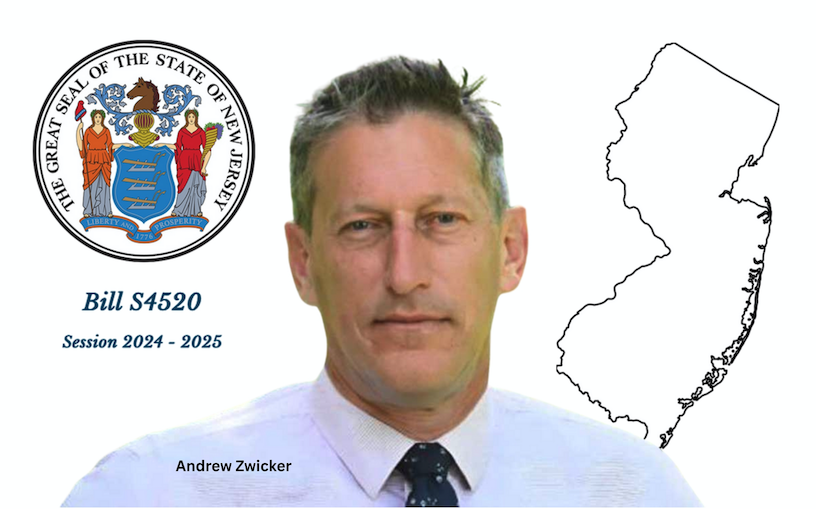
The advancement of New Jersey's library ebook bill represents a new shot of momentum for library ebook legislation after a summer break, and after the passage earlier this year of bills in Washington D.C., Rhode Island, and after the Illinois Assembly unanimously passed its ebook bill in April.
In May 2025, Connecticut passed the nation's first library ebook bill since 2022. New Jersey's library ebook bill (Bill S4520), first introduced by Democrat State Senator Andrew Zwicker on May 29, 2025, followed shortly after Connecticut's bill was passed.
Meanwhile, while much attention has been paid to Illinois's library ebook bill, (which Illinois advocates say is now likely on hold until early 2027 pending a legal review in the state senate) the New Jersey bill now looms as potentially the next big win for library advocates.
If passed, New Jersey's bill would satisfy the so-called “trigger clause” Connecticut's library ebook bill, which requires that another state or state with a population over seven million pass a similar digital library bill before Connecticut’s bill can take effect. With a population of roughly 10 million, New Jersey would fit the bill.
Next up, the New Jersey bill must pass the general assembly before it moves to the Senate.