The Queue: Library News for the Week Ending September 25, 2026
Among the week's headlines: the Tennessee Librarian fired for refusing to censor library books files a federal lawsuit; Missouri's Supreme Court hears a key book banning case; a book ban backlash in North Carolina; and how public libraries are emerging critical partners in AI literacy.

Fired for Refusing to Censor Books, Tennessee Librarian Luanne James Sues
Luanne James, the library director fired for refusing to censor allegedly inappropriate books from the Rutherford County Public Library (Tennessee) as ordered by her board, is now suing her former employer.
 Camellia Burris
"Luanne James filed a federal civil rights lawsuit on Wednesday in the U.S. District Court in Nashville. She’s claiming that Rutherford County’s library board wrongfully terminated her in March–violating discrimination laws and her First Amendment right to freedom of speech," reports local affiliate WPLN. "James is seeking economic damages, including back pay, front pay, and lost benefits, along with compensation for emotional pain, suffering, inconvenience and mental anguish."
As Words & Money reported in April, James's firing comes after Secretary of State Tre Hargett last fall ordered all of the state's libraries to review their collections' “age-appropriateness” and for compliance with a controversial Trump executive order on gender identity.
But in a defiant stance that garnered national headlines, James told the RCPL board that she would not move a selection of LGBTQ+ themed titles. "My duty to protect public access is not merely a personal opinion," she wrote in a March 18 email to the board. "As an arm of the county government, the Board cannot legally limit the public’s access to materials owned by the people based on the content of the ideas expressed within them."
 Andrew Richard Albanese
As we wrote at the time, a lawsuit was a near certainty after James's dramatic firing, with the librarian swiftly issuing a statement through her lawyer calling her dismissal "unlawful," and adding that she hoped her actions would "encourage others to stand against the targeting of our public institutions."
Meanwhile, with Banned Books Week right around the corner, the 72-page complaint offers a detailed, chilling look at what James endured in the months and weeks leading up to her dismissal at the hands of several board members, and what many librarians around the country have also experienced. Particularly alarming are the alleged actions of former board chair, Cody York, who denied any wrongdoing to reporters.
"According to the complaint, once he joined the board in January 2023, York began flagging books that he determined promoted gender confusion," WPLN reports, with the complaint also alleging that York even directed James to "compile a list of people who checked out books with LGBTQ+ themes, including their names, addresses and household information," an order she refused.
One of the lawyers representing James, meanwhile, is Iris Halpern, who has already won several settlements on behalf of wrongfully fired librarians around the country, including Brooky Parks in Colorado, Suzette Baker in Texas, and Terry Lesley in Wyoming.
Missouri Supreme Court Hears Appeal in Closely Watched Book Banning Case
 Annelise Hanshaw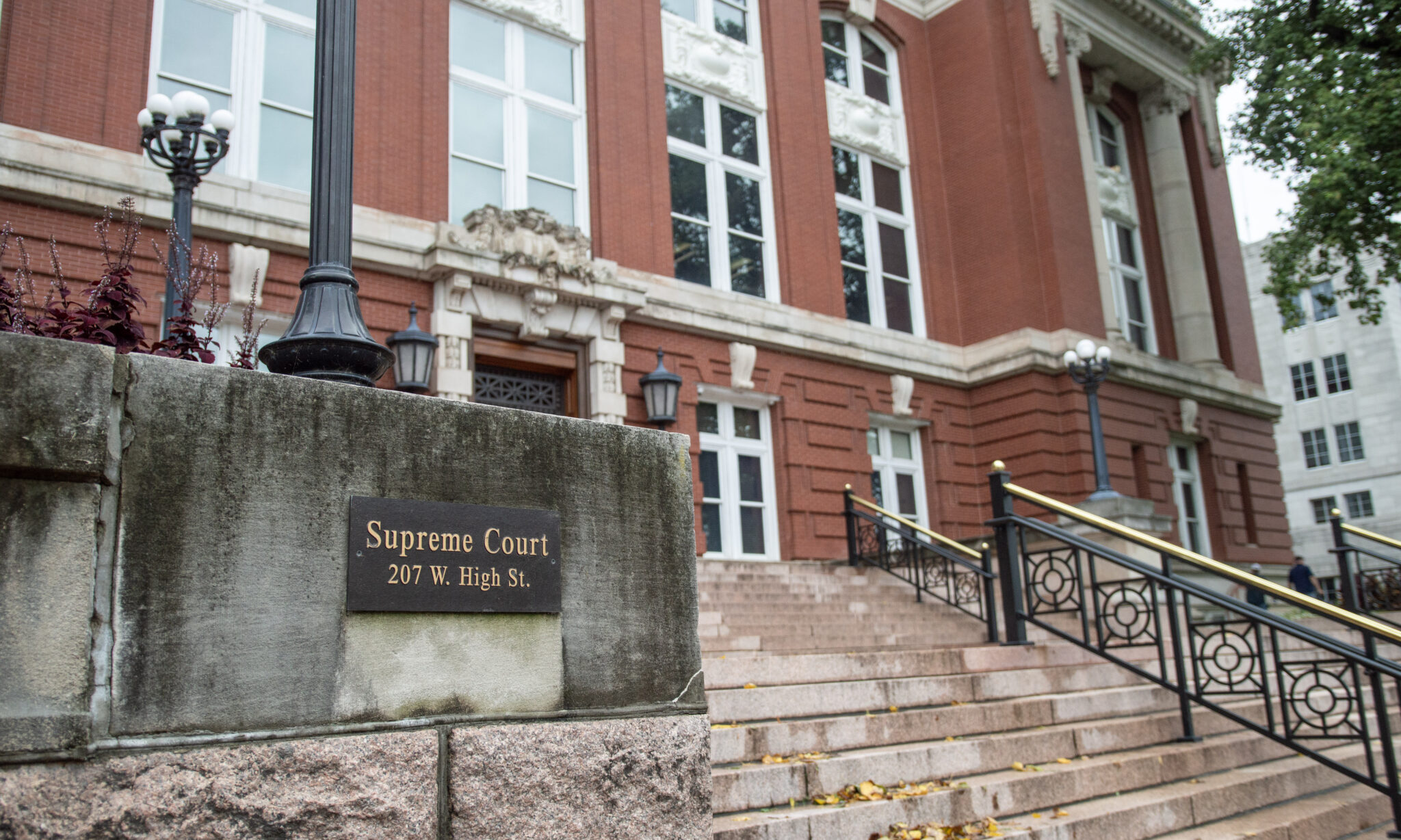
The Missouri Independent has an excellent, in-depth report on a hearing before the Missouri Supreme Court this week over a 2022 law that would make it a crime for educators and librarians to offer students access to books with allegedly “explicit sexual" content.
"The law, which a Jackson County Circuit Court judge struck down last November, 'sowed great confusion across Missouri school districts' and spurred school librarians to remove books from shelves when it was passed, attorneys representing the Missouri Association of School Librarians and Missouri Library Association wrote in their brief," the report notes, adding that much of the oral argument focused on the judicial standard for obscenity known as the Miller Test.
However, the report also notes that the state also argued that library book choices are "school sponsored" speech, and thus not subject to strict First Amendment scrutiny, citing a recent decision from the Eighth Circuit U.S. Court of Appeals that, after being twice blocked, allowed Iowa's controversial book banning law S.F. 496 takes effect.
As Words & Money reported in April, the Eighth Circuit, in a stunningly weak six-page decision delivered by a conservative three-judge panel (made up of two Trump appointees and a George W. Bush appointee), held that "actions 'reasonably related to legitimate pedagogical concerns' do not run afoul of the First Amendment," and that "schools have a legitimate pedagogical interest in prohibiting speech involving sexual content." Stay tuned, this is an important case.
After Appeals Court Greenlights Iowa Law S.F. 496, ACLU Shares Guidance for Librarians, Educators
Speaking of Iowa law S.F. 496, the ACLU of Iowa (one of the plaintiffs challenging the Iowa law in court) this week issued guidance urging librarians and educators not to widely ban books with LGBTQ+ content from schools, citing the appeals court's read on the law's applications.
"The courts have made it clear that this law should be applied only to books with detailed, explicitly written descriptions or visual depictions of one of six types of sexual contact, defined in another part of Iowa law (not SF 496), Iowa Code § 702.17(1)–(6)," the ACLU writes, adding that "books with LGBTQ content, generally," can remain. "As long as a book a) doesn't contain depictions or descriptions of the six types of sexual contact and b) is available for voluntary review rather than required reading, a book with LGBTQ characters or a book dealing with gender identity or sexual orientation as topics is not prohibited," the guidance adds. "These include All Are Welcome, which features an image of two male parents of a student, and Melissa, which tells the story of a child understanding their transgender identity."
This is potentially helpful, but will likely be of little comfort to librarians and educators who face consequences for making the wrong call.
In 2024, after passage of the law, Iowa school districts were said to have pulled hundreds of titles from their shelves—more than 3,400, according to one study by the Des Moines Register—including a disproportionate number of books that contain LGBTQ characters, historical figures, or themes.
North Carolina Lawmaker Responds to School District's Interpretation of State's New Book Banning Rules
As Words & Money shared last week, several school districts in North Carolina are prepared to follow the Wake County school system's view that the state's recently updated rules on school library books only allow for parents to restrict their own children from borrowing specific school library books, rather than forcing books challenged by community activists to be removed from library shelves.
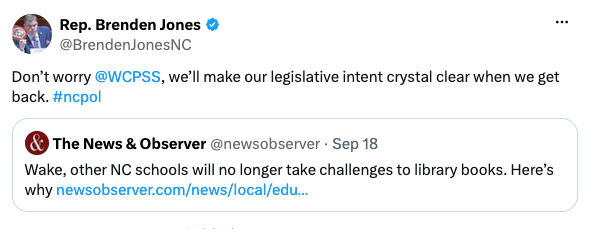
Predictably, Wake County's read on the law has drawn protests from right wing groups. And this week, conservative GOP state lawmaker Brenden Jones, a leading proponent of school library restrictions, posted on X that lawmakers would "make our legislative intent crystal clear" when the legislature returns in November. Just to be clear, their intent is not to empower parents, as right wing activists often claim, but to ban books they don't like.
Jones's response comes after the Raleigh News & Observer reported last week that Wake County attorneys told the school board’s policy committee that its read on the recently adopted library rules (which were slipped into a budget bill passed in July) was that "no parent has a right or community member has a right to challenge books just sitting on the shelf in a library.”
 Billy Ball
In response, Durham Public Schools quickly voiced their agreement with Wake, and this week, a newspaper editorial in Cardinal & Pine, urged Cumberland County to follow Wake's lead as well.
A Defense of the Freedom to Read in New Jersey Draws a Veteran Librarian's Gratitude
New Jersey has a "freedom to read" law on the books, but that has apparently not stopped book banners across the state from pushing to remove books from school libraries. This week, the editorial board at My Central Jersey penned an op-ed urging New Jersey school districts to resist censorship efforts, and drew a heartfelt letter in response from librarian Martha Hickson, one of the library community's staunchest defenders of the freedom to read.
"From the bottom of my scarred and wounded heart, thank you for penning the most full-throated condemnation of censorship that I have read in my five years on the front lines of fighting for intellectual freedom in New Jersey and nationwide," Hickson wrote, adding that for the last 18 months, she has been "touring the world" in support of Kim Snyder's Emmy Award-winning documentary The Librarians, which features Hickson's experiences. "At every screening, audiences have been stunned to see what I view as the poisonous ignorance of book banners wielded in a blue state like New Jersey. Perhaps the most memorable response came after a screening in Berlin, Germany, where viewers—haunted by the aftermath of Nazi-era book burning—were terrified to see similar scenes in modern day America."
Why Sharing Book Banning News Can Be Tricky
 Kelly Jensen
Over at Book Riot, Kelly Jensen leads off her weekly censorship news column with a warning for those sharing book banning news: check your sources. "Good outlets can still make mistakes when it comes to sourcing information because we’re swimming in a mis-and dis- information ecosystem," she writes. As one who does this work, this is sound advice.
New Jersey Librarian Defends Library Ahead of November Ballot Measure that Could Kill It
 AC Joseph Media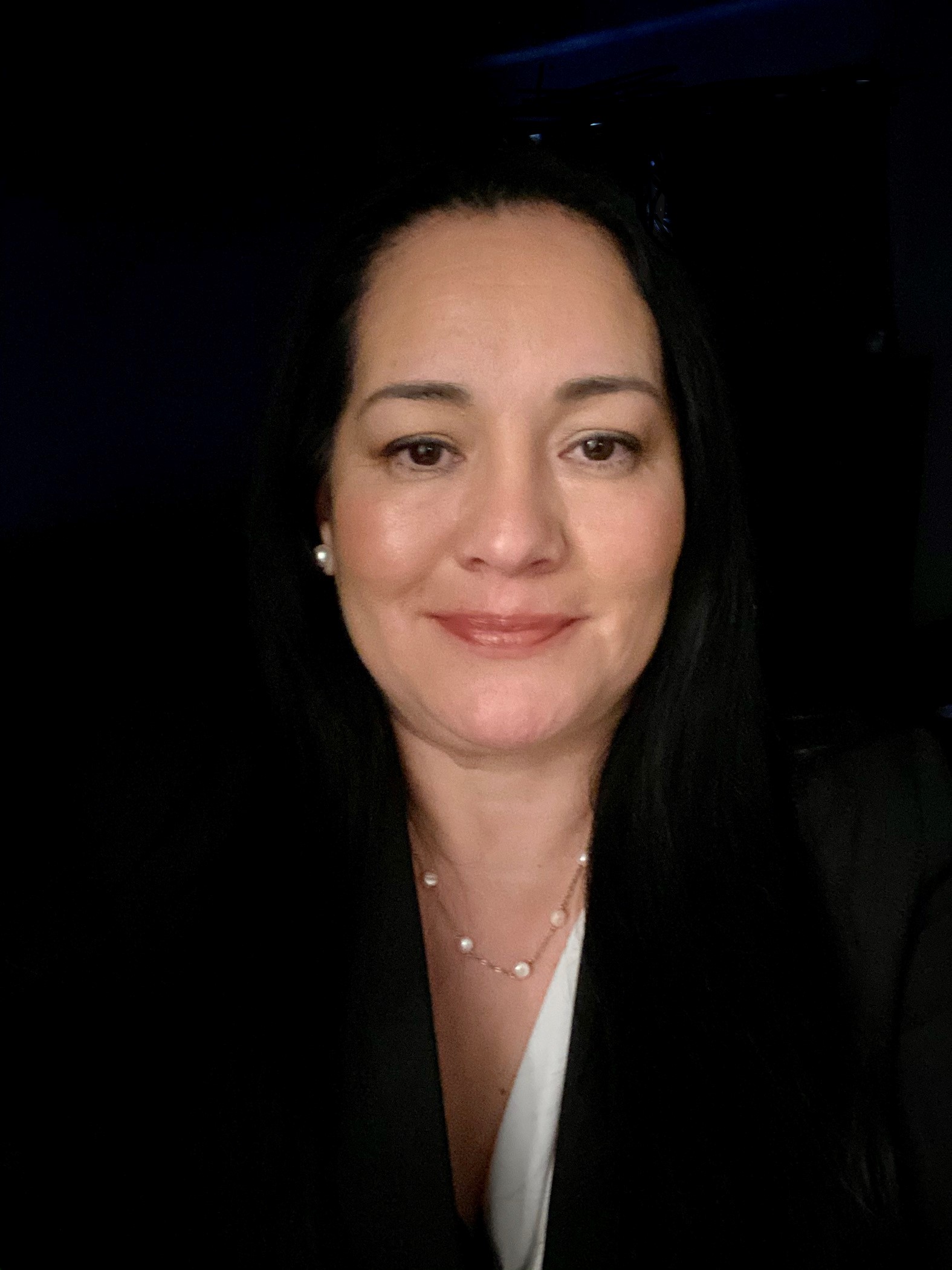
Front Runner New Jersey has a good Q&A with Michelle Azpiri, director of the Bridgeton Public Library, which, as Words & Money has previously shared, will have its future decided by voters on the upcoming November ballot. "The council has said on more than one occasion that it’s purely financial. That’s why they put the referendum on the ballot for residents to decide the library’s fate," Azpiri told the outlet, while adding that the community is "upset" about the possibility of closing. "They’re fine with the small contribution they make. It’s less than one percent of their taxes, actually only .53%. I’m a resident myself; I pay $79 a year toward the library. Some people pay $35, the most I’ve seen is about $103 a year. Everyone who’s reached out to me has said they’re more than happy to keep paying that."
Frustration Grows as Florida Library Board Remains Mothballed by County Officials
 Mollye Barrows, Pensacola News Journal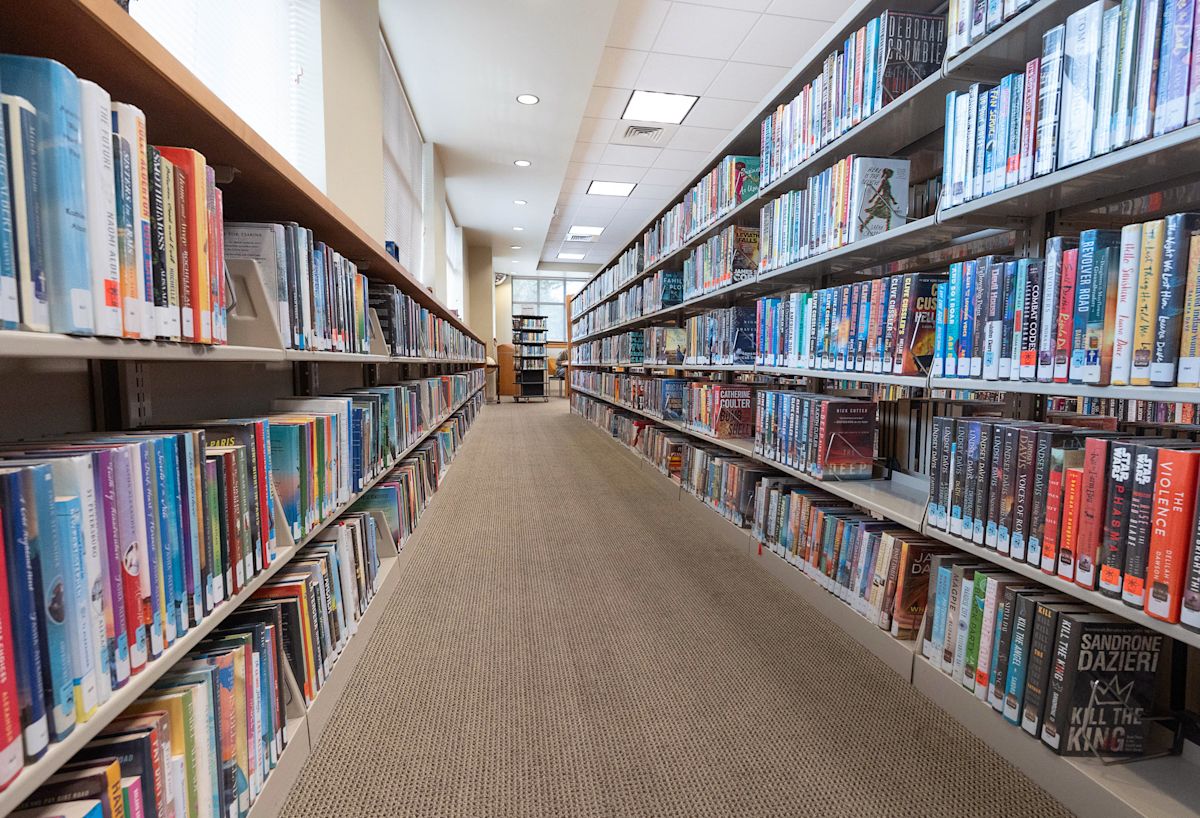
We've been watching this story for months, and it remains at once puzzling and frightening. According to the Pensacola News Journal, "the board created to help oversee Escambia County's public library system hasn't met in five months, prompting calls from residents and county commissioners Thursday to get the West Florida Public Libraries Board of Governance back to work."
It remains unclear why County Administrator Wes Moreno is keeping the board from meeting, but it is almost certainly political, the report suggests. "Supporters [of the board] say Moreno canceled the meetings as part of the political fallout over hiring Cristal Bell-Rivera, whose tenure was controversial from the start," the report notes. Bell-Rivera resigned from the job in August, after just five months into the job. "The board was firm in its position that Bell-Rivera, who had never been a librarian, was not qualified for the $113,547-a-year job and should not have been considered much less selected," the report states.
More on the Harm Facing Florida Libraries as Controversial Property Tax Vote Looms in November
 Zoey Thomas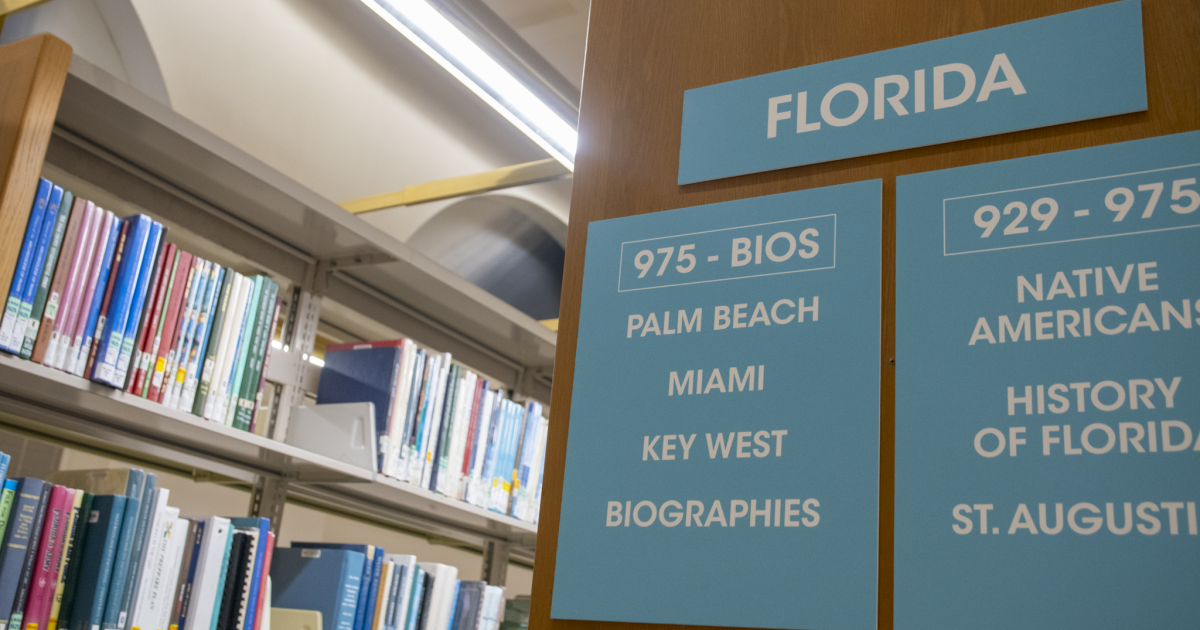
According to WLRN, a new coalition called Keep Libraries Funded, supported by the excellent work of EveryLibrary, reports that Miami-Dade County libraries could face a $20 million hit under the property tax referendum facing Florida voters this November, about 16% of its annual budget.
"The new coalition launched a website last week, which it’s using to highlight county-by-county impacts. It was spearheaded by Friends of the Miami-Dade Public Library members who then reached out to other systems across the state," the report notes. "Florida sheriffs and firefighters have made headlines for criticizing the proposal. But public libraries will also see effects. About 91% of the Miami-Dade system’s 2025-26 operating budget came from assessed-value taxes, the most common of which are property taxes."
Research Paper: Public Libraries Emerging as Critical Partners in AI Literacy
 Michael Parker
Phys.org reports on a new research paper from UAlbany's Center for Technology in Government, which suggests that "public libraries can play an important role in helping communities develop the skills to critically evaluate" AI technology, as well as to "understand its risks and participate in decisions about how it is used."
The study, Who Participates in AI Programs at Public Libraries? Exploring Demographic and Attitudinal Factors," draws on a January survey of 2,010 U.S. adults.
"AI literacy is about more than knowing how to use these tools," said researcher Mila Gascó-Hernandez. "People also need to understand their limitations, think critically about the information they produce and recognize issues involving accuracy, privacy, and bias. Libraries can help people build those skills so they can make informed choices about when and how to use AI."
And Finally This Week...
 Tim Zaun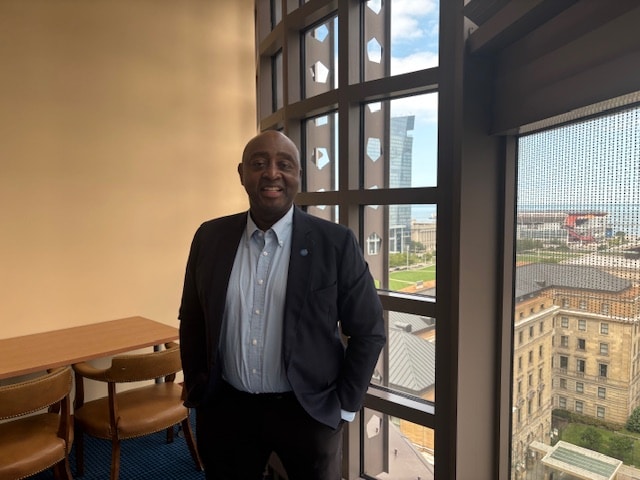
As we wind down September (aka National Library Card Signup Month) The Land has a nice Q&A with Cleveland Public Library Executive Felton Thomas Jr. It's typically thoughtful stuff, and a reminder of just how much good work Thomas has done for the city of Cleveland.
"I once walked into one of our branches and a man stopped me, knowing I was the director. He proceeded to tell me his story about how the year before, he lost his job and within a week, his wife left him to raise three kids on his own. He had to figure out his next steps and the only place he knew to start was the library," Thomas recalls. "He told his story to the librarians and they showed him how to use the computer to do his resume. While there, staff engaged his children in activities. Online applications led to interviews. He enrolled his children in library programming while he went on the interviews, knowing they were safe there. Three months later he found a job and his footing. Today, his kids still use that library regularly. The man was so grateful, he started to cry. He told me the people we have working at the library changed his life. That’s a story you won’t find by analyzing data."